Every successful exhibition eventually faces the same million- dollar question: after becoming bigger each year, what comes next?
For Bharat Tex, the answer in 2026 is not more exhibitors, more buyers or more exhibition space. Those are natural markers of growth. The real story is that Bharat Tex has grown and evolved exponentially in just first two editions. It is, in fact, is evolving at much faster pace than the growth of the global textile industry. That evolution is worth paying attention to and it is already catching eyeballs of industry leaders, sourcing heads, top CEOs and though-leaders of the textile industry world over.
When Bharat Tex was conceived, its primary objective was ambitious yet straightforward-to bring India’s fragmented textile ecosystem onto one integrated platform. For decades, different segments of the textile eco-system: fibre, yarn, fabrics, apparel, home textiles, handicrafts, handloom, machinery, and technical textiles largely travelled on parallel tracks with no point of convergence, often meeting global buyers through different exhibitions, different institutions and different business networks. Bharat Tex changed that narrative by presenting India as one textile ecosystem rather than multiple disconnected industries.
Two editions later, that objective has largely been achieved. The question before Bharat Tex 2026 is therefore no longer “Can India organize the world’s largest integrated textile event?” It is something much more significant. Can Bharat Tex become the place where the future of global textile trade is debated and discussed? And the answer increasingly seems to be a resounding yes.
The timing of Bharat Tex 2026 could not have been more appropriate. The textile business is undergoing one of its biggest strategic realignments. Cost of manufacturing, economy of scale profit margins, worker wages etc. no longer influence sourcing decision across the world as much as other emerging issues like sustainability, application of digital technologies, trade agreements and supply-chain resilience.
Walk through Bharat Tex this year and these shifts will be clearly visible—not because organizers have created dedicated theme pavilions, but because these themes have become integral part of everyday business.
A decade ago, buyers visiting textile exhibitions arrived with seasonal sourcing plans. Today, many arrive with sustainability roadmaps, carbon reduction targets, digital compliance requirements and supplier diversification strategies. Procurement teams now include compliance managers, ESG specialists, product developers and digital transformation experts alongside sourcing professionals. The conversation has moved beyond what can you make to How do you make it. From whether you meet global norms to how do you plan to meet emerging global compliance norms five years from now.
This change has quietly transformed the role of Bharat Tex as well. The exhibition is no longer simply matching buyers with suppliers. It is increasingly matching expectations with capabilities.
Consider the technologies likely to dominate discussions this year. Artificial intelligence is no longer being presented as an experimental concept; manufacturers are deploying it to predict demand, improve quality inspection and optimize production planning. Digital Product Passports, once confined to regulatory discussions in Europe, are now influencing sourcing strategies across export markets. Blockchain-enabled traceability, smart manufacturing systems and data-driven compliance are steadily moving from innovation showcases to commercial necessities. In earlier editions of Bharat Tex too, such technologies generated curiosity. But in 2026, they are expected to generate business.
The same transformation is visible in sustainability. There was a time when sustainability occupied a separate corner of industry exhibitions, often represented by a handful of eco-friendly products or niche brands. Bharat Tex 2026 tells a different story. Sustainability has become part of mainstream manufacturing itself. Visitors are likely to encounter recycled fibres alongside conventional materials, water-efficient processing integrated into production systems, renewable energy powering factories, chemical management solutions embedded within manufacturing practices and circular business models discussed as commercial strategies rather than environmental aspirations.
The exhibition therefore mirrors an important shift within the textile industry itself. Sustainability, a competitive advantage currently, may no longer hold the edge in future as it is increasingly becoming the bare minimum denominator to stay competitive.
Trade policy is also reshaping the conversations at Bharat Tex. India’s expanding network of free trade agreements-including those with the United Kingdom, EU, Australia, the United Arab Emirates and the EFTA countries-is creating fresh commercial opportunities for the Indian textile and apparel export sector. Yet preferential tariffs alone do not guarantee export success. Businesses must simultaneously understand rules of origin, product standards, sustainability obligations and increasingly sophisticated compliance frameworks.
This is where Bharat Tex performs an important role that often receives less attention than its exhibition halls. It serves as a bridge between policy announcements and business implementation. Buyers, exporters, policymakers, certification agencies and technology providers find themselves discussing not simply what trade agreements promise, but how those opportunities can actually be converted into tangible export gains.
A plethora of knowledge sessions initiates this dialogue on all possible contemporary themes searching for optimal solutions. This element of extensive brain-storming distinguishes Bharat Tex from many other international trade fairs.
For decades, India’s global identity rested on its manufacturing strength, rich craftsmanship and abundant raw material base. Those remain formidable advantages. But Bharat Tex increasingly reveals and showcases another India-one investing in automation, advanced materials, smart and sustainable manufacturing, digital technologies and research-driven product development.
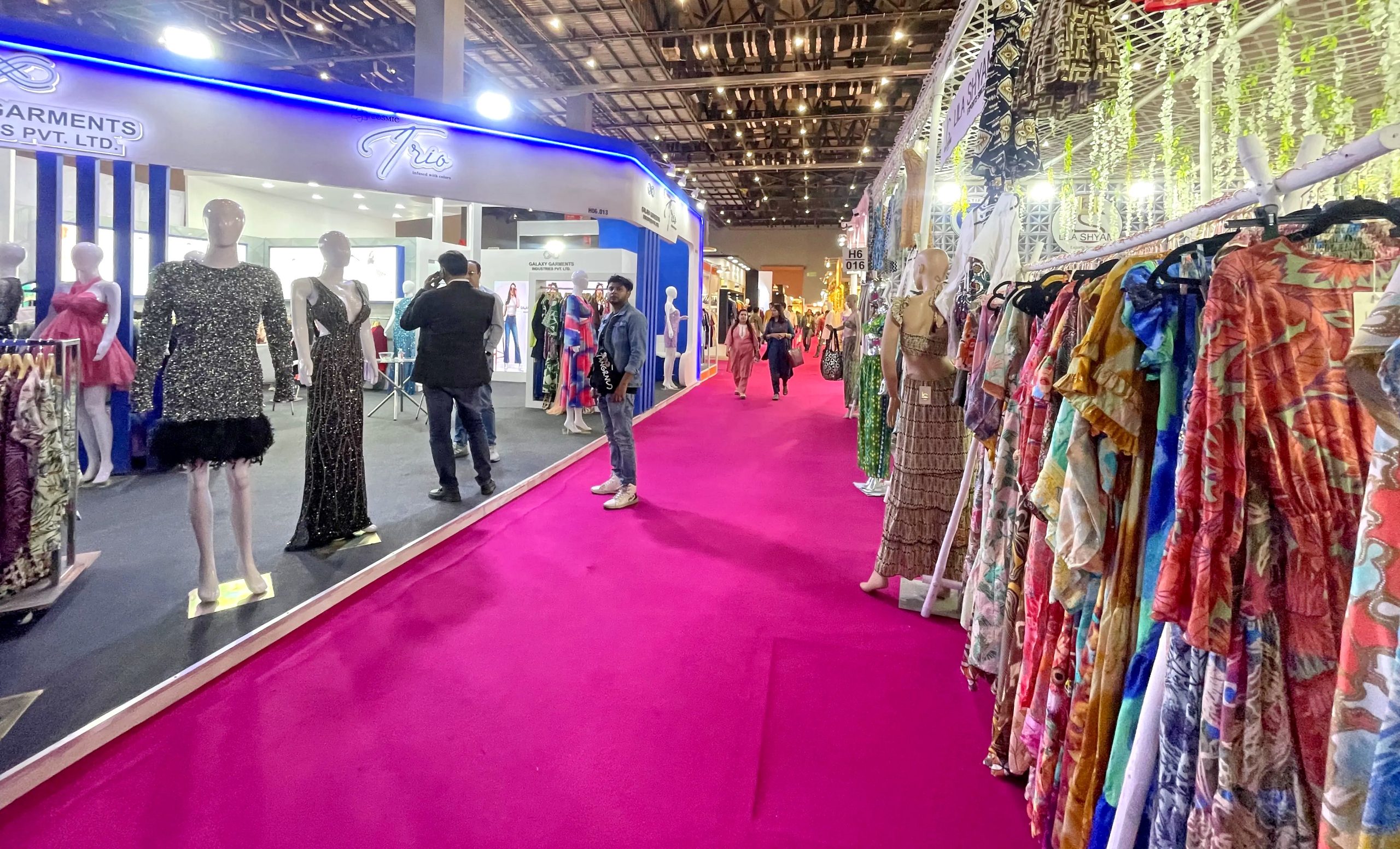
Walk through the exhibition and heritage handlooms may stand a few metres away from AI-powered quality inspection systems. Traditional artisans may exhibit alongside companies manufacturing high-performance industrial textiles. Machinery suppliers, fashion designers, start-ups, exporters and research institutions increasingly occupy the same business ecosystem. This co-existence of tradition with modernity marks the silent yet remarkable evolution taking place within India’s textile industry. That juxtaposition is not accidental. It reflects India’s attempt to compete simultaneously in both tradition and technology-a balance that very few textile-producing nations can claim with equal confidence.
This is also the reason why Bharat Tex has begun attracting attention beyond the textile sector itself. Investors see manufacturing opportunities. Technology companies see industrial applications. Global brands see supply-chain diversification.
Policymakers see an opportunity to translate trade agreements into commercial partnerships. Young entrepreneurs see an industry undergoing technological reinvention rather than one associated only with conventional manufacturing.
In many ways, Bharat Tex has become a barometer of how Indian manufacturing landscape itself is undergoing transformation.
This mega exhibition is no longer measured solely by the number of business meetings conducted or export enquiries generated. Its larger value lies in identifying the direction in which global textiles are moving and demonstrating how India intends to participate in that journey.
Every major industry eventually develops institutions that shape its future rather than merely showcase its present. International automobile shows have historically influenced automotive innovation. Technology exhibitions often signal where digital industries are heading. Bharat Tex is steadily acquiring a similar role for textiles.
That is why the 2026 edition deserves attention. Not because it will be the biggest.
Not because it will host thousands of exhibitors. Not because it will attract overseas buyers from over 140 countries. Those achievements do matter, but do not grab the headline.
The real headline is that Bharat Tex has matured alongside the industry it represents. It has evolved from a showcase of India’s textile capabilities into a platform where global sourcing strategies, sustainability transitions, technological innovation and trade policy increasingly converge.
In an industry being reshaped by profound structural change, that evolution may prove to be Bharat Tex’s greatest success. The exhibition is no longer simply reflecting the textile business. It is beginning to influence where that business goes next.
By Mithileshwar Thakur, Secretary General, AEPC