
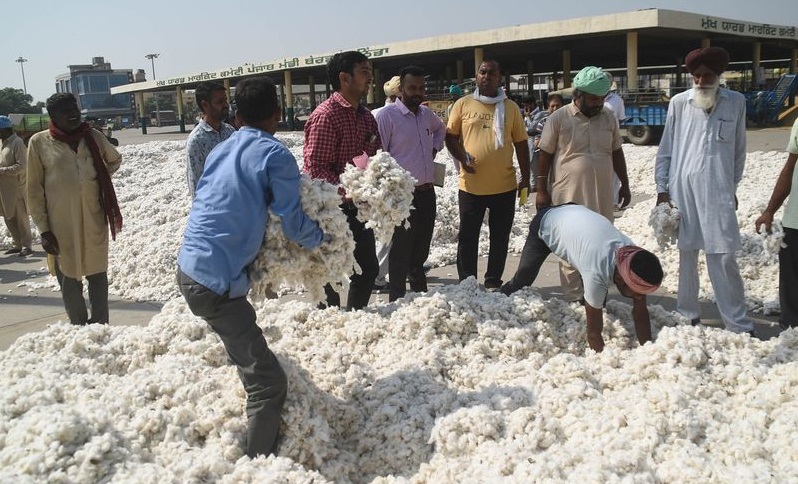
The Centre may extend the exemption from customs duty on raw cotton imports beyond its October 31 expiry, potentially at least until December, as it weighs continued relief for the textile industry, a government source said.
“An extension is likely, although no decision has been taken as of now. The exemption on import duty on cotton may be extended until December,” the source said. The indication from the Central government is that it may extend the waiver at least until December, an industry source said.
The government had temporarily exempted customs duty on raw cotton imports from June 1 to October 31, 2026, to augment cotton availability for the domestic textile industry, reduce input costs and improve the competitiveness of the textile and apparel sector.
The possible extension comes amid longstanding demands from the textile industry for a more predictable regime for cotton imports.
CITI Chairman Ashwin Chandran said the issue had been on the industry’s agenda for several years, arguing that the import duty was a hindrance to the sector and that Indian manufacturers needed a level playing field on raw materials to compete with textile-exporting countries such as Bangladesh and Vietnam. “Give us policy continuity on cotton import duty. These six-month windows are difficult to plan business on,” Chandran said.
Chandran said India had not imposed a cotton import duty prior to 2021, but the country’s supply position had since changed and India was expected to remain cotton-deficit. “Prior to 2021 we didn’t have a duty, but now the state is such that we will be a cotton-deficit country. Even in FY26 we have produced less than what we require,” he said.
In a recent report, NITI Aayog recommended removing the import duty on cotton as part of measures to strengthen India’s textile sector. The policy think tank noted that the government had imposed an 11 percent duty on imported cotton in February 2021 and argued that the levy can hurt the domestic textile value chain when Indian cotton prices are higher than international prices.
NITI Aayog said that when domestic cotton prices exceed international prices, the domestic value chain, including spinners, is affected and the competitiveness of the textile sector suffers. It also noted that countries such as Bangladesh and Vietnam, which rely on imported cotton, do not impose equivalent import duties, giving their textile industries a competitive advantage.
“Today, exporting to Europe and the UK, our disadvantage is 9-10 percent versus Bangladesh and Pakistan. With the FTAs, that disadvantage should go, and we will be able to significantly grow our textile exports, especially if we get raw materials at world prices,” he said.
The UK and EU markets offer significant potential for Indian textile exporters, Chandran said, adding that improved market access through FTAs would need to be complemented by competitive raw-material costs if India is to capture a larger share of global textile trade.
The debate comes as India seeks to expand its textile and apparel exports, with the industry arguing that lower and more predictable raw-material costs will be crucial to converting improved market access into higher shipments.
Chandran said imports were necessary not only to bridge the gap between domestic cotton production and industry demand, but also because certain specialised varieties were not readily available in India.
Contamination-free cotton, for instance, is sourced from countries including the US, Brazil and Australia, he said, adding that the industry should retain the ability to import cotton based on its quality and specification requirements. Chandran added that the industry supports cotton farmers but cannot afford to lose access to imported cotton when domestic supplies are insufficient or when specific varieties are unavailable.
The latest export data underlines the mixed performance of the textile sector. Exports of cotton yarn, fabrics, made-ups and handloom products rose 8.4 percent year-on-year to $1.11 billion in July, while in April-July it increased 4.9 percent to $4.07 billion. In contrast, shipments of ready-made garments fell 4.5 percent to $1.28 billion in July, while in April-July it declined 10.5 percent to $4.95 billion. Outbound shipments of man-made yarn, fabrics and made-ups were largely flat, rising 0.5 percent in July and 0.9 percent during April-July.