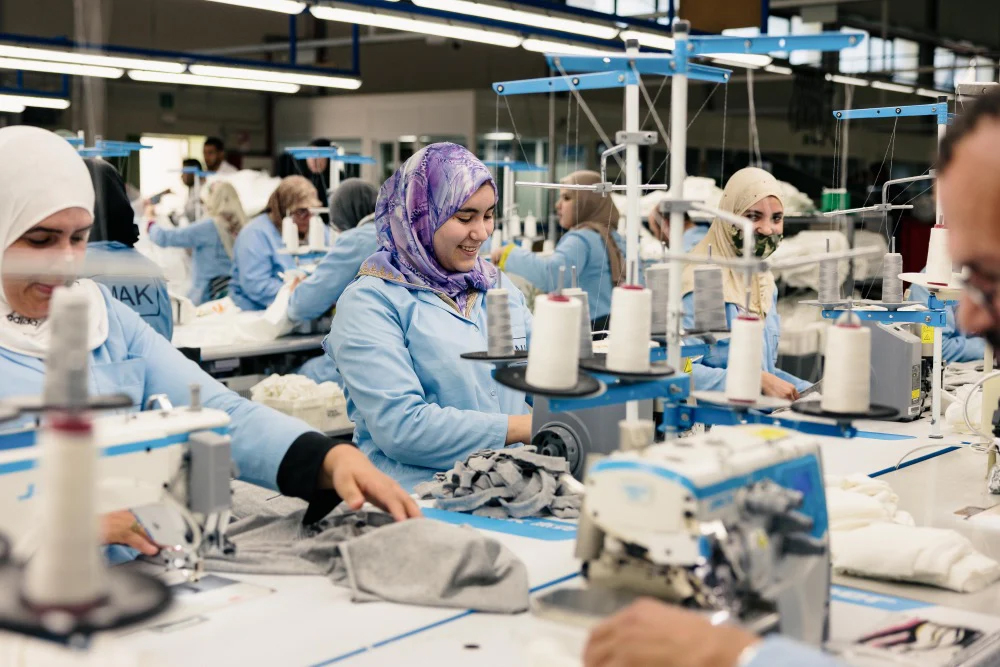
 To strengthen its position in the U.S. and Canadian markets, business development agency Tactical Tactics and the Textile and Apparel Technical Center (CTTH) signed a strategic partnership agreement on May 5 in Casablanca. According to local media reports, the partnership aims to help Moroccan manufacturers move beyond the traditional Cut, Make, Trim (CMT) subcontracting model and develop a stronger finished-products business for North American buyers.
The agreement combines the technical expertise of CTTH with Tactical Tactics’ commercial network in North America. CTTH, Morocco’s main technical center for the textile and apparel industry, will support companies in research and development, quality control, certification and training. The goal is to help exporters meet international standards and improve competitiveness.
Tactical Tactics will focus on connecting Moroccan manufacturers with buyers and distributors in the U.S. and Canada. Founded in 2023, the agency operates under a Delivered Duty Paid (DDP) model and works with a network of Moroccan industrial suppliers and North American brokers.
The partnership reflects Morocco’s broader effort to capture more value from textile exports instead of remaining mainly a subcontracting platform. “Morocco is no longer just a fabric country. Morocco is a finished-product country – designed, sourced, made, certified, ready to ship,” said Tactical Tactics Chief Executive Dikra Aït Nacere.
The United States remains the world’s largest importer of clothing and apparel products. Trade Map data shows the U.S. imported about $83.7 billion worth of clothing and apparel in 2024. Canada imported nearly $11 billion worth during the same year and ranked among the world’s top 15 buyers.
Morocco, however, faces strong competition from established textile exporters such as China, Vietnam, Bangladesh, India and Indonesia. The industry must also adapt to stricter Western requirements on product quality, traceability and environmental compliance. Trade Map data shows Morocco generated about $3.9 billion in export revenue from clothing and apparel products in 2024.
The textile and leather industry remains one of Morocco’s largest employers. In 2024, the sector ranked second behind the automotive industry and accounted for 23.7% of industrial employment in the country. In its latest industrial performance report, Morocco’s Ministry of Industry and Trade said textiles and leather was the only industrial sector to record a decline in added value in 2024. Industrial added value fell 2.4% to 19.3 billion dirhams ($2.1 billion). Against that backdrop, Moroccan manufacturers see higher-value production as a key path to restoring growth and improving export competitiveness.