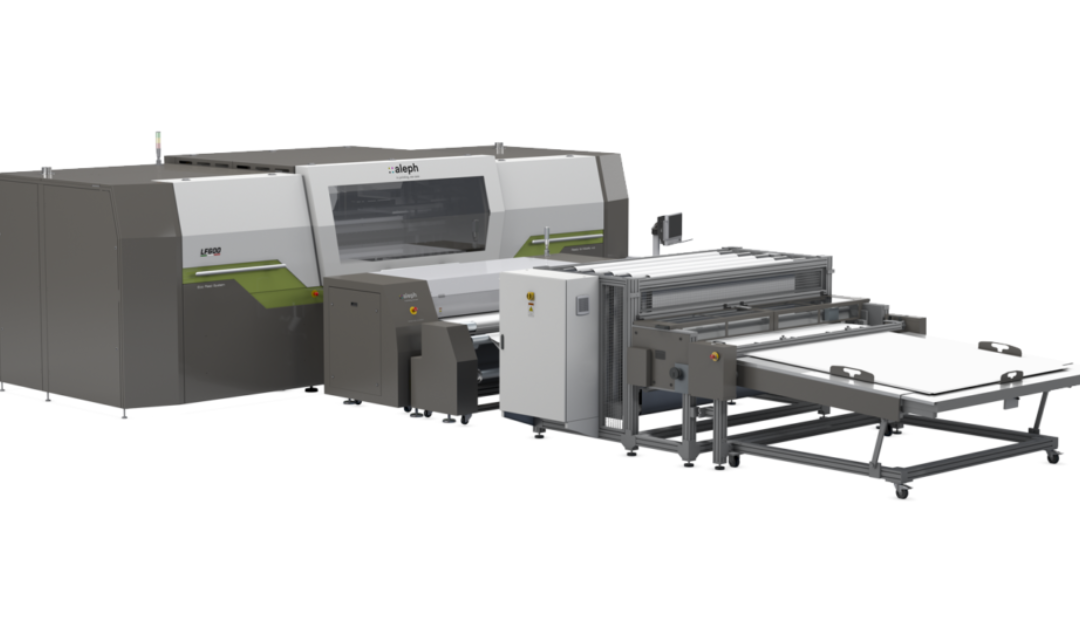
High-speed & High-quality Industrial Textile Printers by Aleph
 Aleph, a leading Italian manufacturer of sublimation and direct-to-fabric inkjet printers, launched its new printers at ITMA Milan 2023 along with new feature-rich products engineered to enhance customer differentiation and profitability. In line with ITMA 2023’s tagline, ‘Transforming the World of Textiles’, Aleph showcased how the company’s advanced technologies enable users to enhance their product portfolio and address new and promising market segments, as well as their They also contribute to improving the ecological footprint and make a positive difference.
Through continuous R&D investments and efforts, Aleph has established a comprehensive portfolio offering that addresses the ever-changing market demands and actual needs of print service providers. Making its worldwide debut at ITMA was the brand-new LAFORTE 400 Fabric H, a hybrid model that enables fabric pre-treatment in line. The printer is equipped with additional specialized printheads engineered to carry out pre-treatment of fabric just prior to actual printing. This enables the highest speed of 480 sqm/h to be achieved and easy to handle three-stage processing. The printer uses aleph’ GOTS certified pigment inks for better stability.
 Aleph also highlighted the company’s top-of-the-range solution, the LAFORTE 600 Paper, which is the fastest industrial printer on the sublimation fashion market, achieving industrial speeds of up to 1,000 sqm/h. The printer is equipped with the company’s ECO Passport by OEKO-TEX® certified sublimation inks and powerful proprietary vacuum transport system that eliminates the use of glue, while also enabling it to print on sublimation paper from 25 gsm. In addition, the latest model showcased at ITMA was feature 4 reflective colors + 2 reflective light colors, resulting in a superior quality, increased efficiency and cost-effective printing process on polyester fabrics for sustainable fashion and home textile applications.
Standout technology on show also included the LAFORTE 100 paper, a roll-to-roll water-based dye-sublimation printer with fluorescent inks. The printer had a maximum speed of 160 sqm/h in high-quality mode and dual channel printhead for each color, allowing for even better performance. The latest version features ECO Passport by OEKO-TEX® Level 3 certified water-based sublimation inks, CMYK + spot colors and fluorescent dye-sublimation inks. The LAFORTE 100 paper can handle paper weighing less than 18gsm coated paper and is designed to enable high quality, efficient, cost effective and green production in the sportswear and apparel markets.
“We exhibit at ITMA with a comprehensive, smart portfolio of cutting edge technologies, enabled by some of Aleph’s core business strengths – our R&D expertise, our closeness to customers and our commitment to the environment. We have a strong focus on the market and this allows us to adapt quickly to market changes and customer opportunities to deliver continuous system improvements or brand-new innovations,” says Alessandro Manes, CEO of Aleph.
“Visitors to our booth in Milan got to experience firsthand the superior performance of our LAFORTE printing platform, which can deliver top print quality in a cost-effective manner while at the same time offering superior application flexibility.”

Sun Chemical showcased complete range of digital textile inks at ITMA Milan
 Sun Chemical demonstrated its complete range of digital textile inks, suitable for printing any textile material, at ITMA. In line with ITMA’s theme this year of ‘Transforming the World of Textiles’, Sun Chemical’s campaign for the show focused on company’s commitment to digital textiles, sustainability, and evolution.
Following the acquisition of leading digital inks supplier Sensient Imaging Technologies in 2020, Sun Chemical has developed and launched new inks in the major technologies of reactive, sublimation, and pigment printing, with the objective of enhancing performance and improving sustainability credentials, while also improving productivity. Additionally, Sun Chemical will also showcase its range of acid dye inks.
Sun Chemical also announced the launch of Xennia Amethyst Evo RC, which was highlighted on the stand. This high-quality ink, an evolution of the successful Xennia Amethyst series, has been specially formulated to enhance production and enable customers to achieve their high-volume targets in the fashion and home textile industry, without compromising quality. The innovative formula is designed to improve colour efficiency and strength while optimising properties to enhance colour balance for advanced colour management and sample matching. The ink has received Eco-Passport (from Oeko Tex) and Global Organic Textile Standard (GOTS) certification and is listed as ZDHC Level 3.
The company also launched a new series of digital pigment inks for textile, Xennia Sapphire. Initially available for higher viscosity printheads such as Ricoh Gen 5 and Fujifilm Dimatix Starfire, Xennia Sapphire inks provide a step-change in pigment printing with enhanced colour and fastness performance, unrivalled print stability and ease of use. Xennia Sapphire aligns with Sun Chemical’s sustainability goals.
and has been developed to have a low impact with a no water process, efficient curing and soft hand fell to reduce the need for finishing chemicals. Xennia Sapphire inks will also be available for Kyocera printhead technology to have a set compatible with the majority of digital textile printers on the market.
Sun Chemical launched its latest sublimation ink to address higher viscosity printheads such as technology from Ricoh and Dimatix. Based on in house disperse dye dispersions, ElvaJet SR342 delivers the purest color shades allowing an extended color gamut combined with the best on printer performance with optimized drying and minimal maintenance requirements.
“Sun Chemical’s latest textile innovations have been formed with both a deep understanding of the textile market and extensive experience in digital printing ink development. Additionally, we are fully committed to delivering innovative solutions that are compliant with the latest textile standards. We work with external testing houses to ensure our inks meet the exacting needs of market and brand standards to ensure our customers can be confident in every aspect of ink performance,” Simon Daplyn, Product Marketing Manager, Sun Chemical, said.
“ITMA is the perfect place to showcase our technology and meet with customers from around the world to demonstrate the value Sun Chemical inks can bring to their business, all while ensuring product compliance and improving their sustainability credentials,” Edri Baggi, Business Manager for Sun Chemical’s Textile Inks Business, said.
Singapore’s DyStar displayed innovative products
 Singapore-based DyStar, a leading specialty chemical company with a heritage of more than a century in product development and innovation, exhibited and presented at ITMA, Milan, Italy.
Eric Hopmann, Chief Commercial Officer of DyStar Group, said: “It is great that members of the global supply chain can finally meet to exchange ideas at ITMA post-pandemic. The energy crisis, inflation, and climate impact have accelerated the pace of the textile supply chain’s transformation. DyStar’s innovations will help global manufacturers, producers, brands, and retailers continue creating value-added confidence and assurance, while keeping up with transformational needs to deliver quality products without compromising sustainability.”
DyStar’s confidence programme created fundamental value for its customers. At ITMA, DyStar featured a suite of product and process innovations which included Cadira, Dianix, Evo, Indigo, Jettex, Levafix, Procion, Remazol, and more.
All customers and stakeholders connected with DyStar’s subject matter experts who were available at the stand, to provide customers with in-depth knowledge of its products and answer any questions during the seven-day event, to make them learn more about DyStar’s latest innovations.
Visitors to DyStar’s stand could also take advantage of getting instantaneous product information digitally in a few clicks. In addition, DyStar delivered an insightful paper at the Innovator Xchange on June 12. Registered visitors could also take the opportunity to establish a fireside chat with the company’s experts on various other topics.
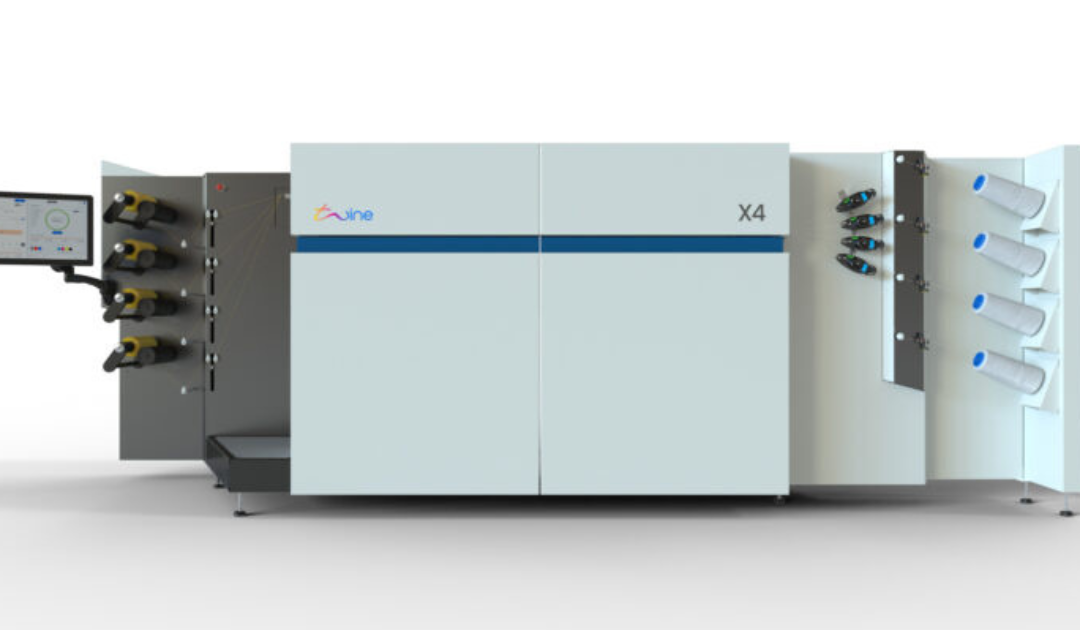
TwineX4 the next-generation of digital dyeing systems by Twine
 Twine displayed groundbreaking waterless dyeing system at ITMA 2023. Their latest innovation, TwineX4, is ideal for small to medium production needs. Say goodbye to water waste and hello to sustainable growth. Twine Solutions launched TwineX4, the next-generation waterless, thread and yarn digital dyeing system for production. With the TwineX4 system, textile manufacturers can optimize their production process, achieving unmatched levels of accuracy, speed, efficiency and sustainability.
TwineX4 offers the convenience of on-demand, in-house thread and yarn digital dyeing for small to medium-sized batches, eliminating supply delays. This enables textile manufacturers to enhance their production flexibility, accelerate order fulfillment, and increase capacity to match the fast pace and demands of the fashion industry.
Engineered for sustainable manufacturing, TwineX4 utilizes a digital dyeing process that does not require any water. This zero-water process makes TwineX4 highly energy efficient, with energy consumption being approximately 2.7 times more efficient per kg compared to the traditional dyeing processes.
By performing in-house dyeing, customers produce exact lengths of thread and yarn, reducing wasted materials by up to eight times the amount resulting from external supplier MOQs. This approach supports the implementation of lower waste-to-landfill policies. Furthermore, producing dyed threads and yarns in-house helps to minimize electricity and carbon emissions by reducing the need for excess inventory storage and streamlining the supply chain.
TwineX4 meets production requirements with its exceptional dyeing speed, averaging 21.6 kilometers per hour, wound on four cones, each capable of accommodating up to 1.5 kilograms in a single run. With its upgraded capacity, TwineX4 can dye up to 2 tons of thread/yarn per year.
“We are excited with the response of TwineX4 from the textile industry,” said Alon Moshe, Twine Solutions CEO, “We believe this system represents the future of textile production and will be a huge change for our customers. We are confident that TwineX4 will help textile manufacturers increase efficiency, reduce costs, and produce more sustainably.”
Twine’s TS-1800 legacy system, designed for product development and sampling, introduced new enhancements to the market, including Coats GCB colors for dyeing sewing threads and an improved color engine with color fine-tuning tools that facilitate unlimited creativity with minimal operational expertise.
The digital capabilities of Twine’s dyeing systems are versatile and ideal for a range of textile applications, including sock, garment, accessory manufacturing, and ribbons. Twine’s systems feature advanced color management tools that enable customers to match and replicate colors and develop new colorways accurately.
Twine Solutions displayed TwineX4 and TS-1800 at ITMA Milan 2023, the world’s biggest textile industry trade show. Industry professionals and textile manufacturers could witness the systems firsthand at the event and explore their capabilities.
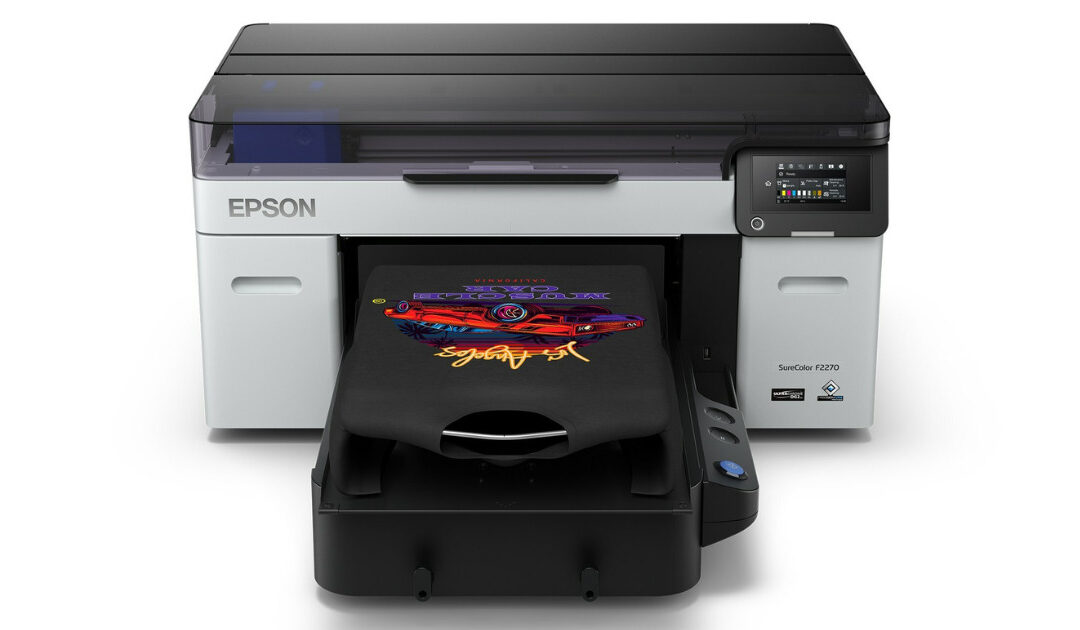
Epson introduces new DTG and DTFilm Hybrid Garment Print Solution
 Underscoring support for the growing textile and personalized products industry, Epson announced the hybrid SureColor F2270 for both direct-to-garment (DTG) and direct-to-film (DTFilm) printing.
Designed to bring customized apparel to the market that holds true to the designer’s vision, with minimal waste and environmental impact, the hybrid SureColor F2270 DTG printer incorporates DTFilm printing capabilities and goes beyond traditional garment printing and transfer to a wider variety of materials, including uniquely shaped items.
“The SureColor F2270 was purpose-built with an eye toward what’s happening in the industry. Specifically, we wanted to address the needs of print shops transitioning from mass production to producing what’s needed,” said Tim Check, senior product manager, Professional Imaging, Epson America, Inc. “With its ability to produce high quality output, with great reliability and consistency, print shops can now create premium quality products, designed to last years. This also results in less waste from the print process to the garment wearability.”
Purpose-built for both DTG and DTFilm printing, the SureColor F2270 hybrid printer features a new PrecisionCore MicroTFP printhead with Nozzle Verification Technology, and next-generation UltraChrome DG2 ink to deliver vibrant colors and incredible detail at impressive speeds – up to 20% faster when printing on dark garments, compared to previous generation model with printing 13.6” x 16.0” dark garments at default print quality.
The printer’s cartridge-free bulk ink pack system helps reduce ink replacement frequency. Featuring automatic garment thickness adjustment, it measures thickness using multiple sensors during the loading process to create a garment height profile and will automatically adjust the printhead and optimize print quality without user intervention to help increase productivity and ensure high-quality output.
Additional features designed to bring a new level of versatility and efficiency to the garment decorator, promotional product and e-commerce fulfillment industries, include:
• Low maintenance – Dedicated cleaning solution channels and fabric head wiper system help reduce downtime
• Intuitive design – Flattop work surface can hold items; large 4.3-inch touchscreen interface with ergonomically placed control buttons
• Easy-to-use, quick-load platen – Assists with garment alignment and helps reduce loading times.
• Intuitive, easy-to-learn workflow – Epson Garment Creator 2 software features improved processing time and high-resolution processing for exceptionally detailed and vibrant prints
• Epson Cloud Solution PORT2 – Provides live production monitoring of your printer fleet status, including production rates and printer utilization
“Ultimately, prints done right the first time saves times, money and physical resources, and that’s the goal with the new SureColor F2270,” said Check.
The SureColor F2270 will be available in August 2023 through Epson Authorized Professional Imaging Resellers with an estimated MSRP of $18,995.
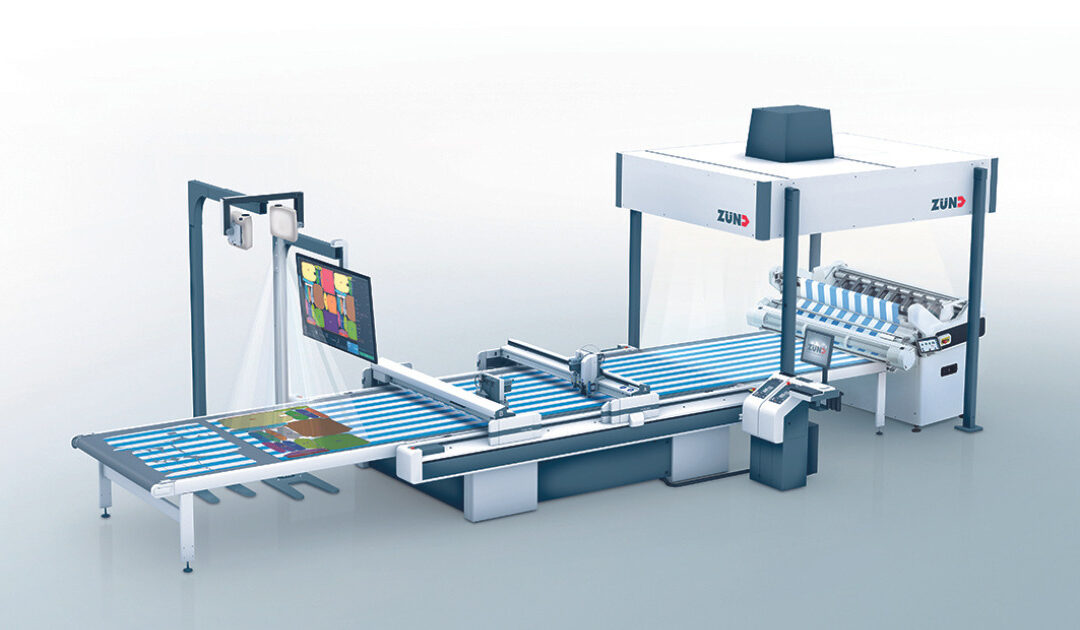
Digital expertise for single-ply cutting by Zund
 Zünd focused on the benefits of digital single-ply cutting in modern garment manufacturing at ITMA 2023 in Milan, Italy. They demonstrated why it is the go-to partner for customized, on-demand cutting, and why single-ply cutting of fabrics offers nothing but advantages. Digital technologies are changing the garment industry Manufacturers are dealing with rapidly advancing digitalization along with increasingly short product life cycles by investing in lean and highly automated production workflows. Zünd solutions allow them to rationalize processes from ordering to cutting while minimizing manual interventions.
Digital, automated single-ply cutting is the answer to these new production realities. Zünd’s single-ply cutters are the perfect cutting tools for production-workflow automation, offering manufacturers the flexibility and profitability they so urgently need. Intelligent automation features, optical solutions, and software tools make it easier for them to optimize their resources, monitor material usage, and support
employees, so they can focus on other activities that add greater value to the business. With digital, single-ply cutting technology, manufacturers can increase productivity while expanding their production capacity. With very economical and efficiently scalable on-demand production, manufacturers can easily accept last-minute orders and meet short delivery times. They can handle spikes in demand with ease and confidence.
Zünd cutters combine tremendous versatility in a single machine, giving users access to a completely new level of flexibility in their production workflow. They can process demanding textiles, complicated patterns, and diverse shapes without any difficulty. Zünd’s cutting technology allows the garment industry to produce customized, made-to-measure clothing in small batches and on demand just as economically and efficiently as large quantities. It enables processing and handling multiple orders more quickly while simultaneously saving both time and material with highly efficient nesting capabilities. Combining this technology with MindCut production software and the superior precision of single-ply cutting leads to almost zero waste. Parts can be nested very tightly and close to the edges of the material, which generates considerable savings but also helps reduce the environmental footprint.