Azim Group Selects FastReactPlan for Digital Transformation
 As the global economy and the Ready-Made Garment (RMG) sector recovers from the Covid-19 crisis, the need for fast, detailed, and accurate planning and control of manufacturing processes is more acute than ever before. Coats Digital’s market leading FastReactPlan software solution will play a crucial role in ensuring that the Azim Group is able to navigate through the COVID-19 crisis and emerge stronger by responding quickly, efficiently, and sustainably to customer demands.
Established in 1975, Azim Group manufactures garments for leading brands in the United States, Europe, Asia and South America. Its clients include American Eagle, Tommy Hilfiger, Perry Ellis, Aeropostale, Bershka, Pull & Bear, Kohl’s, Walmart and Amazon. Currently, the Group comprises of 13 multi-category garment manufacturing units located in Dhaka and Chittagong, supplying woven, sweater and denim products, as well as a further 2 four-tier factories which support a vertically integrated manufacturing model.
Azim Group is committed to becoming a benchmark for garment manufacturers in Bangladesh and beyond. Core values of excellence, integrity and responsibility are deeply embedded within the company. Its vision is to be a role model for environmental and social responsibility. Azim Group’s active engagement with various global programs such as the ZDHC, The Higg Index and Amfori BEPI, is a testament of its commitment to the highest sustainability standards. Azim Group factories are certified by Global Organic Textile Standard (GOTS), Organic Content Standard (OCS) and OEKO-TEX Standard 100.
With a firm belief that digitalization has an important role to play in the sustainable and efficient use of key resources including people and materials, Azim Group will utilise FastReactPlan from Coats Digital to optimise capacity planning, with materials and pre-production activities dynamically driven by the latest plan on a JIT, LEAN basis.
Our response to the challenges arising from the Covid-19 crisis is key for the sustainability of the RMG sector in Bangladesh. After ensuring the health and safety of our people, we must drive forward with innovative strategies which will enable us to operate more efficiently and flexibly. FastReactPlan will allow us to optimise our planning with a highly visual and sophisticated system across multiple processes, and solve the major challenge of drastically shrinking delivery lead times. Farhan Azim, Deputy Managing Director, Azim Group.
Azim Group is a pioneer in the Bangladesh RMG Industry and we are delighted to work with their world-class team to support the company on its journey of digital transformation. Their journey will start with digitalizing production planning and control, and then we will look for further opportunities to support the team with the Coats Digital ecosystem of connected solutions, driving increased visibility, flexibility, speed and cost-efficiency.
In the face of unprecedented pressures within the global apparel industry such as increased speed to market, growing product complexity and order fragmentation, increased cost and most recently Covid-19, we look forward to supporting Azim Group in digitalising their key business processes and helping them emerge from this worldwide crisis stronger than ever. Ayan Barua, Business Development Manager, Coats Digital
FastReactPlan is developed exclusively for the fashion, textile and apparel industry and can be configured in multiple ways to reflect industry best practice and specific business requirements. The Azim Group project will include detailed planning of the sewing lines as well as the scheduling of cutting, laundry and finishing processes within its denim specialised subsidiary, Global Outerwear Ltd, using the highly visual, sophisticated tools of the FastReactPlan planning board.

Sodexo supports accelerated growth with Coats Digital’s VisionPLM
 The Global Supply Management (GSM) Team has selected Coats Digital’s VisionPLM to boost productivity and drive connectivity across the supply chain, supporting the business on a Global level. The GSM Team supplies workwear to Sodexo’s employees from chef’s jackets, aprons and lab coats to headwear and polo shirts.
To support it through a period of rapid growth, Sodexo Services Asia decided to invest in a Product Lifecycle Management solution to help streamline product development, purchasing and production management processes.
Sodexo GSM Team: “Whilst our internal and external demands for uniforms are growing fast, we were struggling to keep up with product development and production using disconnected manual processes and tools. Managing key business processes on spreadsheets, reports, documents and catalogues was slow and resulted in significant inefficiencies and inaccurate data. As well as the inherent inefficiencies of this approach, there were examples of out of date catalogues being used and margin control and management was a real challenge.”
“Something needed to change and we needed to streamline and automate key processes in a way that supported more effective collaboration across regions and with supply chain partners, as well as giving us fast access to accurate information.” After reaching out to a number of providers, the GSM Team selected Coats Digital’s fashion specific Product Lifecycle Management solution, VisionPLM.
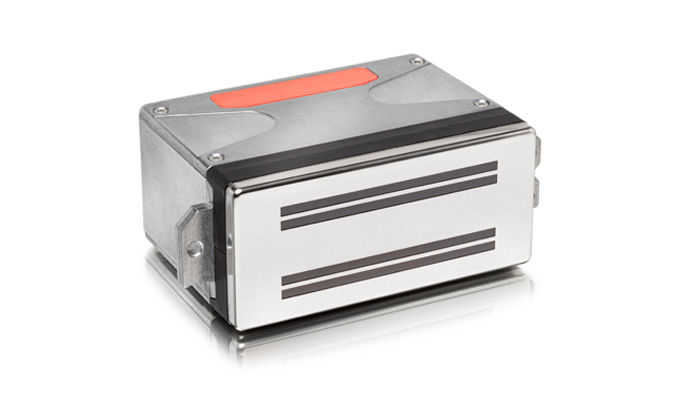
Xaar 2002 printhead delivers exceptional print performance
 Xaar, the leading inkjet printing technology company, has launched a highly advanced, simple to install printhead, following close collaboration with its global OEMs. Designed to deliver exceptional 720 dpi print resolution quality and performance across a range of applications including ceramics, glass, packaging and label applications, the new Xaar 2002 has been developed specifically to provide fast and easy integration and is ready to use straight out of the box.
Using drop in printhead alignment, mechanical tolerance improvements allow the printheads to be dropped into the printbar easier, making set-up times faster, and machine builds quicker. Developed following OEM and customer feedback, the ‘plug and print’ capability significantly reduces set-up times and helps save time and money.
In addition, thanks to its new advanced Tuned Actuator Manufacturing – TAM2 – and Xaar AcuChp Technology, the Xaar 2002 also delivers visibly improved colour uniformity across the width of the printhead, further reducing printhead installation and set-up times, therefore maximising uptime. Print speed is greatly enhanced with the Xaar 2002, enabling lines to be run faster. By using the full capability of the printhead, much higher firing frequencies of up to 36 kHz are now possible, delivering significantly increased printing speeds of up to 75 metres per minute at 720dpi.
Graham Tweedale, General Manager of Xaar’s printhead business unit said; “After extensive collaboration with our global OEMs we worked hard to ensure the Xaar 2002 delivers the operational improvements they have asked for. “With its simple installation and significantly reduced set-up times, we believe the Xaar 2002 printhead offers the speed and performance our customers now demand for the print applications they provide.”
Each Xaar 2002 printhead can be customised by OEMs, ensuring visibility of their brand on the print engine. Furthermore, the Xaar 2002 is serviceable, lowering the total cost of ownership and providing an excellent return on investment.
Designed for use across a variety of applications and ink types the Xaar 2002 is available in three printhead variants – the Xaar 2002 Plus, Xaar 2002 Premium and Xaar 2002 Advanced, providing customer choice and flexibility for a range of print applications.
The Xaar 2002 printhead also incorporates Xaar’s industry leading TF Technology, High Laydown and Ultra High Viscosity printing capabilities. These provide users with significant performance improvements when compared to other printhead designs. Xaar’s unique TF Technology allows a broader range of ink or other fluids to flow directly past the back of the nozzle at very high flow rates. This prevents the nozzle from drying out, increasing the printhead’s nozzle open time, thereby ensuring the printhead is continuously primed for trouble free start-up, even after periods of non-use.
Incorporating many of the performance features requested by customers, the Xaar 2002 is the first printhead to launch under Xaar’s new leadership team and demonstrates the focus on its new strategy. “The Xaar 2002 range offers all round ease of set up and use, while delivering the exceptional print quality, unsurpassed reliability and unique technologies Xaar is renowned for,” concluded Graham. “Saving time and maximising print results for our customers, whatever their application.”
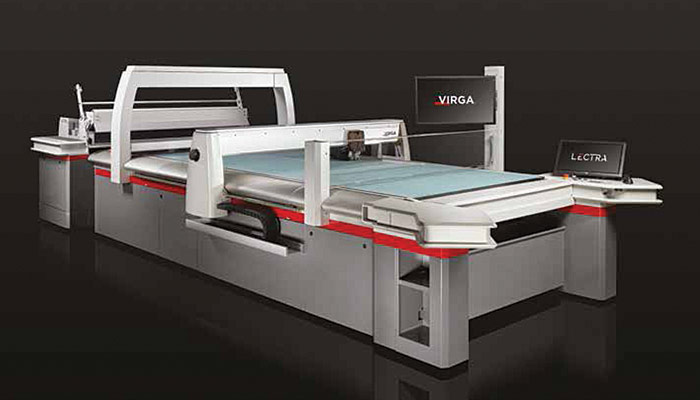
Fashion on Demand by Lectra Bridging the Gap between the Empowered Consumer and Smarter Factory
 Lectra has more than 40 years of experience innovating in the fashion industry. They are working together with major fashion and apparel players in over 100 countries. Drawing from their experience and expertise, company is continuously reinventing the value chain so that businesses can become more profitable, sustainable and agile.Personalization is set to be an industrywide phenomenon. With dedicated turnkey solution and in-depth industry knowledge, Lectra is perfect partner to help you tap into its potential.
Consumers are now driving trends
In today’s digitally connected world, consumers are making faster, more informed purchasing decisions. Not only are they defining the value proposition of products and services, but they are also empowered to impose their demands on the market. Brands, retailers and manufacturers wanting to succeed in this new business environment will have to change their focus to be more customer-centric, adopt industry 4.0 best practices and invest in smart technology to keep up with consumer trends.
Conventional supply chains can no longer meet consumer demand
The conventional fashion supply chain model is too opaque, fragmented and slow to respond to diversified consumer demands quickly enough to satisfy customers. As a result, consumers will look to the nearest competitor to get the personalized products and exceptional customer experiences they want. This inability of the conventional supply chain to meet new expectations puts established fashion companies at risk.
 The On-Demand business model
The on-demand model is a way to make factories smarter and bring business closer to the consumer. The key to meeting the needs of the new consumer is learning how to integrate state-of-the-art digital technology and real-time consumer data into daily business operations. Brands, retailers and manufacturers with the flexibility to produce quickly and on demand are successfully winning consumer loyalty.
On-Demand Business Benefits
• Generate positive cash flow: Take pre-paid orders, optimize operational overhead, gain material savings and minimize excess stock
• Achieve operational agility: Respond and react quickly to new market opportunities around on-demand production and personalization-small series, customization and made-to-measure orders—without disrupting existing revenue models
• Acquire competitive advantage: Integration of innovative technologies at each step of the product lifecycle lets you build and manage a powerful, efficient on-demand supply chain to speed your products to market and strengthen your position
• Think globally and act locally: Create, develop and produce more sustainably for specific regions, adapting your production to business models and/or individual consumers by taking advantage of nearshoring
74% OF MILLENNIALS & GENERATION Z EXPRESSED AN INTEREST IN PURCHASING PERSONALIZED CLOTHING
Lectra provides complete solution for Fashion on Demand
Fashion on Demand by Lectra-the industry’s first end-to-end solution to develop individualized products and automate production-is designed to help the fashion industry overcome the challenges of scaling or implementing made-to-order and personalized offers.
• Lectra Digital Cutting Platform: a powerful cloud-based solution including business applications
• Virga smart and connected single-ply cutting line
• 3 packages for a modular and scalable offer:
Made to Order for sampling, small series, quick assortment
Made to Customize for customization orders
Made to Measure for made-to-measure clothing
• Powerful automatons that automatically process the various activities from preparation up to cutting
• Seamless automatic synchronization between cutting line, digital platform, ERP and Lectra CAD
Prerequisite of Product Development Software
Develop products: Create graded patterns, define variants and add alterations.
Manage materials and their cutting parameters: Set attributes for individual fabrics using material library management and prepare cutting ahead of time using automatic parameter set-up.
Create your personalized products: Store your personalized product offers along with related components, materials and size range. Alterations can also be managed.
Prepare production: Set up production rules and nesting constraints
Automate Pre-Production & Cutting Processes: Automatically generate cutting orders and cutting jobs as of order reception.
Receive Orders for Personalized Products: Track your customers’ orders and automatically assign product IDs.
Virga Cutting Line
Cut orders for personalized products: Cut your patterned materials at the same speed as plain fabrics.
What you will gain with Fashion on Demand by Lectra
Fashion On Demand by Lectra is a game-changer in this space because it automates the go-to-market processes to expedite development while concurrently enabling manufacturers to expertly manage fabric cutting, even for complex, patterned designs. By shortening the cycle, fashion companies will be able to produce the high-quality personalized garments consumers want faster.
Improved time to market
• Simultaneous management of multiple individual orders
• Automation of production rules
• Identical cutting speed for both patterned and plain fabrics
Cost savings at every stage
• Material savings: powerful nesting and high productivity per square meter
• No plastic and paper consumables
• Multi-line and multi-site management
Operational efficiency
• Streamlined production processes
• Pre-set cutting instructions
• Configurable workflow with rules you can change at any time
Full operational control and 360° visibility
• Supervision controls
• Vertical IT system and horizontal process integration
• Data monitoring integrated into dashboard
Flexible and secure management of personalization offers
• Management of any variant or component
• Automatic matching of orders to product catalog
• Line-item product monitoring made possible by unique product ID numbers
Optimized management of a broad range of fabrics and patterns
• Powerful scanner with fabric pattern positioning
• Material library management: set attributes for individual fabrics
• Automatic parameter set-up for cutting
Consistent fit and sizing across products and markets
• 2D patternmaking
• 2D industrialization (including special grading)
• Reliable alterations system with automatic consistency controls
Enhanced user experience thanks to an easy-to-use solution
• Intuitive touch-screen interfaces
• Controlled sequencing of cutting jobs
• Visual loading and off-loading assistance
“Fashion on Demand by Lectra is a dream come true for us. Thanks to this solution, we managed to increase production output, achieve the perfect fit, reduce consumables, save time on preparing orders and minimize human errors.”
Charline Fasquel, Director of Production, Balsan
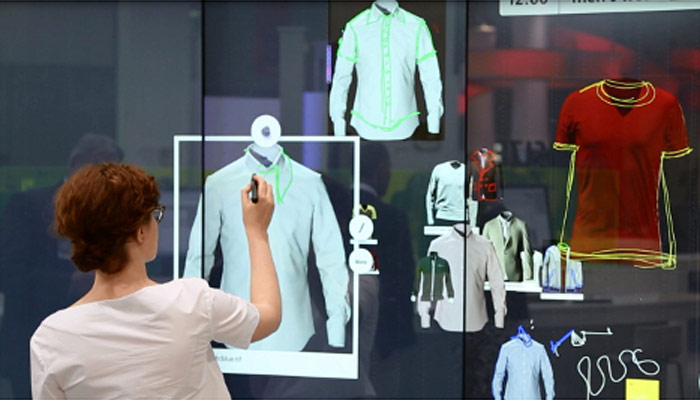
Some of the latest technological developments
Apparel manufacturers are using a wide range of creative and ingenious decorative techniques to add value to their fabrics and garments today. The development of these new decorative techniques has been facilitated partly by recent innovations in garment technology. As a result, the range of economical design options for designers and manufacturers has been widened. These innovations have centred on machinery for direct to garment digital printing, embroidery, conventional sewing, embellishment attachment, heat transfer and laser decoration. Additionally, interesting advancements in electronic textiles have taken garment decoration beyond the field of aesthetics by enhancing the functionality of garments for their wearers. This report discusses recent developments in technologies for garment and textiles…
Cutting, Spreading and Inspection machines by Oshima
 Established in 1971, Oshima Group (Baoyu Machinery Co., Ltd.) is a well-known manufacturer of ready-made garments and textile machinery at home and abroad. Currently, it has set up operations in Taiwan, China, Thailand, and Vietnam. For forty years, the group has always “survived by quality, developed by quality, and credited by service” to satisfy customers in return.
Intelligent Knit & Woven Spreading Machine (K-Pro Series)
When you upgrade to Oshima intelligent Knit & Woven Spreading Machine and experience the innovative Data combination system, there’s no way of going back. Explore the future of spreading with intelligent analytics and digitally-enhanced design. Key functions are:
• Data management (Storage, input, output & reporting)
• User friendly operation with touch device
• Management control (Content, authority)
• Connected production equipment
High-speed intelligent cutting machine
Oshima cutting system brings the future into the present. It is by far the most powerful system we have ever created. Company redesigned with our most advanced knife intelligence device. Its automated cutting solutions combine high technology with manufacturing know-how to create truly “cutting” edge machinery. Key functions are:
• Data management (Storage, inputs, output & reporting)
• User friendly operation with touch device
• Knife intelligent (faster, precision)
• Shipping reduce 30 percent of the space
• Connected production equipment
• Fluent integration with other OSHIMA products
Intelligent Conveyor Type Needle Detector
Smart and seamless management for your factory in a futuristic way. These needle detectors leverage the power of ERP solutions to support data management. Locking system and alarm signal are available for smarter business security, ready to assist your factory on demand. Key functions are:
• Data management (Storage, input, output & reporting)
• Downtime detection
• User friendly operation with touch device • Management control (Content, encryption, authority)
• Connected production equipment
• Fluent integration with other OSHIMA products
Mounted Intelligent Fabric Inspection System
Same precision as the stand-alone version, however this system can be integrated into your existing factory layout. The fabric is automatically inspected while it is being spread out. Key functions are:
• Data management (Storage, input, output & reporting)
• User friendly operation with touch device
• Smart analysis, accuracy up to 99 percent
• Instant data transmission
• Connected production equipment
• Fluent integration with other OSHIMA products.
Coats launches Coats Digital
 Coats, the world’s leading industrial thread company launched Coats Digital. The integrated technology business brings together all its software solutions under a new single brand which describes and aligns with the offering to its customers across the apparel and footwear industries. Coats Digital provides in-depth industry expertise combined with the practical application of the latest technology, including Big Data and AI, delivering market leading software solutions. It built on the advantages associated with the Coats brand of trust, expertise, credibility and its global footprint. A key aspect of Coats’ growth strategy is to build an innovative software solutions business for its customers.
The benefit for Coats’ customers was the one stop shop approach and an unrivalled suite of best in class, and progressively integrated solutions, which also adopted the new Coats Digital branding. The series of acquisitions it has made in this space of GSD, FastReact and ThreadSol have been highly successful. Now is the time to simplify the house of multiple software brands through a coordinated market expansion of a portfolio of products to support customers in the face of unprecedented industry pressures.
Automatic Cutting and Spreading Machines by StudioNext
 The domestic economy has recently been showcasing an inevitable slowdown which has adversely impacted the market sentiments. With the advent of such economic slowdown, it becomes very crucial for the garment manufacturers to be efficient so that they keep their profits intact and keep losses at bay.
In today’s dynamic economic environment, there is a constant need for improvement in processes. An organisation cannot always rely on past performance to remain successful perennially. In order to remain competitive, an organisation needs to upgrade its technology, rationalize the cost of production, improves the product quality & speed of delivery by maintaining less manpower. Organisations will have thousands of job orders per year to accomplish, and thus they will always seek new ways to improve its processes. The focus on efficiency in the apparel industry is mainly on the reduction of the material costs, which often reach up to 75 percent of the total production costs.
StudioNext, with about 20 years of experience in implementing efficient technology and 40 abled staff, offers a very high and extremely stable technology for cutting room automation at an affordable price. Since 2003, StudioNext Technology Pvt. Ltd. (“StudioNext”) has been playing a vital role in the process of bridging the gap between the industry and its demands in the Automation process, by offering the latest technologies.
In this edition of GTE-20, StudioNext is displaying a new model CYG YIN state-ofart automatic cutting machine and automatic spreading machine for the first time in India. In addition, StudioNext is also displaying super-fast & powerful Single ply cutting machine for car seat industry with SCOPE brand. Also Studio Next will be displaying an affordable range of Scope Spreader machines designed and developed indigenously for the small and mid-size manufacturers.
This time Studio Next will be also displaying new version of Richpeace CAD with latest CE compliant 2nd Generation MJKC series of cutting and marker plotter. The company believe that these technologies collectively provide an undaunted much required support to the manufacturing industry and which will alternately boost the industry and economic growth. With the help of automation in its process, an apparel manufacturer can achieve its targets.
Fully Automated Spreader Series by Cosma Technology
 Continuous improvement of advancements in cutting technology, and the higher expectations of service from its customers lead to the birth of Cosma Technology from Italy. The mission is to build up a strong and long term relationship with its technology’s partners, who are the pioneer leaders in the industry, ready to customize their solutions, over the years Cosma has built up a highly skilled and professional team who are dedicated to develop, customize and support all cutting room solutions in apparel, footwear, furniture, automotive, and aerospace. Given are the details of Cosma Venus Spreader, Labeller and Spreading Table with both options of Conveyor and AirBlowing.
Cosma fully automated spreading and cutting room technology
Cosma Technology provides integrated software and hardware solutions to the customers in fashion & apparel, suit, furniture, shoes, automotive, leather and technical textiles. Its largest range of solutions perfectly integrated and customized to meet the demands in sampling, pre-production and production, Cosma Fully integrated cutting line optimise the production process through RFID, Data Manage system and CDAS (Cutting Data Analysis System), each process is digitally transformed and the results are stored for verify the efficiency and productivity. The company is committed to its clients providing Smart solutions to build smart cutting room. The smart factory concept has been designed under the Industry 4.0 as a future aspect of the manufacturing industry.
VENUS Automatic spreader VENUS
Automatic spreader is the solution to spread fast with accuracy on every kind of material from High elastane to denim, able to handle different materials in apparel, automotive, upholstery, and technical textiles industries. The VENUS 120 model dedicated to spreading, rolls or flat folded of knitwear, sportswear or woven fabrics in open width or zig-zag ways. With VENUS 300 you can easily spread denim or hard materials up to 300 kilos.
The user friendly software on board of the machine, enables the operator to set-up different parameters and spreading profiles, according to the fabric types, and double belt cradle system, free tension device, fabric edge sensors, spiral rollers, ply height detectors and the latest generation of motors, ensure a high spreading quality with or without end catchers. The DCS system onboard helps to monitor productivity, fabric loss, operator performance, and machine efficiency and feedback the production in real-time.
Automatic Cutter Series
Cosma Cutting series is the top of the range and the right solution to cut small, medium and bulk orders with high cutting quality and efficiency. Smart Cutting Series is available at 3, 6 & 8 cm Compressed Height. Smart Series cutters are flexible to cut variety of fabrics from apparel, automotive, shoes, aerospace to furnishing. Cosma Smart cutting series can handle a Variety of fabrics from Natural woven fibres to technical textiles and composites. Thanks to the latest generation of electronics and motors able to deliver the fastest output with high quality with lower energy consumption.
The “Smart moving system” combined with the “intelligent knife system” and the latest digital technology, makes Cosma cutting series a flexible solution that guarantees an high cutting quality, reducing the manpower and operational costs. The “zero buffer” profile and the second vacuum pump ensure a high output productivity with a perfect quality, even to cut the high plies fabrics. Over the last few years, the company has developed the Cosma range of cutting solutions, through a strategic partnership with a prestigious European brand, so that it achieves the goal to increase the quality, productivity and efficiency performances of the cutting processes of its customers.
Automatic Tubular Spreading Machine by Orbito
 Orbito Asia Pte. Ltd., Singapore came into existence in the year 2000. It was established in order to cater to the needs of the sewn product industry in the South Asian region. It has a wide range of machinery with the most advanced features. The range of products include band knife cutting machines, straight cutting machines, thread trimming machines, cone winding machines, sewing machines, embroidery machines, finishing equipment, CAD systems, packing equipment and many other allied products required by the sewn product industry. To support the Make in India movement, Orbito started manufacturing various garment machinery in India.
Automatic Tubular Spreading Machine – Model OS- 101A
ORBITO Spreader is indigenously manufactured and designed for spreading tubular knitted fabrics in face to face mode it guarantees top performances in spreading, in terms of quality and productivity.
Modern technology:
• Touch Screen
• PLC system
• Servo Motor with Drive
• Main Motor with brake and gear
• 4 Wheel drivers
Features:
• Safe operator platform
• Programmable lay length and ply counters
• Automatic machine stop at no fabric
•Safety quick stop at either side
Performance:
• Reliable sturdy construction
• Higher productivity
• Tension free spreading
• More fabric savings
• Low maintenance
Avalution presents 3D body scanner
 Avalution recently presented its 3D body scanner AVAone and the results of the Size NorthAmerica measurement survey for the first time in Asia. The CISMA in Shanghai saw Avalution showcase its expertise in the digitalization of the human body for the first time at an Asian trade fair. The company was founded in 2018 as part of the Human Solutions Group.
Avalution also presented its latest 3D body scanning solution – AVAone. Developed especially for use in retail stores and the apparel sector, the scanner completes the range of the company’s body scanners. “For example, AVAone can create an individual body scan in the changing cubicle, a scan which then becomes the basis for customised clothing or a digital fitting,” says Dr. Helga Gaebel, who is responsible for worldwide sales of Avalution’s 3D body scanners. “The AVAone is innovative and just as reliable as our body scanners that we use to measure people for scientific and medical purposes – but it’s much faster and easier to set up and operate.”
Size NorthAmerica results available in iSize
At the CISMA, Avalution also presented the results of its largest measurement survey project to date – Size NorthAmerica – during which around 18,000 people were measured in the USA and Canada. “For the first time, we now have representative data that scientifically confirms the impression that the American population has changed significantly,” says Dr. Gaebel. “The growth in average body length is stagnating, but the average body circumference is increasing. These are the highest average values ever recorded for a BMI (body mass index). Any company which manufactures products for the US market must take that into account.” Size North America’s results are available on the iSize body dimensions portal. The data enables companies to analyze comprehensive information about the physical characteristics of specific target groups and to generate avatars for product development. Avalution makes people digital – and puts them at the heart of product development.
The company has the world’s largest body dimension database containing the body scans of around 100,000 persons. Avalution also carries out measurement surveys and is a leader in the field of body scanning. At the company headquarters in Kaiserslautern, Avalution makes ergonomics and sizing & fitting measurable for product development in various sectors.
Automatic multi-layer cutting machine by Richpeace
 Tianjin Richpeace Ai Co., Limited was established in 2006 and went into operation in 2007 which is jointly held by Shang Gong Group Co., Ltd and Shenzhen Yingning Investment Co., Ltd and Tianjin Samehere Software Co., Ltd. Tianjin Richpeace Ai Co., Limited is located in Baodi Economic Development Park which covers 75.5 thousand sq mtr and 46.9 thousand sq mtr construction area with a total investment of 150 mn RMB.
Automatic 9 cm multi-layer cutting machine Feature
• Aluminum nose which is molded in one body
• Automatic cleaning system (stainless steel filters)
• No need to add lubrication oil, avoid oil contaminating fabrics
• The overall adopts steel structure, more solid and durable
• Cutting Blade change cutting speed automatically, ensure quality of final markers
• 25 years professional software, independent research and development electronic safe and reliable
• With double edge knife and intelligently controls cutting blade’s wear and tear
• Production statistics system, can generate reports and docking ERP/MES system
• Beams of the gear and rack designed to ensure the accuracy of mobile, stability and long life
Hardware: Igus Drag Chain, Omron Cable, BANDO belt, WECO terminals, HIWIN guide rail, Yasukawa control system
Configuration
• Material of cutting head and beam: The cutting head and the beam are made of aviation grade aluminum alloy material, with advantages of light weight, fast speed and high strength, to improve working efficiency greatly
• Unique front tooth plate design: Improve the smoothness of conveying pieces, reduce the manual auxiliary operations, speed up the receiving operation, greatly improving production efficiency
• Intelligent cutting knife: Auto sharpening device coordinated with the sharp durable alloy knife grins and controls cutter wear automatically, with cutting technology of Ultra High Frequency Vibration knife to avoid problems caused by irregular manual cutting, limited precision of punching machine as well as burned smell by laser cutting machine. Intelligent automatic rotation cutting position and uniform velocity ensure uniform cutting performance and precision
• Soft and hard limit for omnidirectional protection: Real-time test for working of the cutter ensures cutting process in a safe and high-efficient way.
Hot air sealing machines by H&H
H&H Asia Group Ltd. was established in 1993, and hence has over 24 years of experience for thermoplastic technology on seam sealing and adhesive film applications. It is specialised in thermoplastic technology for sew free production. The company is one of the largest manufacturers of seam sealing (Hot Air machines). It offers the machines from basic to advanced technology with industry 4.0 and AI – detailed models. It is also known as bonding experts in this industry by offering ultrasonic, laydown, smart bonding machines.
 AI-108 Hot Air Sealing Machine
Intelligent solution
• Applicable to 4-28mm width tape (Standard version): 4-28mm
• Applicable to stretch fabric
• Applicable to all types of waterproof
• Reinforcing, and decorative tape
• Statistical tape usage
• Customized software
• Customized attachment according to different applications
Highlighting features
• Standard digital tape tensioner device
• Differential speed top/bottom roller
• Extremely short nozzle action, quick response
• Automatic fixed length mode
• Colour touch screen interface
• Ergonomic design
• Multi-language support
• Build-in software locking, data protecting
AI-101L Hot Air Sealing Machine
 Intelligent solution
• Applicable to 50mm width tape
• Applicable to stretch fabric
• Applicable to all types of waterproof
• Reinforcing, and decorative tape
• Statistical tape usage
• Customized software
• Customized attachment according to different applications
Highlighting features
• Standard digital tape tensioner device
• Differential speed top/bottom roller
• 3D electronic nozzle positioning system 3D
• Automatic fixed length mode
• Digital air pressure display
• Colour touch screen interface
• Ergonomic design
• Multi-language support
• Data memory bank
• Data memory upgradable
• Data locking and protecting
Robotech presents latest sewing automations
 Robotech A.G. is an Istanbul based company and a leading developer and manufacturer of sewing automation for the apparel industry which started its journey back in 1997. Given are some of its latest technologies:
D-FA 320-P Feed of the Arm Automat
It is for denim and sports trousers is a brand new automat, which is specially designed and programmed to work better on the back rise section of the denim trousers with extra-stretch fabrics. This model minimizes the risk of waving (Puckering) effect between the needles on such extra stretch fabrics. The machine also allows perfect stitching without loose stitches on the cross joints on thick fabrics since the machine is equipped with a special foot and a height sensor which allows the special programming of the machine to temporarily increase the pressure on the foot when the rise over the cross joint is sensed.
LB6000 – Care Label Book Making Automat with Ultrasonic Cutting System
It is another new fully automated station for gathering and sewing of the care labels from rolls. The cutting mechanism on this automat is with the new ultrasonic cutting system. The ultrasonic cutting system melts the fibres within the fabric by mechanical action only (hammering), enabling a very clean and flexible cutting without any burning or colour change. The automat is also capable of folding the (selected) labels and then stitches all labels together on a Brother bartacking head. The station can be ordered with 4, 6 and even 8 heads of Rolls and folding device/s can be inserted on any head at production. Another advantage is that it can operate with all kinds of care label fabrics (paper, satin, nylon or any mixture of these). The greatest advantage is that in brings an operation of 6-8 labour operation down to less than 1 operator because the system requires manual intervention only to change the thread bobbing and the rolls of care-labels when finished.
D-BF-410 Felt Feeding under Bartack Automat
It is another new machine developed based on the needs of the customers. Because recently the stitches on the back-pocket corners and at the edges of the belt loops damages the extra stretch (high elastan contented) fabrics during washing. In response the manufacturers began using small cut felt or same fabric pieces placed under the bartack stitches. However, this operation led to extra manpower and time causing extra cost as well as inconsistencies. Automation means minimum human intervention and fewer errors which result in better quality and higher productivity. These factors also lead to less rejected garments and therefore saving cost and time simultaneously. Second, less number of people performing an operation also leads to saving in labour costs involved. Thirdly, automats require very little training because they are very easy to operate thanks to the graphic based colour touch-screen panels we use on almost all our automats. The high complexity tasks are normally preferred to be carried by skilled operators that means higher cost associated with the higher skilled. Most automated machinery can be operated by less skilled workers which help cut costs.
Koru also adds that ‘Robotech A.G is always striving to find new, more efficient ways through which it can best contribute to the development of the garments manufacturing industry. It is capable of achieving this with a strong R&D team which is continuously working to find innovations and improvements.
Pegasus presents its latest sewing solutions
 Pegasus (Tianjin) Sewing Machine Co., Ltd., a subsidiary company of Pegasus Sewing Machine Mfg. Co., Ltd. from Osaka, Japan has recently introduced AT/DD3A and DDM series, but also the most suitable machine for sewing sportswear, which industry has grown up dramatically these days. In addition, it has automatic machines and optional devices, which contribute to labour-saving and quality improvement.
M900/AT/DD3A Series MX/AT/DD3A Series
• Overedgers equipped with automatic tape/thread chain cutter (AT), automatic presser foot lift (PL), pneumatic waste collector (LC) Only the AT8F has a pneumatic waste collector (LC).
• Equipped with operation panel type controller, so frequently used functions, such as setting machine speed, number of stitches for the AT device and similar functions, can be called up and set immediately. In addition, the machine stops automatically.
• There are two types of AT devices, electric type (AT6F) and pneumatic type (AT8F).
• PEGASUS’ original built-in direct drive motor is employed. Therefore, these series ensure quality and safety.
• The motor and the machine are unified, so setting up is easy.
Machines that have PEGASUS’ original built-in type direct drive motor. The company exhibited a lot of sewing machines with built-in type direct drive motor as follows.
D222/D232 series (overedgers) * D322/D332 series (interlock stitch machines)
• PEGASUS’ original built-in type motor is employed, so safety as well as quality is assured. You can use PEGASUS’ machines at ease.
• The motor and the machine are unified, so setting up each machine is easy.
• Increasing airtightness inside the motor provides additional safety. Furthermore, with no coupling, power is conveyed directly to the machine.
• Featuring energy saving and high power contributes to the increase of productivity.
FS703P-A-G2BX452/PT/PD23/PL3A/DDM/PP3A«LaRgo
The FS700P series equipped with a right and left independent differential feed adjustment mechanism Oil Barrier type, 4-needle, feed-off-the-arm, interlock stitch machine for flatseaming.
• Seaming on functional fabrics that have varying degrees of stretchability, such as mesh fabrics and stretchable fabrics that are employed for sportswear and similar garments.
• The differential feed ratio can be adjusted separately, in order to respond to operations in which the machine is used to sew right- and left-hand side fabrics that have varying degrees of stretchability such as mesh fabrics and stretchable fabrics, and/or curved lines.
• The operator can handle the right- and left-hand side fabrics easily, without worrying about the different stretchability. The LaRgo achieves uniformly and beautifully finished products, regardless of the skill of the operator. These features reduce the operator’s burden drastically, and also help increase productivity.
•Thanks to the air-controlled presser foot pressure (PP3A), the uniform and minimum possible presser foot pressure is always achieved according to the fabric and fabric weight being used.
• Thanks to the air-controlled engagement pressure of the knives, the engagement pressure is reduced, compared to conventional knives. This feature dramatically increases the durability of the knives.
Achieve maximum productivity with consistent quality with JUKI
 JUKI has achieved continuous growth by offering the highest quality products and services to the world’s industries ever since its establishment in 1938. The driving force behind its development was the belief that “everything is for our customers.” JUKI will press ahead in its challenge to innovate while sticking to its DNA of evolution and reformation as a global company serving customers in 180 countries all over the world.
JUKI advances its activities to create the most suitable factories by making innovative efforts to solve the various problems a customer faces, through the further evolution and systemization of products and IoT. As a pioneer in industrial sewing machine manufacturer it has come up with smart sewing solution in order to achieve maximum productivity with consistent quality. This is only possible by introducing digital machines along with atomization.
Digitalization: JUKI’s Digital Sewing Machines can respond actively to changes in sewing items and materials. These sewing machines are capable of digitalizing “seam” adjustment functions and setting parameters can be stored as a pattern. The data after adjustment can be transferred through tablet or mobile with a dedicated app (application program) to other sewing machines. The same setting can be shared to other factories which are running with same style in order to attain same quality seam. This will help the factories reduction of machine setting time during line set-up. It has total line of 12 Models of digital sewing machines:
• DDL-9000C- 1 Needle Lock stitch MC
• LK-1900BN- Computer controlled Bartacking MC.
• LK-Computer controlled button sewing mc.
• LBH-1790AN- Computer controlled Buttonholing mc.
• LH-4500C Series- 2-needle Lockstitch Sewing System
• LZ-2290C: Zigzag Stitching
• MS-1261A/DWS: FOA MC
• MEB-3900: Eyelet Buttonholing
• LU-2800V-7: Unison-feed 1, 2-needle lockstitch
• LS-2328V-7: Cylinder-bed, Unison-feed1-needle lockstitch
• PLC-2700V-7:Post-bed, Unison-feed 1, 2-needle lockstitch
• AMS-221F: Computer controlled Cycle Machine
Automization: Due to the raise in global competition factories are required to reduce their manufacturing cost and to support them JUKI is coming up all new range of automatic machines which will help them process cost reduction. Apart from cost reduction there are benefits like consistent quality and reduced rejection rate as there is no manual intervention. There is consistent increase use of automatic machine in apparel sector compared to last year. And it has customers using all our automatic machines in apparel, knits as well as non-apparel. Juki’s automatic sewing machines are PS-700, MOL-254, AMS-210EN, DDL-9000C WITH JANET (IoT).
Systemization: An IoT based system capable of performing connects all of the machines in a network. JUKI meets customer demands by proposing line solutions to overcome production challenges using innovative, high-precision technologies under the “Smart Solutions” slogan. Equipment data such as operation information on individual sewing machines is visualized in real time, analyzed and used for production improvements, speedy response and Operator education. The real time production monitoring system will help the production team to identify the bottle neck process in a real time so that the action can be taken on time. It helps the factories to avoid production delay due to the incorrect data or not getting report in a real time. JUKI’s Smart factory approach will help apparel makers to compete in global market as it is important to go for a higher productive factory as labour cost & scarcity for skilled labour is increasing in India.
Pocket welting sewing unit made by Dürkopp Adler
 For perfect quality pocket openings with zipper in all kind of difficult materials, Dürkopp Adler introduces the pocket welting unit’s class 755 A and 756 A now with a programmable needle feed. With the classes 755 A and 756 A up to 80 percent faster processing of pocket openings with zipper can be achieved compared to manual production. This option includes zipper scissors with unwinding device, folder guide lift and transport gripper for displacement-free attaching of endless zippers without slider. The max.sewing length is 180mm with pocket bags and 200mm without additional parts.
Special features from this device
• Special folder with improved zipper attachment from the top
• Transport gripper for displacement free attaching of the zipper in the seam beginning
• Automatic lifting from both folder-guiding plates allows distortion free inserts from pipings and pocket bags on top and under the zipper
• Automatic lifting from both folder-guiding plates allows distortion free inserts from pipings and pocket bags on top and under the zipper.
Master your production line with Jack IoT system
 Through Jack IoT (Internet of Things) user can accomplish the seamless link between pre-sewing and sewing. All the Jack IoT sewing machines can realize the intelligent communication with products through built-in costeffective wireless communication technology. Based on this, Jack IoT machine can effectively collect and process the production data for user’s factory information systems. In this way, users can easily realize the guidance visualization and flexibility of process guidance, and the efficiency of the multivariety batch production can be improved as well.
Usages of Jack IoT machines have various benefits. With IoT user can expect reduction in labour cost, increase in data collection efficiency, and traceability of the manufacturing process. When you are out of factory or temporarily unable to contact with production manager, you still can remotely control the overall situation by your mobile phone, whether for adjusting the process and custom parameters in batches, or instructing workers accordingly.
What’s more? Through Jack IoT service users can quickly find out the low efficiency work station in their production line and do workers exchange to make the production process more economical and effective, and have transparent production process to make it possible for users to acknowledge their core orders status wherever required.
Latest Automatic Sewing Machines by Hikari
Hikari is located in an area of 200,000 sq.m in Shanghai, China with yearly production of 300,000 sets. The company works closely with all its global agents to bring more value to customers. At GTE 2020, Hikari will bring 20 sets machines to join with India Agent HCA. Among the 20 sets machines, all are with the new technology and the smart technology.
Hikari computerized super high speed overlock machine is one of the best machines in all the Hikari products. It is the first brand in the world to create the sensor. It has a strong R&D team to create the automatic machines. During this GTE exhibition, Hikari will display some of the automatic machines. Like the neck-rib machines and the knit pocket setter. Hikari Neck-rib machines, so far in the world, it is the most widely sewing area automatic neck -rib machines. Max can reach 100 cm and min can do 28 cm; Hikari auto knit pocket setter: High Efficiency and Quality, Reaching 3 Traditional Operation Productivity.
 HX688T – Computer Direct Drive Intelligent Super High Speed Overlock Sewing Machine
Cloud overlock sewing machine – Extreme quality, speed up again
Function:
• Full-colour touch screen user interface
• Rear puller roller device for selection
• 4 models of intelligent sewing for options
Main highlights:
• Hikari cloud technology: Remote date transferring function enables the remote monitoring
• Intelligent identification of fabrics: Sensitive sense, higher recognition, added light source filter to avoid interference and wear
• Internal and external dust collection system: The patented internal dust collecting device can automatically remove the cloth scraps inside the machine, making the production cleaner and more environmentally friendly.
• New integration upgrade: Integrated design, improve hardware and software performance and sewing quality.
HSAT-K4 (Description Auto (Knit Woven) Pocket setter)
High efficiency and quality, Reaching 3 traditional operation productivity
Functions:
• Improved mold adjusting system
• One-button start, higher efficiency
• Auto collection clean and tidy
• Water separator, air pressure alarm
• Emergency switch
• Multi working modes for option
Main highlights:
• Hikari innovation pocket folding technology: Ensure the flat and beautiful stitches for the thick, thin, elastic, soft fabric etc.
• Automatic transfer and adjustable mold: Auto sewing, mold more applicable
• Quick mold changing increase the efficiency: It only takes 40min. to change the compete mold
HAST-K9-1A (Auto Neck Joining Machine)
Semi-automatic neck RIB machine with wide sewing range
Function:
• Newly designed collar stabilizing technology
• Auto foot lifter, thread trimming and lint collection
• Automatic memory function
• Automatic and manual layer arbitrary switch
• By changing some parts, it can realize the function of installing waistband semi- automatically (Optional)
Main highlights:
• Expand the sewing range up to 100 cm, and the minimum sewing range up to 28 cm
• No need to recut the collar to avoid waste
• Three positioning functions: Automatic positioning of neck joining part, cloth edge and layering, precise and accurately improve sewing quality.
Single Needle Lock Stitch and Overlock series of machines by Bruce
 Bruce Sewing Machine Company from China, a member of Jack holding group is introducing Single Needle Lock Stitch (R5S) and Overlock (X5S) series of machines. The patented designed lockstitch and overlock series can stitch light weight fabrics to extra heavy fabrics without changing any spare parts for conversion of machines. These German designed machines are helpful for exporter/Fabricators for stitching any kind of fabric without changing parts. The inventory of machines will come down and the packing problems in light weight will come to an end.
R5S – Anti Float-Stitch Computerized Lockstitch Machine
• Sewing modes from light to heavy material, easy to adjust, anti-float stitches, short remaining thread
• Two modes can be adjust mechanically, suitable for light to heavy materials
• Finishing sewing without remaining thread, no need of extra trimming
• Auto thread Trimming, auto reverse, auto presser foot lifter and electronic thread tension are equipped as standard
• A: For light material, M: For medium material, H: For heavy material
X5S – High Speed Power Saving Overlock Machine
• Easy operation, high efficiency
• German technology, stable and durable
• Factory reset
• H/M: Wide range for light to heavy material, KS: Vertical pneumatic chain cutter. KH: Horizontal pneumatic chain cutter. Total volume: 525x360x630 (mm), total weight 28/39(kg)
From sewing functions to sewing solutions by SiRUBA
SiRUBA has recently developed products in six areas: Sewing Automation, Overlock, Interlock, Multi-needle double chainstitch, Lockstitch, Advanced function, totally 28 machines.
Sewing Automation
Elastic Waistband Workstation: The company launched a new series of waistband solutions for knit wear such as boxer brief, sports tights and sports shorts. With automatic waistband solutions, garment factory is able to deal with various waistband applications according to major brands’ requirements. The operator can operate more than one machine in the same standing corner with ease. The intuitive user interface and quick settings features are both leading to quick change over and better production efficiency with flexibility.
Rib Knit Band and Sports Wear: Overlock machine equipped with extending roller set, the company presented the tubular sewing with rib-knit band, especially for collar, cuffs, and bottom hemming. Semi-Auto Three-Strip Attaching ASV-ATS100A is equipped with tape feeding, sensor-control cutting, and make sure of the tension balance between fabric and tape to improve the yield rate and efficiency.
Interlock: The company exhibited the brand new cylinder bed interlock machine C007L series by standard type with CR right edge trimmer and dry-head type C007LX with thread trimmer. The current C007K is upgraded to be C007K Plus series (C007KP), which works more smoothly with better oil lubrication controlled. Flatbed type F007K with FNC sensor controlled rear cutter. Small cylinder bed S007K series is added with new function, SRL Left edge trimmer. And the ultra-small cylinder bed (perimeter 130cm), U007, is shown too.
Overlock: 700L Series has 2 extended models: 700LX is dry head model, which has oilfree mechanism design in needle bar and looper. 700LQ is compact model, which is integrated with motor and control box. Cylinder bed type 737KS blind stitch hemming has new hemming guide with autolifting function. Meanwhile, it showed the excellent performance 757L-X3 heavy duty overlock machine.
Multi-needle double chainstitch: Cylinder bed type VC008 Series is upgraded as VC008A and VC008B. A model is connecting rod type transmission mechanism, which has high penetration on needle bar, suitable for 12-needle and thick fabric sewing. B model is belt type transmission mechanism, which has high speed, suitable for 4~6 needles waist band or 3-strip attaching. HF008A upgraded series is equipped with JD auto-skip stitch function and PMP angle-adjustable rear puller, suitable for jeans waistband sewing. NC008 has needle-feed function, which is the high end model for jeans waistband sewing.
 Lockstitch: DL7200 upgraded model B version has dualmoving knife thread trimmer and sealed oil tank. The sewing starts without bird nest, and finishes with short thread end. Brand new DL7400 Series is the advanced model, which has the stepper motor driven feed dog mechanism to ensure a better sewing performance. Overlock 700L Series has 2 extended models: 700LX is dry head model, which has oilfree mechanism design in needle bar and looper. 700LQ is compact model, which is integrated with motor and control box. Cylinder bed type 737KS blind stitch hemming has new hemming guide with auto-lifting function.
Advanced function: SiRUBA electronic control technology is upgraded, and it launched ABS auto-brake system, which can slow down at crossing over the stick join area, and stop at the time of thread breaking. The excellent braking ability ensures the machine slowing-down from 5000 RPM to 500 RPM during 0.05 second, which avoids the trouble of needlebreaking or stitch skip, and provides strong feeding at slow speed to improve the production efficiency and safety. Applicable to all series machines and the company exhibited it by C007K in this show. Sense the thickness and then slow down.
Supreme presents automatic sewing solutions
Founded in December 2006, Ningbo Supreme Electronic Machinery Inc. is already a world renowned award winning Technology Company that engages in the development, production, sales and service of automatic sewing machines, and other automation solutions. The company strives to provide customers with the most efficient machines to maximize productivity and cost savings in their manufacturing processes.
Jeans Series SP-430-105APW – Automatic Loop Attaching Machine
 As the machine is installed with high-speed lockstitch sewing head, it is suitable for all kinds of belt loop. Adopting airflow magnet valve and oil-free cylinder, it could prevent noise and oil contamination. Automatic device carries the belt loop under the needle, which protect the hand from hurt, so you can operate safely.
Specification:
• Single-needle flat seam
• Highest sewing speed 2,700 rpm
• (XXY) Sewing area Normal length: 42-80 mm Width: 10-20 mm
• Cloth feeding mode: Intermittent feeding Pulse motordrive mode
• Needle length 0.05-12.7 mm
• Max. Needles number 5000 needles/1 pattern
• Work clamp height: Max.20 mm
• Weight 120 kg
• Power: Single phase 200-240V
Garment Automation SP-1790B-S/K/SL (Flat Buttonhole Sewing Machine)
Automatic production
• Multifunction operation control panel
• New pulling thread- slacking device (National Patent)
• Oil-free clean sewing
• Simple and convenient operation, simple and accurate positioning
• New lower thread and upper thread cutting device (National patent)
Advantages
• Lower noise and malfunction of cutting knife
• Improve stability and efficiency
• Motor pressing, stable and accurate material stitching
• Convenient operation
• Lower temperature and avoid wrong position
Full-auto template sewing machine
• Scope of application: Designed for saving labor, the intelligent template sewing machine “is capable of doing what others are unable to accomplish.” It adopts the intelligent closed-loop control system, suitable for sewing products with particularly complicated patterns. It ensures stable and standard stitches of products as well as the precisely same patterns through computer control, which fundamentally changes the sewing process, and greatly increases the yield and quality
• Pioneering oil supply system (basic type): Innovative oil supply structure, stable oil supply power and flexible adjustment
• Intelligent mid presser: Enable jumping sewing of materials with different thickness, with the maximum follow up stroke at 7mm
• Screw rod drive system: Precision industrial-grade drive system
• Intelligent closed-loop sewing system: The closedloop sewing system enable the real-time monitoring of input and receiving signals during sewing, the intelligent feedback on operation status, and automatic adjustment of the control system
 SP-9811 Snap Button Machine
Performance & characteristics
• Adopt pneumatic punching nail, high efficiency, energy saving, stable and easy operation
• Widely applicable to garment, leather, shoe, craft., etc. industries, can use for various type buttons: Rivet, snap button, eyelet., etc.
• Upper and lower button feeding at the same time, foot pedal controller, hand protective device, it makes button more accurate and safety
• Using universal button mold to decrease replacing cost
• Button rail can be adjusted according to button size, ensure the stability of button feeding • Speed 4-6 times faster.
Loiva launches Automatic Button Hole Indexer
 With pioneering trust and unparalleled automation technology in the field of industrial sewing machines, Loiva has built the trust and reputation for customers at home and abroad. Loiva, which is based in Korea, has launched its new Automatic Button Hole Indexer attachment. This attachment can be installed for both Juki and Brother Button Hole machine.
The advantage of Button hole Indexer is to reduce the manpower and deskill the operation. One operator can run 3 machines, the operator is only to load the shirt front on the table rest all automatically done by the machine. In its Indexer you can program 9 Button Holes and each button hole distance can be programmed individually. It is very user friendly. The technology comes with very high quality air cylinders, solenoids and electronics. The length of the mechanism up to 1,000 mm. It uses touch screen for easy programming.
In India market, products manufactured by Loiva Korea are sold under trademark Loiko. While speaking about the technology Shivalingappa NG (Shivu), Loiko Global Private Limited says, “Loiva has new Automatic Button Hole Indexer attachment, which doesn’t require much labour force as you need only one operator to load three machines. The machine comes with sensor so if you don’t load the fabric or if there is any thread breakage, it will automatically stop working. The technology is 100 percent manufactured in Korea.
Barath Machine Works launches industrial sewing machines
 Barath Machine Works is an ethical firm in the textile machinery field since 1980. Barath Machine Works have launched the new BMW industrial sewing machines with and without Air Compressor.
BMW models: Manual & Automated Overlocks with LFC/BK, Flatlocks with Puller /Ring Elastic, Single Needle Lock Stitch, Edge cutter, Left knife Fabric cutter, Cloth cutting Machines, Flat seamer, Multineedle, Feed of the Arm and other Variants.
Salient feature: With the immense experience in the machinery technology, the BMW Machines have been introduced with the view to provide quality machinery in affordable price. A machine without air compressors is a novel and welcome technology in the textile field. The efficiency and durability of the product is gaining public attention. It has minimal power consumption, pressure foot lifting option, auto trimming and guaranteed free service.
EmbroideryStudio e4.5 in India by Wilcom International
 In 1979 Wilcom’s founders shared a vision for automating the embroidery industry that has changed the way people create and produce embroidered goods. A global organization headquartered in Sydney, Australia, Wilcom has led the industry with ongoing innovations that push the boundaries of creativity in personalized expressions and apparel decoration. With a reputation for excellence, Wilcom has become the world’s favourite embroidery software for quality, productivity, ease-of-use and service.
Today, Wilcom is present in over 100 countries with products in over 12 languages and has a global community of more than 250,000 licensed customers. Wilcom International is launching EmbroideryStudio e4.5 in India at the GTE 2020 show. The highlights of the new software version are some intricate new stitch types:
• Maze Fill – that will be particularly useful for Indian fashion designs as it does not cross the lines, does not jump (therefore very suitable for cording, metallic thread designs) and will reduce the digitizing time of complex shapes dramatically as now the designers do not need to worry about editing connecting stitches
• Hand Stitch – This new feature can vary the regular stitches, so that they look as if they were made by hand and therefore increases the perceived value of the final garment
• Wilcom is introducing the third method to convert a photo to embroidery! The new method is called “Reef” Photo Stitch, the word refers to the look of the Coral Reef underwater
• EmbroideryStudio e4.5 introduces a range of support of special embroidery embellishment devices
• Quad Sequin Support – now also allows the so called Sandwich sequin, Flip sequin, and a true Sequin Stipple Fill
• To bring the embroidery Factory into the 21st Century, Wilcom EmbroideryStudio e4.5 now introduces EmbroideryHUB a Wifi machine network management feature with the newly designed
• EmbroideryConnect devices. No need to manually copy designs to machines, no mistakes, no confusion, design security is ensured and intellectual property of the company is protected. Further, Wilcom has added about 360 smaller technical improvements to the software. In 2020, Wilcom and IIGM are celebrating their 25 Years of partnership in India and more than 5,000 software.
Automatic Industrial sewing machines by IMB
IMB is based out of China. It is providing world class Customised Automatic Industrial sewing machines. Below are its some of the main products:
 MB1002F Automatic Denim Pocket setter Single Needle / MB1002F-2 Automatic Denim Pocket setter Double Needle
• Creasing-free one time folding mechanism
• Bartack reinforcement function optional
• Auto-folding, auto-feeding, auto-sewing, autostacking mechanism
• Apply to varieties of different pocket shapes
• Quick jig changing mechanism
• New program quick designing system
MB6004B – Automatic Beltlooper
• Automatic loop loading, loop cutting, loop attaching mechanism
• Joint detection mechanism
• New program quick designing operation system
• Easy touch screen
MB1002B – Automatic Shirt Pocket Setter 1 Needle
• Creasing-free one time folding mechanism
• Innovative new operation system, easy program mechanism, easy jig change mechanism
• Auto-folding, auto-feeding, auto-sewing, autostacking mechanism
• Apply to varieties of different pocket shapes • Work skill unneeded
MB5009A – Automatic sleeve placket setter
• Left sleeve placket & right sleeve placket can be both made on this machine, no any physical change involved
• Innovative new operation system, easy program mechanism, easy jig change mechanism
• Work skills unneeded
• Match up with placket creaser together using IMB provides complete automatic technology for Shirts, jeans & trouser manufacturing. An automatic machine gives great advantage of productivity & consistency. It increases productivity while reducing your labour cost and saves your time.
Yamato presents solutions for recent demands in “Automation
It looks that the industry has started to find out limitation and inconvenience in using “Automated Sewing Unit,” especially for assembly of knitted garments. On the other hand, various “Challenges” in the apparel manufacturing, such as soring production-related costs, unavailability of skilled hands, and increasing demands for quality and function of garments, stays the same. Yamato recently presented unique and practical solutions, which have been developed for deskilling sewing operations, while enhancing productivity and quality, such as…
 UTQ Automatic Thread Trimmer with Advanced Anti-unravel Function
A function to minimise risk for seam unravelling has been added on automatic thread trimmer of Yamato’s cylinderbed coverseam machine VG, VGS series. The function provides various advantages throughout apparel supply chain. The device works as the thread trimmer works and makes a kind of knot at the end of seam, which minimizes the risk for seam unravelling from the end! Thanks to the feature, there is a possibility to eliminate tacking from overlapped part and it brings a lot of advantages:
• Better outlook, function and comfort for consumers and apparel buyers
• Great saving, such as labour, equipment, energy, material and risk for needle breakage, for factories
In addition to 2/3 needle coverseam, the device also works on 401 stitch and further improvement in efficiency in operations like contour seam of trousers can be expected. Several apparel buyers have been introduced the feature and enjoying various advantages brought by tacking-free coverseam, and some more to come.
EZH-B Semi-Automatic Workstation for Circular Hemming Operation
The workstation dramatically diskillize one of the most critical operations in assembly of knitwear, and help unskilled operators to catch up the productivity of skilful operator within a very short period of time, while ensuring incomparable quality of finished garments. With the help of “EZ (=easy)” hemming device, operators are free from “controlling” the hem by their right hands. Also, supreme sewing machine head, equipped with Variable Top/Bottom Feeder and Active Thread Control Technology, ensures “Pressed-like” twist/pucker-free flat finish as well as ultra-high seam elasticity. Furthermore, the workstation is equipped with Automatic Thread Trimmer with Advanced Anti-Unravel Function for tacking-free overlap.
NB Electronic Button/Counter Button Sewer & Neck Wrapper
Truly versatile button sewer for men’s and lady’s tailored garments. The machine can attach Flat, Shank and Marble buttons with Neatly Uplight Neck Wrapping. Also, the machine can sew Flat Button with Counter Button, then neck-wrapping in a Single Cycle. And conversion from “Button Sewing/Neck Wrapping mode” to “Button & Counter Button Sewing/Neck Wrapping mode” takes only a minute with least skill. Thanks to 7-axis control and language-free graphic user interface on large colour LCD controller, change of setting is quite easy and intuitive.
YMH Seam Opening Machine
Introduction of narrow ladder seam for undergarments, athleisure wears etc. might be giving headache to stitching floor as well as buyers and consumers.
• Lower productivity due to very short stitch length plus manual seam opening operation
• Workers’ health issues, as manual seam opening may cause wrist ache
• Uneven opening and fingermarks, which damage outlook of finished garments
Yamato YMH-200 mechanized the seam opening operation for increased productivity, less loads to the workers, and far better garment quality. The machine can also open overlock blind hemming seam and free the operators from whipping the work after the stitching.
Compact Embroidery Machine by TAJIMA
 Since its foundation in 1944, TAJIMA is building a trustworthy relationship with its customers by offering them high technology and elaborate service. What we have strictly adhered to until now is “to use our inventiveness to attain our unattained goals and to keep providing world-class products along with world class service.” TAJIMA, has provided over 3,000 embroidery machine models to customers in over 100 countries around the world. One of the latest innovation by TAJIMA is its SAI Compact Embroidery Machine. It has outstanding quality and durability of industrial embroidery machines, condensed into a compact body. Bring colour to your business with SAI, the model that offers high quality finishing with production power.
• Capable of professional quality finish using 8 colours: With SAI, it is possible to embroider designs with threads of up to 8 colours, just like that. Its layout makes it easy to change threads. With a structure that inherits the high performance of industrial embroidery machines, fine lines and wide areas can also be beautiful embroidery.
• Easy operation using a touch panel: Even those new to the art of embroidery will quickly pick up on how to use the touch panel to prepare the machine to embroider.
• Exceptionally fast: SAI can complete 800 stitches a minute. It can maintain this high speed during stitching.
• “TAJIMA Writer PLUS “can easily convert hand drawn artwork into embroidery data: You can easily make original items by combining lettering with an existing design. Connecting SAI to a computer, allow you to send the embroidery data directly to the machine. (TAJIMA Writer PLUS OS: 64- bit computer and on/after WINDOWS 7).
• Lettering can be selected on the operation panel.
• Enter the letters on the operation panel, the embroidery data can be generated on the machine. There are 3 different sizes for each font.
SINSIM presents latest embroidery machines
 SINSIM company was founded in 2002, a national high- tech enterprise mainly engaged in research & development, production, sales of high – end computerized embroidery machines, with embroidery solutions as its supplementary in China. The company’s products are preferred by customers from more than 70 countries and regions. Its performance continues to grow steadily, especially in the field of super multi-head computer embroidery machine and high speed embroidery machine. All Sinsim machines come with additional devices like Sequin Device, Easy Cording Device, Beads Device, Easy Towel Device and CO2 Laser Optical Fiber. Some of its latest machine models are:
Computerized wire stitching machine
• Automatic wire feeding device: Real-time adjustment according to wire demand, to meet the wire sewing needs, and avoid accumulation of wires
• Automatic sewing frame: Automatic cloth clipping, firm clamping, with clamping and stretching function, ensure the cloth flat without being folded
• Automatic feeding device: Roll cloth and automatic feeding, Y direction product spacing can be adjusted.
• Independent wire feeding system: Resistance wire feeding coil, independent channel, reduce wire feeding resistance, and increase the angle around resistance wire, the maximum winding angle is 7200
• Automatic resistance wire cutting device: Patented design, automatic wire cutting, accurate and reliable
• Main Application: Computerized wiring sewing machine widely used in clothing (Shoes, gloves, coat and hat etc), automotive supplies, car mats and steering wheel heat preservation purpose), household items (electric heating carpets, electricthermal bedding bag, mattress sets, and other insulation products), project and residential and commercial buildings to cold resistance, heat insulation, heat preservation products.
Super multi head lace embroidery machine
• Extensible, large capacity: The super multi-head embroidery machine is useful in various textile designs and performs flexibly in embroidery range, which improves the productivity greatly and fulfills the market needs completely
• Internally installed high technology: Improve your embroidery quality greatly with our high-tech machines
• More colour: Make the embroidery more colourful! Low cost but high returns
• More stabilize: According machine model to use double colour change, double upper and down shaft power train system, Double main shaft motor, double Y motor.
• Mixed needle number/mixed head distance: Different needle number and head distance on the same machine is valid
• High speed. High efficient: Help you to realize the dream of low cost and high productivity with using our machines. Machine speeds reach to 1500rpm
• Main application: The Sinsim-SF super multi-head flat embroidery machine are widely used and for formed well in mass production of toys, handbags, baby clothes, sweaters, underwear, bedding, curtains, mats fabrics, textiles, denim clothes etc.
Automatic bobbin changer
Function characteristic
• Can be replaced bobbin case according computer parameter to automatics stop machine
• Either can be separate automatically replaced or the whole machine’s bottom line can be changed meanwhile according to the settings
• Any bobbin case or all bobbin case can be replaced by manual operation according to the actual situation
• One to ten spare Bobbin case can be configured according to the needs
• With guide rail and X direction servo motor, it manages the precise transverse displacement of module set, solving the problem of 110 mm interval thread cutting machine which unable to automatically change the bobbin thread
• The mechanical arm module runs independently, it does not affect the operation of other functions of the machine
• Reduce the stop time of bobbin thread replacement, and significantly increase effective working hours, thus create huge economic benefits
• Reduce the workers’ labour intensity, solving the problem of shortage and difficulty in employment • The settings of detachable material tray and centralized spare parts changing improve the productivity of the workers and save labour
• Keep balance of the bobbin thread tension, improve the embroidery quality
• Control effectively the use of the bobbin thread to save the material cost.
Gama Saistar launches 3 Lever Pinned Head Technology
 Saistar Impex’s primary business is importing computerized embroidery machine from China. In the four years of journey the company has delivered its machinery in each and every industrial estate area of Surat market. Company’s after sales service supports distinguishes it in today’s competitive market. As its main business, it is much focused and takes care of every situation of the embroidery market trends. The company’s technical experts are mainly taking the responsibility of the mechanism. Saistar Impex which is at the heart of the Surat, provides added advantages for entrepreneurs.
After 16 months of researches and working GAMA Saistar have launched the 3 lever pinned head technology in embroidery Machine model ZETA-3. The latest head also called super high speed running with perfection of embroidery stitch quality. Inside the mechanism it has added 3 lever, 2 cam, to bring the speed on 1100 to 1200rpm actual, as our earlier technology was with 2 lever 1 cam, (machine model ZETA-2). Company experts technical engineer team makes the head base of making the quality embroidery fabrics mainly for the garment and related fancy fabrics. The heads main benefit is it can regular running on the 1100 to 1200 rpm at actual at customer’s factory. The company has just launched the technology in Sep.2019.
Till day, the company has booked and delivered several machines. The customer’s feedback for the head is amazing with high performance speed as well as we get the repeat orders from the same customers, to get & build up the customers confidence on this technologies providing 2 years of replacement parts guarantee. Resulting in significant improvement in the performance of this technology both in terms of quality and productivity. This is a great milestone for this sector to achieve the 3 lever pinned head technology, the company looks forward to expanding the scope of relationship with more and more customers. This is a big step towards our goal associate with the leading customers in Surat embroidery market.
Latest embroidery and value addition machines by Golden Falcon (Paresh Jariwala Group)
 Established in the year 2002, Golden Falcon India Pvt. Ltd. (Paresh Jariwala Group) is engaged in sales and services of imported computerized embroidery machines, pearl fixing machine, rhinestone hot fix machines, paperless stone fix machines, laser machine, fusing machine and many more.
One of the latest technologies introduced by the company is MY/SHXP-938-400/850*1350 embroidery machine by Maya. It is the first 18 meter embroidery machine in India, which will be displayed for the first time in Open House during SITME 2020 Surat.
Highlights:
• Intensively integrated control system with 10 inch touch screen and upgraded X/Y motion and cutting system improve stitching quality and feasibility while minimizing electric noise and maintenance
• Unlimited loading in container, no matter it is longer than 13.5 mtr, or over 20 meters long, now possible to reach our customer by sea transportation in 40 ft container. The customized chassis also allow the double layer loading of a machine with 500 mm upper beam
• Now closed loop powerful double motor cutting system is more precise, steady and suitable for synchronized frequent cutting, on super multiple heads even all day and night
• All new double powerful servo motor and double drive system on main shaft bring the most balanced driving and performance of the Hugh machine. All new DS arms is more quiet and maintenance free but higher speed
• Double colour change system enhances the precision of colour change on super multiple heads and secures your efficiency, productivity and quality of embroidery.
Innova Embroidery Machine by Brother
Brother International (India) Pvt. Ltd. Incorporated in 2006 operates with fully integrated sales, marketing and service capabilities. The company has recently launched Innova is BP3600 Embroidery Machine. Design for those whose creativity known no bounds and who demand a professional finish every time Brother has built the Innova is series just for you:
 • Perfect positioning with my design snap app
• Create any time with your bright 10.1 HT LED display and adjustable light settings
• Express yourself 272 embroidery designs and monograms
• Laser vision for perfectly accurate sewing
• Finish faster with embroidery speeds up to 1050 SPM
• Generous embroidery area of 240×360 mm (9.5 x 14″)
General features:
• Workspace: 11.25” (285mm) long arm to the right of the needle and 5” (127mm) height from sewing bed to top of machine arm
• Lighting: Almost 11” (280mm) of full-spectrum lighting around the needle with five adjustable brightness settings
• Needle threader: Easy to use, automatic needle threading system
• Bobbin winder: Independent bobbin winder system with adjustable winding speed
• Wireless: Wireless LAN capability for exchange of embroidery data with PE-Design 11 and My Design Snap mobile app
• Thread tension: Automatic thread tension
• Thread cutter: Trims upper and lower threads automatically
• Presser foot: Automatic presser foot lift and extra high lift
• Thread sensors: Gives you a warning when your upper and lower threads are running low
• Teaching movies: Up to 24 built-in teaching videos and MP4 playability
• Start/stop button: Ergonomic large start/stop button for use without the foot pedal
• Environment: Save energy with the Eco and Deep Sleep modes
• My Design Center: Create your own designs on-screen
• My Design Snap: Mobile app for perfect placement of embroidery designs
• LCD Display: Large and clear 10.1’ (800 x 1280px) built-in HD LCD display
• Intuitive user interface: Easy-to-use screen layout and realistic preview of selected stitches and patterns
• USB connectivity: Two high-speed USB ports to upload designs easily. Can also use an optional external USB embroidery card reader for older Brother design cards
• Safety features: Easily disengage needle to make changing presser feet and needles safer, and lock the screen to avoid any accidental stitch changes.
Automatic sequin punch press machine and Bling machine by Technics
Technics Engineering Co. is working harder to leading the textile industry with superior products. It has developed many kinds of automatic machines related with the textile machinery so far. Taking advantages of this experience, it has developed ASPSeries. The company is doing our best to improve the quality of products constantly based on research and advanced technology.
 ASP-Series
Automatic Sequin Punch Press Machine
Don’t use pneumatic
ASP-series use electricity.
Peripheral devices such as air compressor are not required
Maximum 1,000 RPM
Production will increase from high speed of machine
6 colours of sizes
ASP-series are equipped 6 press unit. Using a variety of colours or sizes can make design Press Unit of the square shape has been launched
Easy operation and convenient function
Easy operation of the machine, and has a convenience functions to work. (Automatic setting to scope of work, Off-Set & Origin-Set, reverse & rotary of design etc.)
Creativity of Spangle motif
ASP-series create new spangle motif.
The existing spangles have a hole in the centre, but ASP-series is no hole in the centre.
Available design software
• Sierra HOTFIX Era is enabling to make a variety of designs and input.
• Provide the design input program (ASP-Read)
• Any kind of design made by embroidery punching programs (.DST/.DSB) is compatible with our machine. User can make any design with R-Wear Studio Program
Spangle Elite – Compact, profitable, show stopper bling machine
Convenient operation by the computer: The machine can be operated more conveniently by using a computer to operate. Users can check the progress of the work by a computer screen.
One touch change the press unit: Users can change the Press unit by one touch and installation of the material is very convenient. Users can make design using various colours of sizes.
The cassette type spangle tape; exclusive use for plot spangle machine: Supplied is an exclusive cassette type spangle. Spangle cassettes can be quickly and conveniently changed.
Specification
• Working speed: (RPM) 450 ~ 900RPM
• Working space: X: 500mm/Y:300-500mm, free
• Colours and sizes: 1 colour – 2mm, 3mm, 4mm
• Electricity: Single Phase 220V (50~60Hz)
• Machine size: 760* 600* 300* mm
• Machine weight: 25 kg
FZY presents World’s Fastest Pearl Fixing Machine
 Zhejiang FZY Machinery Co., Ltd is one of professional ultrasonic rhinestone hotfix machine manufacturer in the world. Established in 2007, and located at Xiaoshan District, Zhejiang Province, China, the company is involved in rhinestone hot-fix research and development, manufacturing and sales. Till 2010 it was mainly into domestic market sales, but after 2010 it started focusing on international market. After successfully catering to the market in China, it successfully established itself in international market. The company recently launched world’s fastest Automatic Pearl Fixing Machine. Given are some of its features:
• Working Power Supply: AC220V 50/60Hz
• Working Pressure: 0.5 MPa
• Single head energy consumption: 5W Static, 600KW Dynamic
• Speed: >350 per minute
• Size of rhinestone: 4mm-10mm optional
• Number of colours: Two
• Packing Size: 790mm x 800mm x 1150mm
• Weight: 350 Kg
• Working width: 1.6 Mtr.
• Suitable for embroidery fabric, net fabric, velvet fabric, etc.
• Automatic colour change: Can run two colour
or two size pearl at same time
• Multiple languages are supported
High speed sublimation machine by Bluejade Texink
 Bluejade has always been a pioneer at development and improvement of its products, to give the best to its customers. Keeping our mission and vision, this year also, many new development and product versatility and creating cost effectiveness as well as new technology was introduced in machinery and inks.
A much required high speed sublimation machine with 230 sq m/hr+ speed at low capital investment and low cost of production will be unveiled at GTE on January 2020. Since this was the demand of many customers, the company is expecting large number of bookings for this machine. To give Seamless printing, brightness with increased fabric absorbency, inks here developed and improved. HD3 was introduced in the beginning of 2019 as an economical solution to domestic clients and a high performance ink A-star 3; best for high speed machine was developed. This ink can run on any GSM paper. All these inks are running smoothly and giving great result to the satisfaction of its customers. As far as Bluejade machine series is concerned, it has modified all its machines to show best performance on even 20 GSM paper this modification has been integrated and is available in all Bluejade machine since October 2019.
Its new DR range of reactive inks has a large gamut and better fastness. They are also much cost effective than other reactive inks the market. Heat transfer machine too has been upgraded, so that now at the same power consumption customers can achieve more output. It believes in putting customers first, and as a manufacturer it has listened to its customer feedback and has made better products. This whole year was dedicated to upgrading, developing and perfecting its products.
Zimmer Colaris leading the way in pigment printing
Zimmer (Austria) recently unveiled a digital printing machine that prints exclusively with pigment ink. This step forward for the application of digital printing is a result of Zimmer’s years of experience in the field of digital printing, in tandem with Fuji StarFire printhead technology. Existing customers are running this machine with pigment ink – as opposed to reactive ink – as pigment ink offers various advantages, such as:
 • High colour strength and brilliancy; 4 to 6 colours are enough to cover the full gamut of colours
• Unsurpassed colour fastness properties
• High drop size and flowability
• Suitable for any textile substrate
• No washing, only drying fixation required
• Easy print process as no pre-coating is required in many cases
• Minimal post print processing needed
• Energy efficient and environment friendly
• Simple process; low investment compared to reactive printing process
• Easy for short run print jobs
Zimmer Colaris DX3 – standard features:
• Ink tank with 10 litre capacity
• Ink and printhead heating and cooling for constant temperature
• Automatic printhead cleaning with water and vacuum
• Printheads with 12, 30 or 80 picolitre droplet size
• Sticky belt (permanent glue application device) for textiles and nonwoven products
Colaris DX3 pigment digital printing machine has high-performance Fuji StarFire Dimatix printheads, which have a number of salient features:
• RediJet: Continuous ink recirculation system that prevents nozzle blockage due to high density pigment inks
• Repairable
• VersaDrop technology with binary and greyscale jetting modes
• Coated metal nozzle plate to withstand abrasion and damage.
16 head digital inkjet printer by ColorJet
 ColorJet India Ltd, the largest manufacturer of digital inkjet printers in India, markets its products in 25 countries worldwide. Over 4,000 ColorJet printers are in operation around the world, across India, Middle East, Australia and Europe and the company keeps its presence strong, by exhibiting at various international platforms like ITMA Asia, Shanghaitex, DTG- Bangladesh, ITMA-Barcelona, etc.
The Vastrajet is an established winner. Over the last several years it has fulfilled one purpose without fail – ensure a quick ROI on investment. How is this achieved, customer after customer? Some key factors that make it an optimised profitmaking investment are:
• Robust and simple printing system
• Adaptable to multiple fabric styles
• Superior printing accuracy with minimal maintenance needs
• Outstanding performance with increased productivity
With the introduction of 16 head version, the industries favourite digital inkjet printer, Vastrajet has become an even more attractive investment. From the most basic of print designs on home furnishings to high fashion wear, success has become a habit. It is one machine that has stood the test and resulted in repeat investments within months. Once a Vastrajet customer, always a Vastrajet customer whether it is pigment, disperse, reactive, or acid ink.
Metro by ColorJet is a modular, versatile industrial production printer with Kyocera print heads and with variable drop printing technology enables higher resolution of 600x1800dpi, fine printing quality and excellent sharpness with top speed up to 350 sq. mtr per hour is perfect fit for textile market globally.
Sub Pro-II sublimation printing machine by Colorix
 Colorix (Orange Group), is one of the most trusted brands in digital printing Solutions. Colorix brand offers customised printing solutions for various textile printing segments in the market. The company has launched its Sub Pro-II sublimation (Paper transfer) printing machine during two-day open house show held in Surat. This innovative product was exhibited in front of representatives of leading mills, brands, trading company and textile sector who attended the show.
This Sub Pro-II machine uses a less amount of print head and gives increased production. Also, it can print 4,500 – 5,000 mtr per day and can work more efficiently to 4 to 5 small plotter requires to make the production of Chinese machines with few workers and cost. While speaking about the machine, Aayush Rathi, Director, Colorix (Orange Group) said, “This is a faster sublimation printing machine. We have seen a huge surge in demand for digital printing as the world is moving faster towards the digital era and we are expecting high demand for digital printing machines in the coming years. “Colorix has introduced revolutionary product,” which can print 4,500-5,000 mtr per day with only 4 prints heads. Hence it saves time and efforts thereby minimizing errors.
Colorix will thus bring about a change in the fashion world with its advanced set-up of textile printing. It will transform the face of the fashion industry in Surat. Orange Group is into direct textile printing from more than 10 years and has more than 50 percent market share of high speed direct to digital textile printing. It has a dedicated and expert team of 27 technical members for quick support.
• USP: Superior result with a similar running cost. The new machine is heavy built, consumes less amount of ink but prints accurate design thus giving sharper results. This results in the reduction of skilled labour requirement
• Vision: Is to provide high-end machine at the best “Price to performances Ratio” and top enhances the quality output of the industry. The company has always tried to bring a product which adds “Value to customer”.
Latest intelligent hanger system by INA
 Established in 2004, INA Intelligent Technology (Zhejiang) Co., Ltd (hereinafter called “INA Zhejiang”), is a high-tech enterprise specialised in intelligent hanger system. It is a multinational company whose headquarter office is located in Singapore, R&D center in Canada. Taking the chance of world’s industrial transformation and upgrading and driven by the force of technology and innovation, INA Zhejiang widely expanded the market of intelligent hanger system.
By using this system, it can help the manufacturers to improve production efficiency and enhance the service quality as well as making the enterprises to achieve informationization management. With the attitudes of being professional, attentive and concentrated, INA Zhejiang always takes quality and sustainable R&D as the core mission in the course of its development. INA Intelligent Production Management System can provide individually tailored intelligent system for every manufacture companies in accordance with their specific requirements and factory real conditions. It has gained a good sales and popularity worldwide and is leading in this industry. The company:
• Owns more than 200 hanger systems related patents and is ISO certified
• The design of INA System based on piece flow production & reduces WIP by 75 per cent and improves production efficiency
• Environmental friendly, with versatile customisation of system layout to optimise for high production output per unit space
• Durable INA product 75 percent of INA System components are manufactured by INA and the rest using imported high quality components for outsourcing part 3 quality control process make the system run stability and quality is durable
• As a result INA Hanger System transform government or home textile industry to achieve automation digitalization and paperless.
Laser, Ozone and Nano Particle Technologies by Onyx Machinery
 Onyx Machinery Pvt. Ltd has tied up with Perfect Group. Perfect has created a niche for itself in its pursuit towards excellence since more than 40 years. Keeping abreast with the latest cutting-edge technology has enabled it to scale new heights of excellence in terms of technological and engineering breakthroughs. A company capacitating qualified engineering graduates, with CAD systems and stateof- the-art CNC machines, laser cutting, automatic bending machines etc.
Its ambition is to transcend the normal expectancy level in the Indian standards of quality. With its establishment, the company introduces its brand name PHERICAL to the market. PHERICAL is a part of Onyx Machinery Pvt Ltd. & Perfect Group. It has also done tie up with Best Bilgisayar Elektronik Sanayi ve Ticaret Ltd. Sti. (ARGES LASER) for Laser technology on garment & textiles.
Laser: Today, not only do manufacturers shape their manufacture through profit maximization but also through social responsibility awareness such as efficient use of environment-friendly energy resources. In accord with this aim, ARGES offers 300, 500, 700 watt power options in new generation LG-3D / LG-5D series laser machines combining its laser manufacture experience of 25 years with the cuttingedge technologies of today. In addition to that, they allow faster and more ergonomic use with two options; four-paneled automatic loader cabins and security sensor-fitted cabins.
Protection of human health and environment is a substantial priority for Arges. For that reason, its objective is to minimise the effects of conventional denim methods, namely chemical and dry processes. Human health, environmental matters and ergonomics have significant roles in developing and manufacturing its new machines. Its efforts, mainly, is to reduce ecological footprints even more, and to use the sources, provided by nature, as efficient as possible.
eco-n: Apart from LASER Technology we have also developed Nano Particle Technology machine (eco-n). Water is becoming more & more precious day-by-day and Hence eco-n technology is not only Sustainable product to be use but it is becoming essential part of Washing Industry as this technology works @ 1:0.5 – 1:1 Liquor ratio hence there is no discharge during the process of eco-n Technology. Which also helps in reducing chemical cost, man power, electrical consumption, Load on ETP plant etc. In overall manner if I say it’s most profitable equipment for the current scenario for processors to use.
eco-n is built with unique & special Nano Bubble generation system along with 3 Tank System. Each tank capacity of 65 Liters and have filtration door for better performance of the system. With Specially Designed PLC helps our customer to customize their process based on garment & fabric needs. With special IR sensor helps us to precise control of the process. We also have Eco-N combo machine which helps to work with 2 machines simultaneously. Eco-n can be connected with any Front loading Washing Machine.
Ozone Machine: It also have Ozone Technology Machine. Its unique design of small module system ensures best result and breakdown free working of Ozone machine. Ozone machine is equipped with all safety systems like ozone destruction system, ozone analysing & ozone leak detection system etc.
With special module system design & specially programmed PLC designed helps customer to customize their recipe as well as continue doing the same production by selecting the stored recipes. It has been given with special fresh air inlet to ensure there is no smell of Ozone inside the drum while opening the door and also door safety mechanism also ensure the set safe value ozone level before opening door.
Ramsons focusing on Sustainable Thinking
From the last 6 decades Ramsons is a pioneer and leader in the manufacturing of all Modern day Garment Manufacturing Equipment’s and other corelated equipment’s. It has 3 state-of-the-art production facilities based in-and-around Bangalore in South India and have the widest sales and service set-up in sub-continent of India, with overseas offices in Sri Lanka, Bangladesh, Africa, Italy, Egypt etc.
Ramsons Equipment and Turkey Solutions have been on the path of sustainable thinking over 5 years being environmentally responsible means that every machine we produce, has to consume less water and energy. It puts its best minds at work to build and upgrade its machine to conserve its natural resources. We’ve infused ground-breaking technology into every machine we make resulting in highefficiency, environmental responsible products.
Having achieved “reduced water consumption” Ramsons products also ensure reduced chemical consumption steam and ETP load. Some of its Sustainable Products: Go Green (Nano Technology), Mayin 3 in 1(Ozone / Nano/ Low Liquor Process), Ozonator, Laser Tex Machine, Jet Spray Vertostar, Converized Drier.
Go Green (Nano Technology)
Conventional technologies seek the utilization of huge amounts of water and chemicals during the process of fabric finishing. The quantity of discharge produced whilst this procedure is also high and harmful. Inspite of the ill-effects, these procedures have remained untouched since decades due to lack of a reliable alternative. The latest innovation of Ramsons-Go Green Technology is a greener and earth-friendlier alternative for the fabric finishing and is undoubtedly an innovation for the future.
Special features
• Water savings up to 95 percent
• Chemical saving more than 60 percent
• Zero discharge
• No cost of E-Fluent treatment
• No extractor needed
• This unit can be connected to existing washer Processes
• Softening • Enzyme (Denim & Non Denim) • Garment dyeing • Resins
 Mayin 3 in 1(Ozone / Nano/ Low Liquor Process)
All in one sample processing machine Ramsons has designed and manufactured a compact sample washing machine for development of samples to meet the customers demand and latest trends of apparels industry. It is fully automatic washing machine with inbuilt ozone generator & also equipped with Nano spray technology. This machine is equipped with latest PLC to store the program required for all type washing & special effects on garments and fabric samplers
Features:
Ozone: The machine has inbuilt Ozone generator controlled by PLC and also Ozone destructor as per compliance. It is also supplied with Ozone leak detector & Ozone analyzer. Nano Spray Technology: Ramsons Go-Green is an inbuilt feature of this machine. This has a high pressure pump with spray nozzle to create fine mist. This process reduces the consumption of water chemical beside increases sustainability of the industry.
Ozonator:
Ramsons Ozone generator is manufactured with latest German Technology which produced high concentration ozone
• High concentration ozone generator with modular design for better safety and trouble free running
• Fully automatic control system with PLC. Can store up to 100 programs and easy to operate
• Modular design of the ozone generator can run produce the ozone independently and provision to switch off modules when lower capacity is required
• Vent ozone destructor with both heating and catalytic convertor for faster disintegration of ozone.
• Skid mounted oxygen concentrator to produce high purity oxygen
• Increased safety features with additional leak detectors for the ozone generator
• Total turnkey support for installation as per the compliance. Will provide the safety norms with the layout drawing and assist in installation
Laser Tex Machine
• Accuracy of the laser is 100 percent due to projector system and synchronization between projector and conveyor.
• The same machine can be used for garments (All Types including Trousers, Shirts, Shorts, Skirts, Knitwear, etc…) and fabric rolls.
• One tube with cover the full garment without the need to mix laser tubes for the same garment they while preventing change in intensity as is the case with many other laser manufactures
• The conveyor can be used individually or both as the process demands.
• The Laser tube is from M/s Coherent USA.
• The Marca full graphics interface (Software + Dongle key for supervisor access + TCP/IP Cable) is provided.
• 1000 free design package (Whiskers, Hot Spots, Chevrons, Scrapping and vintage effects, Destroyers, Brushing effects etc.) are provided.
Jet Spray Vertostar
 • Variable speed inverter drive with 6-40rpm for Washing and 80-120rpm for extraction
• This machine has a microprocessor based programmer to control different cycles of the dyeing programmer like timing, temperature, dosing etc.,
• Controlled indirect heating and cooling system. The machine will have stainless steel (SS) heat exchanger coil for both heating and cooling with pneumatically operated control valves, the heating gradient can be programmed through the PLC up to 6 degree per minute. This system can also be programmed for controlled cooling of liquor bath
• Two tank dosing system consisting fully SS tank fitted with stirrer. These tanks are provided with water inlet and pneumatically operated valves and SS pump for dosing. It is also supplied with level sensors which are controlled by the PLC for progressive and digressive dosing
• This machine has specially designed wedges to ensure minimum beating of the garment. This feature will allow the garments to oscillate in the water without any beating
• This machine is supplied with imported water flow meter to ensure exact quantity of water to be filled into the machine which is controlled by the programmer. Also the machine is fitted with a visual level indicator to check the water liquor level during the process
• The machine is provided with dual drain which can be opened depending on the process cycle. This feature can be used for water reuse thereby reducing the ETP capacity
• This machine has 2nos of pneumatically operated valves for water inlet. Additional water inlet can be provided as optional feature
• This machine is provided with PH testing port and sampling port on the main door.
Converized Drier
RAMSONS would also like to introduce “Sustainable Drying System” called Conveyorized Dryer. This system takes 70 percent less energy than standard tumble drying system. Also it helps you to avoid problems like back staining, Lycra Damage or Garment DE shape etc.
Advantages
• Energy saving
• (Steam + Electricity)
• No Back staining: Crocking occurs when exceeding dye rubs off one garment onto another garment, Our Conveyor Dryer avoids Crocking caused by the friction generated in Tumble dryers
• No damage of Lycra: No damage of Lycra due to higher temperature + abrasion
• No yellowness on garment: No chance of over drying hence no yellowness on light fabric.
Warehouse solutions by Timtas
 Timtas is one of the leading complete warehouse solution providers in the world. Timtas has been serving Industrial and Commercial customers since 1995. It was founded in 1995 by Yilmaz Pulucna and Guner Semercioglu. Started with a small set-up which eventually grew up with time.
They are pioneers in manufacturing of following products:
1. Warehousing solution for fabric storage
2. Warehousing solution for carton box/ finished goods storage
3. Warehouse/ finished goods solutions for hanger pack shipments- Automatic and manual
4. Container loading Telescopic Conveyor Hanger Systems for loading hanger pack shipments in the containers
5. Hanging system for sewing machines, this helps in increasing the productivity by 15 percent to 20 percent. Eliminates workers for transporting/ handling the garments, centre table is not require, WIP is controlled.
6. Hanging system for finishing lines.
TIMTAS Solution is totally maintenance free. TIMTAS has successfully installed the hanger conveying system for sewing lines in one of the largest garments exporter in India this year along with successful installation of their warehousing facility also for fabric/ carton storage.
Upholstery Fabric Crochet Machine by Unix Stitchmachines
Established in 2005, UNIX Stitchmachines Pvt. Ltd. is one of the most innovative and creative companies emerging in computer embroidery industry. The company has positioned itself as a pioneer technology supplier in the embroidery industry with a distinctive identity. The new inventions in technology are tradition at UNIX and all our machines are built with necessary expertise to accommodate the various needs of the customers. One of the latest innovations by the company is Upholstery Fabric Crochet Machine (UN-SGD1700S).
UN-SGD1700S Upholstery Fabric Crochet Machine is used to embroider diverse laces for special jacquard fabrics such as window curtain fabric, table and towel fabrics, bedding articles, finished garments and different type laces and is perfect supporting equipment for the knitting and garment making industries. This machine boasts a simple operation and easy maintenance. All the different laces are obtained by controlling the weft yarns through diversified arrangements for the pattern chain plates.
 Technical parameter
• Operational breadth: 1700mm
• Gauge needles per inch: 10, 15
• Weft bars: 2 – 6 Bars
Standard equipment
• Control device: One set
• Motor: 1.5Kw
• Finished product collecting roller: One set
• Fabric tension controller: One set
• Fabric traversing device: One set
Standard accessories
• Bearded needle (g2): 300 pcs
• Weft guide tubes: 500 pcs
• Warp needle: 500 pcs
• Dropper: 600 pcs
• Link chain: one set
• Tool: one set
Device on Request
• Creel for 260 Bobbins: One Set
Dimensions and Weight
• Net Weight of Machine: 1250 Kg
• Net Weight of Creel: 120 Kg
• Weight of Machine and Crate: 1650 Kg
• Weight of Creel and Crate: 320 Kg
• Crate of Machine: 3330 x 1270 x 2170 mm
• Crate of Creel: 2860 x 750 x 290 mm
Loop Ager by Reckon Industries
 Reckon Industries ventured into manufacturing of textile processing machines in November 2015 and in a very short span has made its presence felt with technology advancement and innovative and initiative efforts to give its clientele futuristic technology helping reduce energy utilization and increasing the efficiency without compromising on quality.
RECKON made Loop Ager can be offered in three variants as mentioned below
1. High temperature application
2. Low temperature application
3. Universal application
RECKON make steam agers are very easy to use for almost all kinds of fabrics printed with different recipes of printing. The high versatility of RECKON steam agers, together with high quality standards, allows their utilization in all continuous production lines for the colour fixation process. Reckon is in constant perseverance of continuous technological innovations, upgrades and development made to reach an even better final quality of the printed goods together with reduction of maintenance cost. RECKON not only believes in development but also look at how easily the machine can be maintained if at all the maintenance is required. The company has been associated with the industry since two decades, so the difficulties faced by the maintenance staff has been taken care in our machines.
Reckon make Loop Agers, the quantity of steam injected is more at the entry of the fabric as the first few loops the steam condenses on the fabric and due to steam condensation the Exothermic reaction takes place for colour fixation & UREA dissociation in initial few seconds, so accordingly the steam is distributed / injected into the chamber. Steam consumption is comparatively very less because of compact design of chambers, which is fabricated completely by SS 316, bigger Thermic oil heaters/Gas Fire arrangement are installed to head the chambers faster when processing with High Temperature or Hot Air.
Textern Dyeing presents Finishing Machinery
TEXTERN is an Indian company specialised in manufacturing and marketing textile finishing and bed section machines it was founded in 2009 but with that tradition in the textile industry since 2003 it factory is located 20 km from Surat Airport Gujarat (India). Given are some of its latest machines:
PLC based relax dryer
 General description and main features:
• High entry
• Web straightener
• Inlet desk & rail
• Chamber (oil gas heated)
• Outlet rail and outlet desk
• Batching device (small or big)
Technical data: Batching stenter – available in two models can also be provided with three ball mangle. Mainly used for printing base fabrics. Mangle with batching stenter can be used in digital printing padding purpose.
PLC Jet Dyeing Machine
General description and main features:
• The Wet Weight Reduction Machine treatment and process are applicable to both textures and staple polyester they permanently modify the physical character of the fibre by creating many micro cavities which greatly increase the surface area and consequently the surface tension.
• The technician operating the system can set the parameter values which provide the complete uniformity reproducibility of the soflena process namely bath concentration absorption of alkaline solution reaction temperature reaction time and fabric characteristics.
• Soflena more than a simple process for improving drape, soft hand and achieving a silk like depth of luster soflena treatment by extracting polyester from the surface of the fibre to form micro cavities cause a reduction of fabric weight, the purpose of our soflena is to add quality and value to polyester fabric to achieve comfort soft hand, drape transpiration, soil release effect electrostatic and conductivity.
Automatic Hydro Extractor
General description and main features: Hydro extractor (Automatic): Valued as a reliable manufacturer a finest quality of Hydro Extractor durable construction thermal stabs hydro extractor is designed in using advanced machinery.
Features:
• User friendly operations
• Optimum performance
• Longer functional life
• PLC based
PLC Based Soft Flow Dyeing Machine
General description and main features
• Heat Thermo soft to High Flow Fabric Dyeing Machine/ Securing Machine is laid out for the dyeing of light and heavy knitted fabric of cotton polyester and its blends and also suitable for securing of light cotton woven fabric and also for Terry towel
• Liquor ratio starts with 1:5 for polyester and 1:6 for cotton, soft nozzle and penetration pipe have been especially conceived for mild surface treatment of the material to be dyed
• Soft Flow Dyeing Machine offers new kind of technical advantage with regards to process times, total energy conduction and fabric appearance
• Lifter reel driven by frequency inverter controlled motor for fabric speed upto 300mtr/min subject to quality of fabric
• Excellent results are achieved in very short process to complete one turn, as one basket holding capacity is 150 kg of fabric
• Heavy duty stainless steel centrifugal pump for optional dye liquor circulation. Thanks to turbo pump which consumes less power and high discharge of liquor
• Pressure vessel and all wet parts of machine are fabricated from stainless steel AISI 316/316L highly corrosion resistance.
Laser cutting & marking solutions by GBOS LASER
GBOS LASER has always been focusing on smart laser cutting & marking solutions for garment/ garment accessories/denim wash industries. Onestop solutions for apparel industry were launched by the company recently which can help you increase quality and productivity, and meanwhile reduce your labour cost. Some of the technologies showcased by the company were:
 XXP3 laser marking system, Integrated for both cutting & engraving & perforating
• Super-fast perforating air hole for fabric (High efficient perforating, 300 holes per second)
• Kiss-cut cutting for heat transfer label
• Super-fast fabric marking
XXP5-600-2D the fifth generation of smart denim washing system
•Exhaust system
• Automatic feeding system
• Red light positioning system
• Projector positioning system
• Portable projector positioning system
• Multi-application, integrated system (Cat whiskers, scrapping, destroy, grinding, full prints)
S series laser system for cutting seamless bonding & label
• Camera positioning cutting system
• Double working table, cut off and feeding system
• Any angle cutting & Onetime cutting multi patterns
• Automatically identifying the defective products
SCCD digital cutting system
• Super camera smart visual-reading system
• Auto-feeding system
• Nesting system, saving material & auto counting
• IOT system (Machine remote connection & control by man)
Multi-layer Oscillating knife cutting machine
• Automatic feeding, gripping feed system
• Projector preview and position- Convenient, fast
• Smart nesting-Save materials, high speed
• No need of die-cut blade.
Non-Woven T-Shirt Bag Making Machine by KTL
KTL is a high-tech enterprise focused on design, R&D, production, sales and after-sale service of special” computerised embroidery “machines and equipment. Founded in 2004, design R&D center and purchasing center in China, head office, sales center and after-sale service center in Surat, its major products are domestic mid-to high-end computerised embroidery machines. Non-Woven T-Shirt Bag Making Machine (KTL – 500) is one of the latest offerings by KTL Textile Machines.
 Technical specifications:
• Bag Length: 100-800mm
• Bag Width: 200-600mm
• Material basis weight (thickness): 30-120g/m²
• Production speed: 20-120pcs/min
• Power supply: 380v/220v
• Total power: 15kw
• Overall dimension: 9600*1900*2100mm
• Weight: 2500KG
Jumbo display of temperature and humidity with Amith Garment
 Amith Garment Services is in the business of quality control and testing, measuring, inspection of instruments and equipment and serving textile industry in India and abroad since twenty years. Its products are working all over the world helping textile manufacturers to ensure their product quality.
Jumbo display of temperature and humidity In a typical factory shop floor where hundreds of labour are working. It is important to maintain proper temperature and humidity conditions. Also it is required to arrange large display of these parameters so that concerned staff/workers can see the temperature and humidity conditions under which they are working.
Also it is nowadays part of compliance system to ensure proper temperature and humidity. Amith Garment Services has recently supplied “Jumbo Display of temperature and humidity “of the working area along with sensing. Following are the technical specification:
Jumbo Display
Specification:
• Display: 2”Red LED x 2 Display
• Accuracy: ±0.5 percent
• Resolution: 0.20C, 0.2 percent RH
• Operation Voltage: 230VAC
• Dimension: 505mm (L) x 110mm (D) x 120mm (H)
Sensor
Technical details of temperature and humidity sensor
• Measuring range: 0 to 100 percent RH, 0 to 1000C
• Accuracy: ± 2 percent RH, ±0.30C
• Operating temperature: Up to 800C
• Sensors: RH – Thin Film Capacitor
• Weight: Approx. 180gms
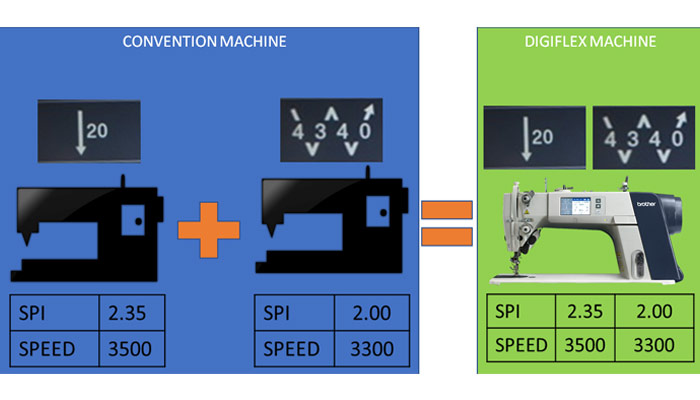
Relevance of Automation & Technology in Indian Garment Factories
 Imported best technology machines and automation models is no longer an option for Indian factories, but a necessity if they are serious to sustain and grow. For Last 5 years it is believed and industry is hoping for the shift of garments orders from China to India; but is this really happening?
Maybe it is too slow too little is happening last 1 year. But overall exports from India are decreasing or stagnant last 3 years. Brother believes it is a great opportunity for Indian garment industry to make the best of this timing to capture maximum orders which can only be possible by making our factories better efficient with best technology machines which can deskill the operations.
It’s been 4 years of introduction of Digiflex Technology machines and its popularity is continuing in satisfying the garment manufacturers in terms of quality and productivity. In the present market situation, every garment manufacturer is looking into reduce the cost of manufacturing and aiming towards better profit, but how that can be possible? Brother Digiflex technology made this with new unique function called Cycle Program, by which one can set two or more different parameter settings and operate the same automatically.
The Digiflex machine can change the parameters automatically in cycle program mode with different SPI, Speed, Stitch pattern enable to use one machine rather than using two machines, resulting in reducing the machine in line thus increase in productivity and reduce in cost of manufacturing.
The most important point to address, in every garment manufacturing industry sewing machine play the most important role in the production of a finished garment and needle breakage is one of the most frequent disruptions in the process of garment making. The small parts of the needle can get trapped in the garment, can go unnoticed during the whole process and may even reach the end customer causing accidents thus factories will follow strictly needle policy.
In the process of following the policy, results in downtime and production loss. To overcome this disruption of needle breakage, Brother has come up with the patented needle breakage prevention function in all brother models enables to reduce the needle breakage and reduce downtime.
 Brother network IoT system is the latest trend that garment industry needs to implement for real time production monitoring and real time action to resolve bottle necks. Brother network IoT system is always upgrading its software according to the customer demand and made the data availability simpler. It has introduced quality monitoring system with 100 defects which enables the quality team to check the defects in detail with parts wise and defect location wise. Every garment sector concern to visualise the production loss data which is difficult to gather, and the available data is limited and cannot be analysed properly to reduce the down time so as to gain the production. But with Brother IoT System made it possible to gather the data from the machine automatically.
Now with Brother IoT system it is possible to get machine operating time/needle time, handling time etc. from this data it helps industrial engineers to analyse the same to bring down the handling time and increase the machine operating/needle time resulting in enhancing the production capacity within the available time.
Garment industry is now focusing on new automation technologies to enhance their firm to in terms of productivity. Brother has stretched its wings to support the garment sectors in automation by partnering with IMB automations The various range of products like pocket setter, button attaching and button hole indexer, button feeder etc. are promising with its product quality to enhance the efficiency of the firm. IMB pocket setter unit which has less jig change over of 2 min and less die changing facitity for different pocket shapes promises to implement with cost effective automation.
 IMB button feeder is the fast-moving product and Brother is recommending the same to all shirt manufacturers to enhance the production capacity by 50 percent and increase more than 4 times sewing efficiency.
IMB sleeve placket unit is now a popular product and customers are appreciating the technology. They are able to reduce 4 manpower for each line making 1,000 pcs per shift by this automation model. It has one work place where both side placket attach is possible with cycle program function and easy to operate.
With the implementation one can achieve higher productivity with consistent quality garment. Lastly, the company is confident if Indian factories implement the latest technology machines and systems, it can compete with Bangladesh factories and increase its orders from all top buyers. Next three years are important to showcase our new efficient factories and enhance India’s total export volume by two-fold at same time increase our profitability. Let’s not compromise in this most productive investment of our factory, which is the machine!!