EFI launches Next-generation Reggiani BOLT Textile Digital Printer
 EFI™ is a global technology company, based in Silicon Valley, and is leading the worldwide transformation from analogue to digital imaging. The company is passionate about fuelling customer success with products that increase competitiveness and boost productivity. To do that, it develops breakthrough technologies for the manufacturing of signage, packaging, textiles, ceramic tiles, and personalised documents, with a wide range of printers, inks, digital front ends, and a comprehensive business and production workflow suite that transforms and streamlines the entire production process.
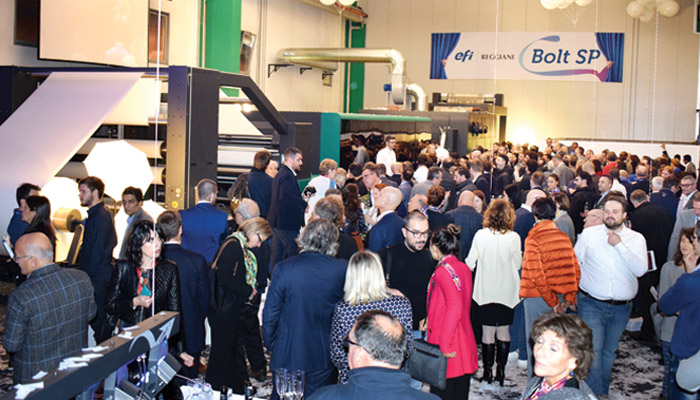
The brand-new, next-generation, single-pass EFI™ Reggiani BOLT textile digital printer from Electronics For Imaging, Inc. was launched recently during an open house event at the EFI Reggiani facility in Bergamo, Italy. The advanced, ultra-high-speed digital single-pass printer has the potential to revolutionise the textile printing market, providing users with high uptime and reliability, outstanding performance, superior printing uniformity and accuracy, long printhead life and minimal maintenance needs. The EFI Reggiani open house created huge interest in global textile market opportunities, with nearly 300 customers and journalists attended to see the new BOLT in action.
“The innovative development of our new single-pass printer comes from Reggiani’s speed of innovation in digital textile printing, its 70 years of history, and our proprietary knowledge of high-volume analogue rotary printing,” said EFI Reggiani Vice President and General Manager Adele Genoni, while speaking to Apparel Views Editor Arvind Kumar during the event. “Our EFI colleagues’ proven, worldwide expertise in single-pass technology and, most importantly, EFI Reggiani’s serious commitment to listening to and addressing our textile customers’ needs, have allowed us to achieve incredible results with our newest print technology. The EFI Reggiani BOLT re-writes the rules of digital textile single-pass printing, delivering superior throughput and quality with a highly competitive return on investment for customers. We are excited to bring this technology to our customers and see their businesses succeed and grow.”
Highlights of the event
The event began with a panel discussion on the future trends in digital textile single pass and about BOLT the next generation textile single pass. This created huge interest in global textile market opportunities, with nearly so many customers and journalists attending the same. During the session, speakers including Ron Gilboa (Group Director Production Technology- InfoTrends), Mark Hanley (President – IT Strategies), Michele Riva, Sales & Marketing Director and others from EFI Reggiani team discussed the benefits & future prospects of next generation Textile Single Pass technologies, and its comparison with analogue printing method. Also discussed was the growing market of digital textile printing worldwide. This was followed by an interactive question and answer session.
Later, a workshop was organised on ‘Terra pigment solution for a green, fast and competitive process’ and ‘The spectacular COLORS your creativity desires’. This was followed by the factory visit wherein EFI customers and journalists were given opportunity to experience the whole EFI Reggiani Digital Product Range in action at EFI Reggiani Demo Centre. Here they witnessed live demo of Reggiani Power Digital Printer for Direct Printing on Fabric and Paper, Reggiani Terra Solution – Digital Printers for Direct Printing on Fabric, Reggiani Colors – Digital Printer for Direct Printing on Fabric etc. to name a few. At the end, new Reggiani BOLT printer in action was unveiled to the industry.
Cutting-edge printhead technology and highperformance ink delivery
The BOLT offers an innovative, low-maintenance, fast-startup recirculation printhead that delivers better, more-uniform printing with superior uptime. Thanks to its cuttingedge printhead concept and high-performance ink delivery system, the BOLT has throughput speeds of up to 90 mtr per minute (more than 8,000 sqmtr per hour) at a 600 x 600 dots per inch (dpi) resolution. It features high-end greyscale imaging in drop sizes from 5 to 30 picolitres, and also provides premium-quality 600 x 4,800 maximum-dpi resolution printing, allowing customers to address the full range of design needs. The printhead has been developed in partnership with a leading printhead manufacturer, and will be available exclusively for EFI Reggiani.
 High-end capabilities, with reduced downtime
The EFI Reggiani BOLT meets growing requirements for high-quality, ecologically sustainable digital textile imaging in apparel, décor and other markets. Paired with an EFI Fiery® digital front end (DFE) print server offering unique, high-speed processing capabilities on demand, the BOLT printer is a robust, industrial platform designed for 24/7 operation and continuous productivity that drives high-volume throughput while reducing the cost per metre. Additional new features and enhancements on the printer include:
Enhanced maintenance features – The printer’s contactless wiping system prolongs printhead life and quality. Plus, the printer comes with an assisted alignment system for its test calibration scan unit, and features extractable printing beams for easier maintenance.
Extended colour gamut and superior image quality – Thanks to EFI expertise in colour management and flexible colour configurations, customers can easily reproduce a wider variety of work, including designs featuring plain colours, geometric patterns, fine lines, deep blacks and smooth gradients.
Proprietary IP combining digital and rotary technologies – One or more analogue printing stations, which may be easily connected as an optional feature, can be integrated into the digital printer for special effects.
Efficient, high-powered EFI Fiery technology
 The Reggiani BOLT is a Fiery Driven™ printer, featuring an EFI Fiery DFE with RIP and colour management technologies running on Fiery XB bladed hardware for maximum performance. Fiery technologies for the printer give textile printing businesses the ability to successfully produce highly challenging jobs with the finest detail, demanding colours, smooth gradients and more. EFI colour scientists developed special algorithms and custom screening for this Fiery system to deliver vivid print results, including high saturation without losing detail, and superior colour even when using the fastest print mode.
Fiery technologies for the new Reggiani BOLT printer also will include a 1-year subscription to EFI Fiery DesignPro, a powerful textile and fashion design suite that runs inside designers’ Adobe® Creative Cloud® applications. Fiery DesignPro reduces the time needed to create colour books, repeats, colourways and prepare files for production to minutes instead of hours. Together, the new Reggiani BOLT single-pass printer and Fiery technologies address key market trends as customers face pressure for faster time-to-market, quick fashion cycles, shorter print runs and more customisation.
 EFI Reggiani high-speed innovation in digital printing for textiles. The BOLT printer is the newest in an important series of EFI Reggiani innovations. In the last 15 months, the team has developed a totally renewed range of digital scanning printers with cutting-edge technologies, launching a new model every quarter to offer customers solutions to whatever their requirements may be for easily scalable textile printing. The list of EFI Reggiani advancements includes two recent launches – the COLOURS digital printer, which provides unparalleled performance with up to 12-colour printing, and the TERRA pigment ink with binder solution featuring inline polymerisation, a process that speeds up customers’ printing with one of the industry’s greenest production technologies.
Some other highlights of the technology are
 Fabric in-and outfeed systems, based on EFI Reggiani’s proprietary knowhow, allow complete flexibility and high performance in fabric management
- Precision conveyor belt enables to reach top speed without compromising on printing accuracy
- Compact printing chamber footprint extractable printing beams ensure easy access to print heads and ink system to the operator
- Plain colours, geometric patterns, fine lines, deep black, smooth gradients…any limit can be overcome thanks to EFI expertise in colour management and flexible colour configuration
- High- efficiency dryer with removable filters based on EFI Reggiani’s expertise. Heavy insulation panels to dramatically reduce heat waste
- Innovative recirculation print head concept, developed with first class print head manufacturer, ensures 3x ink laydown in the same time unit and better printing uniformity.
- High performance and versatile ink delivery system, tailored on print head, overcome printing quality limits, thanks to real time printer start up and minimal maintenance needs
- Contactless wiping system and test calibration scan unit with assisted alignment system make any maintenance operations easier and smoother
- EFI proprietary electronics and software, ensure real time printing and high performance throughout
Jack organises Global Distributor Conference in China

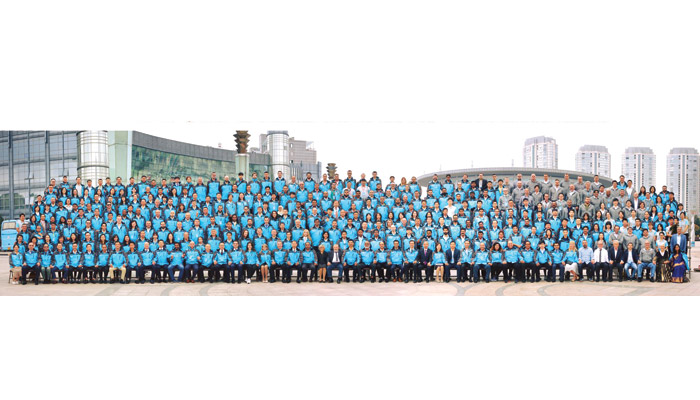
Established in August 2003 in China, Jack Sewing Machine Co. Ltd., started sewing machine business from July 18, 1995. And ever since 2010, the sales amount of Jack is leading in global sales with the absolute advantage of lockstitch, overlock and interlock sewing machine. On October 21st, 2018 the annual Jack Global Distributor Conference was held in Taizhou International Hotel. In the beginning, Ruan Jixiang, the Founder of Jack, delivered a keynote speech on value marketing at the conference. According to him, the strategy of focusing; focusing on small and medium-sized customers, focusing on the lockstitch, overlock and interlock machine, focusing on the development of quality and technology is the way to achieve no. 1 ranking in sales, value marketing, and becoming leading company in the world.
In the new era of intelligence, regardless of the traditional business or the future market, he said that the price war will not only defeat the unbeaten competitors, but also indirectly affect the value of the brand itself, but also bring a vicious circle to the industry. What Jack needs to do is to create value for customers by quality and technology, and let the whole industry move towards benign development. Only by moving towards value marketing can we go closer to Jack’s first brand of global sewing equipment.
Later, at the meeting, he shared the contrast between smart sewing and traditional sewing for the dealers present. For example, the sewing machine A5 with short trimming(no need to cut again), the technology not only solves the difficulty of recruiting labour for the garment processing factory, but also brings high sales volume and high quality reputation to the clothing brand.
The consumer demand for improvement, for quality is increasing, and intelligent sewing products can help Jack in the value war from price war. Jimmy, General Manager of the sewing machine department, brought the industry analysis to overseas distributors, and made in-depth description from the macro trend, market customers, sewing industry and Jack’s own aspects.
In November 2015, the supply-side reform was formally proposed. With the implementation of the national environmental protection tax collection policy, environmental protection and safe production became the threshold of the manufacturing industry in China, including clothing. The elimination of backward production capacity was accelerated.
The continuous deepening of supply-side reform has improved the market concentration degree of the industry. The growing market share of leading enterprises represents new opportunities for Jack. He pointed out that, with a global perspective and an overview of the development trend of international clothing, garment factories need more advanced equipment as consumers purchase more frequently and demand higher quality of clothing. In such a context, Jack is the market leader in terms of user awareness and data in both the brand and the product.
Presently, Jack company’s sales account for a very high share in more than 105 industrial sewing machine factories in China. The sales performance is far ahead, which will accumulate more potential energy for Jack and its dealers. Then, by presenting data comparison of the sales performance of sewing machine enterprises in the first half of 2018, he helped distributors to further understand Jack’s influence in the field of sewing machines in China and even the world, and anticipated the huge potential and development scale of the sewing machine market.
He said that from the acquisition of Germany’s Bullmer in 2009 to the acquisition of Italy’s VI. BE. MAC this year, Jack has entered the stage of multi-brand operation and multi-industry production supply chain coordination. Jack has not only brand, product, capital, but also product, technology, quality, service and personnel. With 9 R&D centers, 1000 R&D teams, and 14 offices in over 130 countries around the world, we provide local services and technical support, provide win-win global co-operation opportunities and realize the aspiration of “co-construction, sharing and win-win.”
Victor, Vice General Manager of international trade department, reported on the theme of innovation channel and value creation. At the conference, he showed Jack’s promising market and business development in the world in 2018, as well as the great success of Jack’s products in all markets around the world. He listed a number of statistics to prove that Jack is covering around the world. The reasons for Jack’s good performance overseas are explained in detail in the aspects of product, service, training and brand:
In terms of training, the training mode of “technicians going out to overseas markets” and “overseas technicians invited to China” are combined, as well as the cooperation made with training schools. The quick service is more and more in-depth for users. After the service training for agents and sub-dealers, the service starts to develop to the terminal and facilitates sales. Many countries have regular service day to train terminal operators and so on.
 Jack’s success in 2018, he said, depends on the strong support and hard work of his family of dealers around the world. Meanwhile, the work priorities of 2019 were elaborated in detail, including increasing investment in brand publicity, product innovation, channel construction, professional training, etc. It aims to face customers with the most valuable products and services, and build core competitive advantages to make dealers successful.
Many overseas distributors have made very infectious sharing for us, telling us how they get acquainted with the sewing machine industry and Jack, as well as their market situation, company situation and successful experience. At the end of the meeting, Vincent, the Vice Chairman of Jack, gave summary for the meeting. He once again emphasized the importance of value marketing. Not only the agent but also dealers have value marketing abilities. Agent also need to help dealers to get this ability of value marketing, stimulate the potential of dealers, and achieve greater victories.
At the same time, he also emphasized the customer-centric aspect; helping customer to success is the most essential part of any business, the reason is very simple, but not everyone really understands, and not everyone can practice it. As a dealer, do you understand the pain points of customers? How do you manage your time and how much time is it spent on your customers? These are questions worth thinking by all the dealers. Finally, he said that Jack is committed to helping dealers grow, helping dealers develop distributors, and better serve their customers to achieve their success.
In order to thank the distributors for their dedication in the past year, the conference honored outstanding teams and individuals who have made outstanding contributions and presented awards. A total of 67 distributor families received different categories of awards.
Jacks lays foundation stone of new manufacturing unit
 Jack focuses on industrial intelligent sewing machine, automatic cutting machine and motor & control box. It is the only intelligent manufacturing complete solution service provider integrated pre-sewing equipment and mid-sewing equipment in the global sewing equipment industry. Jack has more than 5,000 agents and service center in more than 120 countries.
Jack’s overseas acquisition co-operation began in 2009. German Automatic cutting machine Bullmer company enjoys the “Mercedes-Benz” reputation in pre-sewing industry and has more than 80-year history, which became a member of Jack in that year. In July, 2017, Jack acquired Italian MAICA, which is the onlyprofessional manufacturer to produce shirt automatic equipment in the world for more than 40 years. The acquisition of VI.BE.MAC marks Jack’s globalization made another historic progress. VI.BE.MAC with 38-year history is the leader of industry sewing machine for jeans. However, many factors constrain the development of VI.BE.MAC. foreign markets. In the Asian market, especially in the Chinese market it faces challenges from other peers.
 Today, Asia is the main production area of jean clothing. China, Bangladesh, India, Indonesia, Pakistan, Cambodia, Vietnam, Myanmar, etc., are the big countries in jean clothing production. And China is the world’s largest denim clothing production base. The company, who owns the Chinese market, is equal to half the sky in the jean clothing production market. Jack’s co-operation with VI.BE.MAC. will achieve this possibility. Both the companies have same target that not only provides products but also offer the solution to meet customers’ need. After the acquisition of VI.BE.MAC., Jack will give full play to advantages in supply chain, production, technology, channels etc.
The acquisition of VI.BE.MAC marks Jack’s globalization made another historic progress. Taking this further, Jack Sewing Machine recently laid foundation stone of its high-end intelligent sewing equipment manufacturing unit in Juhai Avenu, Taizhou, China. The ceremony was led by Heye, Director, China Sewing Machinery Association (CSMA) along with the Chairman of Jack Group and Mayor of Taizhou city, in the presence of some of the Government officials from the region.
The land, covering around 7.6 lakh sq mtr area, was recently allotted to Jack by the Taizhou Government. Apart from the manufacturing base, it will also witness the start-up activities of the provincial and municipal major projects related to the sewing industry. The manufacturing base will take about 3 years to get completed and after the completion of the project, it will have an annual production capacity of 2 mn sets of intelligent sewing machines and 1,00,000 sets of intelligent special sewing machines.
The high-end intelligent sewing equipment manufacturing base is an important measure for the company to expand and upgrade to become a complete service provider of intelligent equipment. As per the company, manufacturing will be completely robotic right from loading, unloading to assembly of parts of sewing machines.
According to Jixiang Ruan, Jack Stock, founder, “We share with VI.BE.MAC.’s philosophy and values and are grateful to the mutual knowledge in these years. After the acquisition – due to the added value that Jack can bring in terms of supply, production and distribution in China and in the world, with its more than 5,000 sales and service channels in more than 120 countries – we will share with VI.BE.MAC. an even wider market. Moreover, thanks to the brand, the experience and the technological know-how of the VI.BE.MAC. Units, we will enrich the automation of our products with the aim of quickly entering the market for the denim clothing automation, establishing a position of leadership in this area.”
The new manufacturing base will be helpful to reduce the cost of manufacturing of MAICA and VI.BE.MAC. Also, Jack will be producing its future high-end ‘A’ series lockstitch machines in this facility.
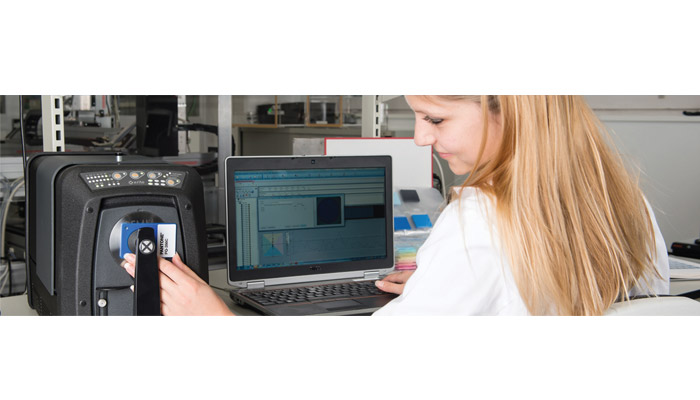
Industry-leading technology behind Ci7x00 Family of Spectrophotometers

The Ci7x00 is the flagship family of bench top spectrophotometers in X-Rite’s broad portfolio of colour solutions. Offering the highest level of both accuracy and consistency in measurement, the Ci7x00 family has set a new standard for colour control across formulation, production and quality assurance. This technical paper provides detailed insight into the technology powering these revolutionary products.
A Legacy of Innovation
The technology powering Ci7x00 instruments is the product of decades of innovation in colour measurement. X-Rite’s CE7000 benchtop spectrophotometer, launched in 1989, used a photodiode array for measuring colour. When the CE7000 was introduced, the photo diode array offered the best design and performance options available for measuring light and processing colour.
In the 1990s, X-Rite started to investigate the use of two-dimensional charge-coupled device (2D CCD) arrays as light detectors in instruments. These types of imagers provided low noise and excellent linearity and opened the door to the design of a multi-channel benchtop spectrophotometer— the Color i7. This pioneering product achieved a new level of performance, and provided simultaneous measurement of specular included (SCI) and specular excluded (SCE), along with the reference channel, to enable tightly coupled real-time correction of illumination uniformity.
X-Rite’s legacy of innovation continued in 2015 with the introduction of the Ci7x00 family. These instruments combine the latest advances in 2D CCD array technology with sophisticated processing capabilities to deliver the industry’s most accurate and repeatable colour measurement yet.
The powerful array that makes it possible
At the heart of a Ci7x00 instrument is a highresolution spectrometer that couples an aberration-corrected diffraction grating with a highquality 2D CCD that is suitable for scientific instrumentation. The all-reflective design provides exceptional control over stray light, resulting in minimal spectral and spatial cross-talk in the CCD detector. This enables remarkable measurement purity, which leads to excellent dark and light repeatability and colour accuracy.
The Ci7x00 family’s 2D CCD array allows simultaneous, full spectral imaging of multiple measurement channels: Reference channel, SCI, and SCE. Since all measurement channels are imaged simultaneously with the reference channel on the 2D CCD array, any changes to the instrument’s light source or drift in wavelength can be detected in realtime and corrected in all measurement channels. Additionally, with the measurement channels being imaged together on the same physical 2D CCD array, the correction of errors from electrical noise and drift is greatly simplified.
In the instruments, each channel is connected by glass optical fibres to the input slit on the spectrometer. The spectrometer maps the spectral dispersion of each channel in one direction on the CCD, with the spatial dispersion mapped in a perpendicular direction to create a 2-dimensional reading. In the spectral direction, a wavelength sampling interval of just over 1nm/pixel spreads the spectrum across hundreds of CCD pixels, and produces a calibrated output range of 360 to 780nm—the most expansive wavelength range on the market.
State-of-the-art data processing and correction
In addition to its advanced 2D CCD array, the Ci7x00 instruments use multiple data processing techniques to achieve accuracy and precision. Wavelength bands are over-sampled both spatially and spectrally to provide more than 750 CCD pixel samples per wavelength per flash. Each measurement is executed through multiple flashes, which creates a “super pixel” with an effective dynamic range that exceeds that of a typical photodiode array. This results in a 20x improvement of resolution and signal-to-noise when compared to common one-dimensional technologies.
Signal-to-noise is also effectively managed through over-sampling. A dark blue repeatability test best demonstrates the Ci7x00’s advances in this area. The Ci7x00 series outperforms other manufacturers as well as our own previous benchtop spectrophotometers on this test. The system also incorporates colour balance filters to flatten the input light at the detector so that dynamic range is carefully managed in order to optimize signal-to-noise in the CCD. This provides low noise at all wavelengths, and clean signal detection without saturation, leakage, or crosstalk between pixels. The Ci7x00 series also implements a continuous wavelength calibration in real-time that is used to re-align the spectrum with the factory reference spectrum using no moving parts. Along with other corrections, it is this innovative whole-system design approach that allows the leading Ci7x00 device, the Ci7860, to deliver industry-leading repeatability of <0.01 E and inter-instrument agreement as tight as =0.06 E.
Finally, measurement accuracy can be affected by the amount of optical power being instantaneously delivered to a sample by the illumination system, especially while measuring certain fluorescent materials. Photodiode array-based spectrophotometers typically take a measurement with a single high-powered flash. Measurement differences caused by this over-powered illumination can temporarily alter some samples, resulting in colour measurement errors up to 1 E. X-Rite’s Ci7x00 spectrophotometers use multiple lower-power flashes during a colour measurement to help minimize and control this error. These are light conditions that more closely match the way the human eye sees these special samples.
Streamline your workflow
Establishing and achieving the strictest colour standards requires accuracy and precision at each stage of the product development process, from formulation to final production to quality control.The Ci7x00 series solution offers the unique ability to maintain an audit trail, ensuring data traceability and integrity of standards throughout production. In the event that a product falls outside of a specified tolerance, this traceability allows for quick identification of the sources of error. Users can easily review measurement and process variables, including temperature humidity, and even a picture of the sample being measured, during each step of the production.
The Ci7x00 family’s advanced technology for accurate capture and data processing also allows operators to achieve a new level of efficiency in controlling colour. Simultaneous SCI and SCE data capture eliminates the need for multiple measurements as well as the effort and potential error associated with adjusting the instrument’s mechanical set-up between measurements. This is particularly valuable for the measurement of samples exhibiting gloss and texture. The ability to combine measurements of reflection and transmission also allows colour experts to gather accurate data for colour and translucency in a single operation.
The Ci7x00 family offers users additional measurement flexibility with optional UV wavelength cut-off filters, four transmission apertures (25 mm to 6mm) with active laser targeting, and up to five reflectance apertures (25 mm to 3.5 mm).The 2D CCD arrays used in the Ci7x00 family have enabled the design of industry leading instrumentation with unmatched accuracy, repeatability, and inter-instrument agreement. Customer workflow is simplified with simultaneous measurements of SCI and SCE, and operators will be able to meet their customer colour requirements with less rework and wasted material. This makes the Ci7x00 an unparalleled tool for a wide range of industries.

Is there a future for pigment inks in textiles?
 Since the mid-90s, research on digital textile printing has become more and more important. This application field offers the possibility of printing photographic-quality images with quick design time. A great advantage, especially for the fashion industry, is the ability to print-on-demand in small quantities down to a lot size of one. According to an analysis by the WTiN Intelligence: Digital Textiles, the worldwide output of digitally printed textiles is growing at an annual rate of approximately 20 per cent. Despite this rapid growth, the proportion of textile production that uses digital printing is only about 3-5 per cent up to now. One difficult criterion for effective industrial digital printing on textiles is the various number of different textile substrates ranging from natural such as cotton, wool or silk to synthetic materials like polyester and blended fabrics. All these fabric types require different types of inks and additional different needs for pre and post-treatment as well as processing. The ink types mainly used in industrial applications are reactive inks for natural fibres and sublimation/disperse inks for digital printing on polyester.
However, the ideal would be to have an ink suitable for all kinds of textile substrates. This request is to be fulfilled by the use of pigment inks. In this article, Zschimmer & Schwarz will describe the role of pigment inks for digital textile printing – do they have a real chance in the future or is it just a hype?
Pigment inks: Characteristics, application, and market
Rather than a dye that is soluble, water-based pigment inks use an insoluble pigment to provide coloration of the textile. Compared to dyes, the pigments do not have a real affinity for special fibres, which makes them suitable for colouring on the top layer of a various number of fibres as well as blends.
However, the global textile printing market (Fig.1) shows that pigment inks represent only about 3 per cent of inks used in digital textile printing. Inks most commonly used are still based on reactive, disperse and acid dyes. There are different reasons for the currentlow market share of pigment of pigment inks in digital textile printing. As previously mentioned, due to the top layer of printing by using a binder for better substrate adhesion, most pigment inks are limited when it comes to multiple-wash as well as rubfastness. Furthermore, the feel of the fabric is often stiffer than in reactive printing which is one of the main problems, especially in fashion or bed linen for example.
On the other hand, the use of pigment inks shows some remarkable benefits (Tab. 1). With the suitability of printing on a various number of textile substrates a broad field of application can be served, ranging from home textiles, soft signage and banners to fashion (mainly T-shirts) or speciality products. Pigments are especially beneficial in areas where high light-fastness is required. Furthermore, the entire process, compared to reactive prints, is very quick and easy.
 Pigment versus reactive printing

As mentioned above, one benefit of using pigment inks in digital textile printing is the ease and length of the process. Fig. 2 schematically shows the process of printing with pigment inks compared to reactive inks. Due to their chemical characteristics, reactive dyes have to be bonded to the textile fibre after printing. Therefore, a steaming process of 8-12 minutes at 102°C (saturated steam) is necessary. Subsequently, the unbound dye has to be removed in a complex washing process (after treatment) at different temperatures ranging from about 50°C to 98°C, with soaping agent to 60°C, and finally 30°C (slightly acid). Then the printed textile has to be dried.
 In comparison, the pigment printing process does not need the complex steaming and washing steps. Since the pigment dye is printed only on the top layer of the fabric without any chemical bonding, the textile fabric has to be condensed at 150-170°C for a few minutes to fix the pigments. Consequently, the pigment printing process requires significantly less water due to the omitted washing step. This may be a crucial deciding factor when deciding on whether to use digital pigment printing in the future.
 Nevertheless, an additional point has to be mentioned regarding the printing process with pigment inks. Due to the insolubility of the pigment particles, the sedimentation of them could result in problems of nozzle clogging in the fine nozzles of inkjet printing machines.Therefore, to overcome this, two things should be noted: Firstly, all the inks have to be well stirred before using and secondly, the necessity of a print head with a circulating system becomes more and more important. The circulation provides a kind of continuous flow that avoids sedimentation and thus clogging the nozzles. In particular, the white pigment inks mostly based on the inorganic compound titanium dioxide need those circulating systems.
Inks exhibit a reliable printing performance, an easy handling, and cleaning, an outstanding light-fastness and can be processed according to the easy process described earlier. Furthermore, due to their chemical characteristics, it is possible to achieve very good rub-fastness values with these inks (Fig. 3, exemplified for cotton raw material). The dry rub-fastness values are in a range of 4-5 and the wet rub-fastness in a range of 3-4.
 Additionally, investigations looking into multiple-wash have been done for cotton raw material by washing the printed and fixed textiles at 60°C for several times up to 25 times. Figures 4 and 5 illustrate the outstanding performance of Diamontex P HQ inks in case of multiple-wash. Any significant changes in the colour yield of the print could not be observed after up to 20 times of washing at 60°C. The average luminance is nearly stable in all basic colours. This colour stability is the basis for coloured printed motifs over several washes which can be seen in Figure 5.
Outlook
 Pigment inks have the potential to have a big future in digital textile printing, especially when it comes to environmental aspects and process simplification.As well as being used on commonly used textile materials such as cotton, polyester, and polyamide, pigmented inks can also be used to easily print on mixed fabrics such as cotton-polyester blends where two different ink types are usually necessary. Moreover, the usage of Diamontex pigment inks opens up the possibility to print on specialised materials. Some tests have already been done on textile substrates that are usually difficult or almost impossible to digitally print on and these tests have had promising results.
Finally, pigment inks for digital textile printing have a great chance to prevail in the market for special material applications but also for the commonly used textile fibres when needing to save energy and water consumption.
By Andreas Schönfeld, Dr. Julia Ahrens, Dr. Nora
Wetzold, Peter Oehme, Oliver Richter from
Zschimmer & Schwarz digital printing team
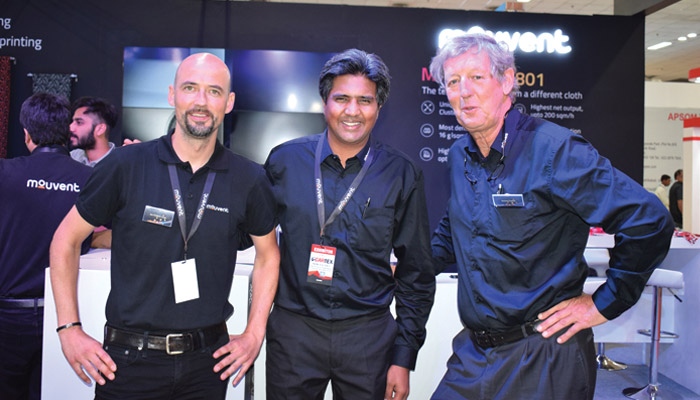
Mouvent eyes to revolutionize India market with its digital textile innovations
 Mouvent is a Swiss start-up company focused exclusively on delivering the future of digital printing using pioneering digital technology. Mouvent offers a fully integrated solution, developing, engineering, testing and industrializing digital printers based on the Mouvent™ Cluster Technology, a highly integrated cluster design arranged in a modular, scalable matrix. The company develops the controlling software, the inks and coatings, and provides a full service range.
For India, Mouvent identified Fortuna Colours & Prints LLP as key distributor for its digital textile printing solutions. Vinod Krishnamurthy, one of the co-founders of the company, started digital printing on textiles in 1998. The company launched Mimaki, Reggiani, Hong Hua, Kornit, Huntsman and almost a dozen brands, ranging from ink over software to machines.
“We were the first to set-up a center for textile printing, servicing the industry as nobody wanted to buy a 100,000 euro machine with 500 euro inks,” Krishnamurthy explains. “We printed for top designers in the country and we partnered with manufacturers before. But when we enter into a partnership, we want to share the responsibility for the service, support and ownership of the technology as we are not interested in box moving. This is one of the reasons why we jumped at the opportunity to organise sales and support for Mouvent in India.”
Mouvent has high expectations of the partnership. Ghislain Segard, Global Marketing and Sales Manager for textile machines at Mouvent, said, “We picked out India as one of our four key markets for the rich and long history of their textile industries. It is here, where innovations in textile printing are appreciated for their intrinsic worth, and we expect the Mouvent™ Cluster technology at the heart of our textile printing solutions such as the TX801 to catch on very quickly.”
The company recently participated in Gartex 2018, which took place from August 18-20 in New Delhi, India, where it showed for the first time in India their revolutionary digital inkjet textile printer TX801. Just as with similar high-profile tradeshows in China and Turkey, Mouvent’s innovative TX801 digital textile inkjet printer made heads turn at Gartex. The ultracompact TX801 prints with up to eight colours and, although it is a scanning type machine, can complete up to 50 per cent of the print jobs in a single pass, delivering top-of-the-bill productivity of 200 sq mtr/ hr without compromising on quality.
The reason why the TX801 drew so much attention is its use of the revolutionary MouventTM Cluster Technology which uses clusters instead of fixed size print bars by colour, arranged in a modular, scalable matrix. This results in one system that can be simply adapted to all substrates of all widths, for all markets. Its print quality is extremely high with an optical resolution of up to 2,000 dpi. The machine can process knitted, woven and non-woven textiles with a maximum fabric width of 1,820 mm with roll diameters of up to 400 mm.
“The TX801 showed how innovation guided by the needs of the market results in a pioneering product that delivers what that market has been waiting for,” said Segard. “The industry experts who saw the machine were delighted with its extremely high print quality that remains constant even at very high production speeds, as well as its precision and scalability. And we are very happy that companies will be able to immediately profit from the competitive advantage the TX801 is bound to deliver through our strategic partnership with Fortuna Colours & Prints LLP.”
“We are very happy that we can help Mouvent bring the TX801 to customers in India. The Indian textile market is extremely varied, interesting and rapidly changing, and the TX801 perfectly responds to the need for a very high quality, productive digital textile printer,” Krishnamurthy said. “It came as no surprise to us that the presentation of the machine was met with such enthusiasm. After all, the Indian textile production market consists of companies producing exclusive high-quality textiles as well as huge-scale mass-produced products. The solutions Mouvent can offer are very well-suited to this market.”
When asked if the company has set any target for India market, Vinod said, “We are not company driven with targets, and believe customers are our partner, so our aim is to get the right customer with a mind set to adopt our technologies. We want the technology to be understood, adapted and inspiring you to publicize to the Indian environment. So, currently we are not looking at no. but good establishment. We already have started to set up a showroom in India, and are still waiting for some other operations which need to be established so the customers can come and see the fabric getting printed through performance of the Mouvent printers.”
Talking about the sales and services they’ll be providing Vinod said, “So, we have a Mouvent service center based in Gurgaon which is dedicated to live demo and services. Here a client can come to do tests, understand the technology, so we are providing total solution. That’s one part. Secondly, all our engineers are well trained and continue to report and discuss with the Swiss service team. It’s like a Swiss support center where all the persons are being guided, supported and trained. We at Fortuna are there to manage the sales network. Service is a key part and it is something which keeps our technology up.”
Speaking about how Mouvent technology is different from others Ghislain Segard explained, “We don’t just sell any product but a new way to print with our technology, which has huge benefits. Our TX801 is an eight-colour multi-pass digital textile printer producing highest print quality on textiles with up to 2,000 DPI optical resolution at high printing speeds. We are able to print 200 sq mtr but our target is to provide an industrial single pass engine. Today, Mouvent is a new technology governed by a new market and we don’t want to sell it all over the world but to few selected countries. We have chosen few countries including Italy, Turkey, China and India, and before arriving to any country we make sure to have complete technical support and spare parts availability.”
Commenting on the digital printing market in India he said, “India being a textile hub, printing is very much needed. There has been a phase from certain speed of 20 sq mtr to speed of 200 sq mtr and more. Now, the speeds are going to jump more. More people will look into doing large projects, they need full support and I think the market is going to be very positive but how well the companies are going to adapt is going to be the challenge.”
“Confidence in the technology is the key driver. The company that gives the key technology buyer must have confidence that they are able to run that technology. That’s what the key is. That’s what our vision is. India will adapt digital in every segment like home textiles, fashion, label so digital is something you can’t ignore. Everybody will adapt it,” said Vinod.
Speaking about the response from the India market he said, “We are using a special head, and the technology built around a head gives us very good quality. Quality is very surprising for a lot of people who visited our stall. Those with printing experience will understand that it has excellent saturation of colours, which is a huge challenge when you want the rotary to shift into digital and that’s a very key point for us. So, I think people understand and when you see it’s a new technology and we are not expecting every second person to buy. There will be key players, key companies who will adapt to this technology and make a success story with us. Then eventually many will follow. But as far as product is concerned everybody is excited as they have never seen a technology like this.”
“Digital will be ahead in every market. Mouvent has already shown a new technology in Labelexpo, and Mouvent is going to come up in textiles, and packaging so you’ll find us in various segments. Mouvent will continue to develop a vast product portfolio for the different printing markets and roll out its products worldwide,” said Segard.
When asked about the future market prospects Vinod said, “I believe by 2025, there’s a good chance of 30 per cent jump which is huge by number in digital textile printing market share in India. As far as my company is concerned, I expect good percentage growth in next few years”
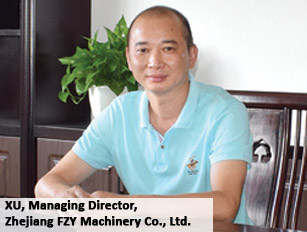
Zhejiang FZY Machinery foresees to become World’s No.1 rhinestone machines manufacturer

Zhejiang FZY Machinery Co.,Ltd is one of professional ultrasonic rhinestone hotfix machine manufacturer in the world. Established in 2007, and located at Xiaoshan District, Zhejiang Province, China, the company is involved in rhinestone hot-fix research and development, manufacturing and sales.
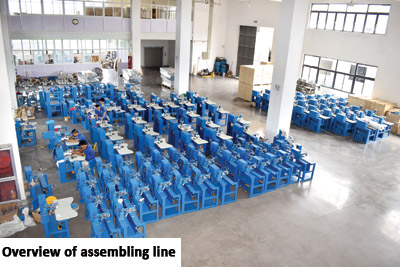
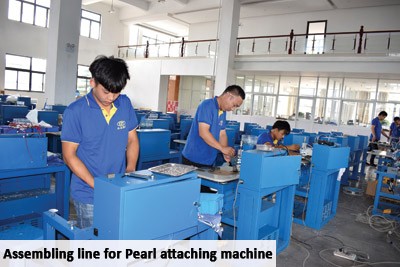
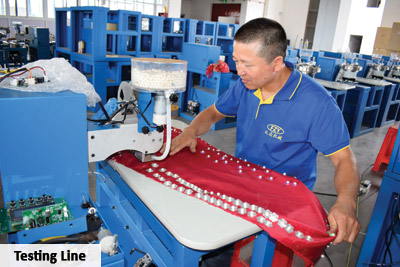
The company recently shifted to a bigger 7000 sq mtr factory where it employs around 30 people and has increased its production capacity by many fold.“Our machines are highly appraised by our customers for its low energy consumption, high efficiency, easy operation, high stability and high performance-price ratio. Various technical indexes give us a leading position compared with same industrial products. Our brand FZY is well known in the industry for being a complete rhinestone solution provider and now at this new plant we can make 6,000 machines per year in all different varieties including 16 different machinery models like rhinestone machine, pearl fixing machine and our new paperless rhinestone transfer machines etc.,” said Allen, Sales Head, Zhejiang FZY Machinery Co., Ltd while speaking exclusively to Apparel Views Editor Arvind Kumar, during his recent visit to China.
The company has recently launched a revolutionary Roll to roll technology of printing rhinestone without any film or paper, directly on the fabric. Speaking about the technology he said, “The machine saves a lot of labour, time and cost as it doesn’t require prior paper usage as the rhinestones are directly printed on the fabric. This machine is ideal for roll-to-roll fabrics and sarees, which require faster bulk production. It comes with two units, wherein the first unit puts the rhinestones on the fabric, and the second unit does fusing to fix the rhinestone permanently on it. So, ultimately, the new technology eliminates the one complete step in this procedure, which earlier used to require fixing the rhinestone on film and then transferring it on the fabric.”
Some of the benefits of the technology are: Ideal for roll-to-roll fabrics and sarees, transfer paper notrequired, save paper cost, fully automatic features, economical production, high production in less time (3,000-5,000 mtr/10 hrs.), low investment, low maintenance cost, less labour required, less space required, less power consumption. Other specifications of this technology include: Working power supply: AC220V 50 / 60Hz, Working Pressure: 0.5 MPa, Working width: 1450 mm, Max Fabric width: 1600 mm, Power consumption: 600W, Speed: 0-12M/min, Size of stone: SS10-SS20, Colour: Single, Overall Dimension: 1100 mm x 2000 mm x 1400 mm, Weight: 350kg.
“ Very soon we are also going to launch Rhinestone Hotfix machine without air compressor. It’s a revolution for rhinestone, as for last 15 years single head rhinestone machines always needed air but this machine doesn’t require air. Its installation is also very easy. Even a person sitting at home can take order and start doing production. We have been working on it for last two years and finally it’s done. We’ve been doing some production testing in local market here and by October we will be ready with this machine,” he said.
While commenting on the market scenario in its major markets Allen said, “For last two-three months China market is not doing well,and everybody will be placing their new machines’ orders after Chinese New Year only, so things are expected to improve after that. Garment and textile is a traditional industry, and if you come out with something new, then there’s always a demand. In future our total sales will increase in both domestic and export markets.”
“Today our main overseas markets are India and Africa. For last one year Africa market is picking up except Egypt which is facing a lot of problems these days. India is going to be very important market for us in coming future. Especially West, North and South India markets are very good for us. In Western India Surat has very much potential because of huge production of sarees and dress materials. Demand for automatic rhinestone machines is increasing in this market because after rhinestone work sarees’ overall presentation improves with better look and shine at the same time adding value,” he said.
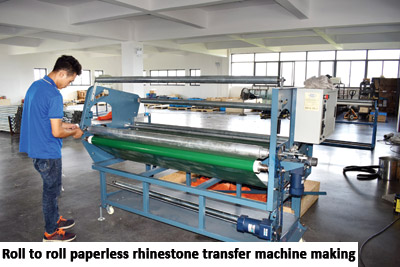
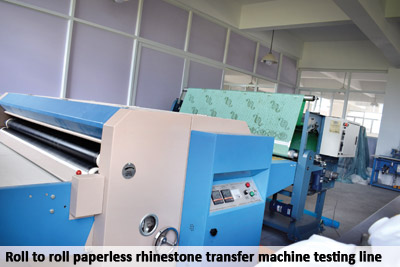
Adding to this Allen said, “Surat market is very similar to keqiao textile market in China, customers’ needs are similar in both these markets. We have sent 10 paperless roll to roll rhinestone printing machines to Surat for customers to do sampling and all of them have expressed their satisfaction over its performance as it gives very good production and saves a lot of money. They were very happy to see this machine and we have even started getting orders for which dispatching will be start by the end of this month.”
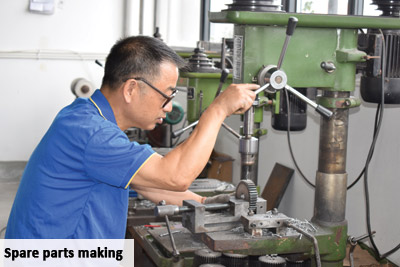
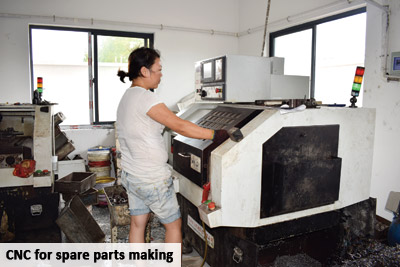
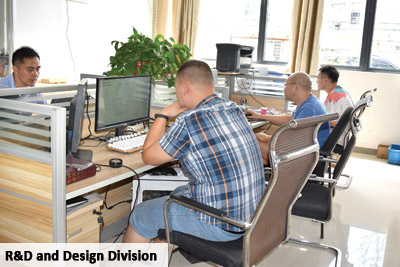
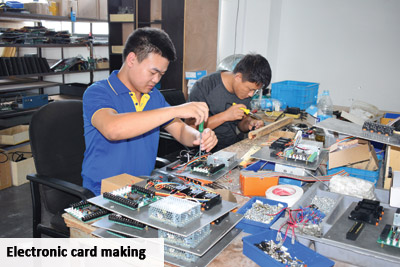
When asked about the quality control and after-sales-service of the machines in India he said, “Our machines quality is better than others available in the market. We have very good software engineers’ team, mechanical engineer team, research team which altogether make us best. Every year we spend more than 30 per cent investment in researching department. We strictly control the quality as all our newly launched machines are firstly tested in domestic market and then only sold in international markets. With business conceptions of quality, technology, service, we are doing better than our competitors in this segment. In our machines 60 per cent spare parts are made in house by us. Other standard spare parts are from Germany and Taiwan. We guarantee quality of our spare parts and especially ensure quality of critical parts.”
“In India, our agents and our own staff are taking care of machines after sales service.All electric parts can be repaired in Surat and have provided enough spare parts stock to our agents.We send our engineers three-four times a year in India for updating and changes in the machines. India market is very big with huge potential. But the labour force there is not very skilled. So,we make fully automatic machines at very low cost, which is a better option for them,” he said.
“When I see India, in factories some workers are very skilled. Embroidery work is very old so you have a lot of skilled people in this segment. But they too need little bit of training, to operate the machines. Due to scarcity of skilled labour force, in future automatic machines will be more in demand in India. These machines are not too costly and one can get return on investment in less than four months. With same workers and salaries one can increase its production,” said Allen.
Commenting on his future plans Allen said, “Today we manufacture 16 different machines at this new factory, and are planning to introduce 2-3 new models soon, which further will be increased to 20-25 models in next three years. Within half decade we foresee to become no. one in the world for rhinestone solutions. Rhinestone industry is not only limited to garments, it has jewellery, wallpaper and other segments also so we want to be at top in all these segments and make our production line wider.”
When asked about the current market scenario in India he said, “Dollar price increase has affected our machinery price for customers in India especially the domestic one as machine becomes expensive for them. India is one of our biggest markets today and in future we will mainly be focusing on the same. Especially targeting at the Surat market, we have certain concepts/changes for our machines keeping markets requirements in mind. As India is a very important for us so we are looking at spreading our business in all parts of the country including Mumbai, Delhi, Tirupur, Kolkata etc.”
FZY’s wide range of machines include LED Single disc rhinestone, LED Double disc rhinestone hotfix machine, LCD Single Disc Rhinestone Hotfix machine, LCD Display Disc Rhinestone Hotfix machine, Automatic lace rhinestone hotfix machine, Computerized rhinestone hotfix machine, Rhinestone Device, 6 colours rhinestone hotfix device, automatic roller rhinestone machine, semi-auto rhinestone transfer paper machine, Semi-auto double layer rhinestone transfer machine, Automatic rhinestone transfer paper machine, Automatic rhinestone heat fix machine, Nail stone modify machine, shape stone modify machine, Multi-function ultrasonic hot fix machine. Its rhinestone hot fix machine is suitable for various fabric such as velvet, polyester, silk, lace, jean, leather, etc.