INDUPRESS presents finishing and fusing equipments

NDUPRESS® stands for more than 40 years of tradition and experience in the field of complete equipment of garment factories worldwide. Its family business is your renowned partner for the production and processing of clothing.
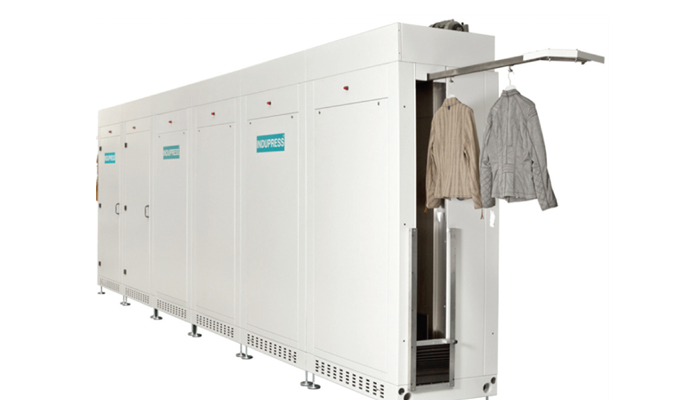
IPN-TF-24 / Tunnel finisher
The INDUPRESS® high performance finishing device is constructed in modular version and can be assembled and operated in optimum way for different performance requirements and therefore offers an universal field of application for all garments like blouses, skirts, dresses, coats, trousers, anoraks, clothing for children, T-shirts, sweatshirts, sportswear, pad clothing, thermo jackets and so on.
In the steam modules the garments absorb enough steam to achieve good results even at high speeds. Also at garments made out of natural fibre. The fabrics (fibres) get softened with a measured and well directed amount of steam. In the next step the fabrics will be treated from top to bottom with air, fluid flow speed and temperature. All parameter can be adjusted individually and steplessly. A good finishing result can be achieved by a well balanced programming and exact dosage of the influential finishing parameter for different materials. All finishing parameter (temperature, steam quantity, steam quality) can be adjusted individually per chamber. Very energy saving because of automatic switching to Standby operation, if no garments will be feeded as well as perfect, high-class, mineral fully insulation.

IPN-HD-23-15B / sleeve finishing (Setting and finishing of sleeves)
Special pressing machine for setting and finishing of sleeves on men’s jackets with patented, pneumatic variable body for small and big sizes, adjustable to three size ranges (e.g. 46-50, 52-56, 58-64 and bigger) as well as three changeable sets of setting stamps for this three size ranges in addition one set of setting stamps for extremely small sizes and armholes.
Also the shoulder obliquity of the jacket body is variable, easy mechanical, adjustable in order to hang up the jacket perfect fitting to the model and order to justify the balance. The upper sleeve finisher which is mounted on the top of the machine frame can pass completely around the sleeve in three axes as well as rotary motion and so completely finish the sleeve. These movements can be programmed variable. A very flexible, to all directions adjustable side part holder supports the exact positioning of the jacket. Because of the back part holder with pneumatic positioning you will get a flat back at the armhole.

IPN-VHD-23-14B / shoulder pads (Fusing in of shoulder pads and form-pressing of shoulder)
Special pressing machine for fusing in of shoulder pads and form-pressing of shoulder. Because of accurately fitting pressing shapes the shoulder padswill be pressed perfectly and the shoulder will be perfectly in form. You can process different heights of shoulder pads through electropneumaticdjustment of the lower shapes (9 steps each 2mm, to be selected on the Touchscreen).
Battistella semi-professional and industrial ironing equipments

Battistella B.G. S.r.l. designs and sells semiprofessional and industrial ironing equipment. More than 40 years of experience have enabled the company to become a top player and spread its brand worldwide. Every machine is assembled with Italian components as “Made in Italy ” is a fundamental feature for the company, together with minimum consumptions and maximum performances. The wide range includes more than 100 models such as ironing boards, steam generators, spotting tables, dummies, toppers, presses and packing machines.
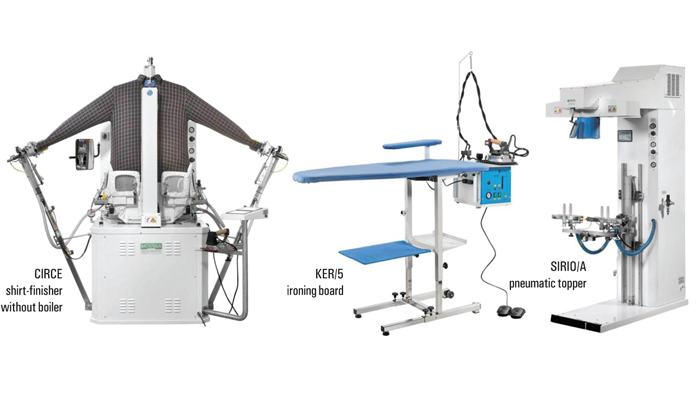
CIRCE shirt-finisher without boiler
Pneumatically operated shirt-finisher without boiler, to be connected to a steam source (min. steam 20kg/ h at 5 bar) and to compressed air (min. 7 Bar constantly). Fitted with 3hp blowing unit and 0,75hp vacuum unit for shirt positioning. Equipped with electronic programmer, dry iron for touch-ups, rotating arms and clamps, telescopic front paddle, rear paddle with photocell, pneumatic collar blocking/lateral tensioners, hot air battery. Suitable for the ironing of long and short-sleeved shirts.
Heated, vacuum and blowing foldable ironing board (120×45 cm) adjustable in height from 85 to 105cm (with spring), equipped with 3.4L stainless steel boiler, EOS iron, double safety valve, thermostat in case of damage, pilot lamp for water and discharge tap SIRIO/A pneumatic topper.
SIRIO/A pneumatic topper
Pneumatic topper with 10 lt. built-in boiler and pump, suitable for the ironing of washed out and casual trousers. Fitted with crosswise stretching evice and electronic/pneumatic size regulator with sensors, electronic programmer with display, steam atomizer. Also supplied with adjustable neumatic cylinders, leg-stretcher clamps with photocell, manual adjustment of air flow and 1,75Hp entilator- and internal and external tensioning of the 2 clamps.
Barudan computerised embroidery machine

Barudan Co., Ltd. is the manufacturer of Japan made computerised embroidery machine in Japan. Since 1959, Barudan has been producing the best built, most reliable embroidery machines in the world and proudly produced in Japan. It has exported embroidery machines to over 100 countries throughout the world with the corporation of Barudan Global Network.
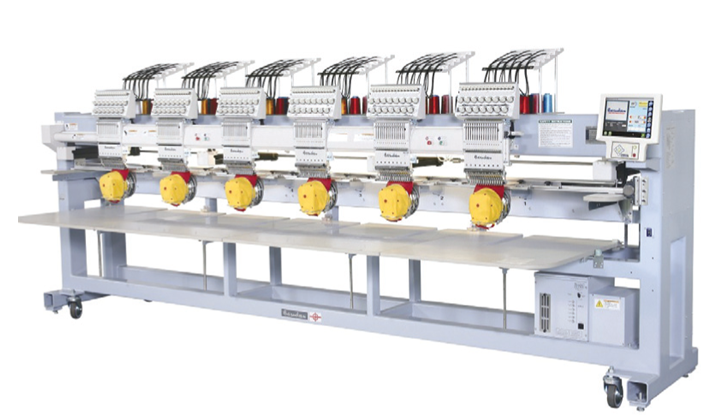
Compact embroidery machines
Introducing new BEKY-CII Series. Barudan’s newest 2 through 8 head machines now have:
- New SH embroidery head (Smart Head technology) for higher performance and increased durability
- Servo motors for increased production and more power
- New K automat
Barudan’s new K Series multi-head machines were introduced in September of 2016. The new K automat features 10.4″ Colour Touch Screen, higher resolution and a 100 design, 70 mn stitch memory. User-friendly icons and an intuitive main screen provide quicker access to functions and features. It is available on all new Barudan multi-head machines. LAN and COM connectors are standard for Barudan networking along with 2 USB ports for devices such as barcode scanner, keyboard, mouse, hub and card reader.

Triple combination embroidery machines
Barudan offers multi-head speciality combination machines with various specifications and field sizes for chenille/embroidery, chenille/sequin, lockstitch zigzag and chenille/embroidery/sequin.
Big field embroidery machines
Introducing BEXS Series.
- Biggest embroidery field size in the world
- High speed
- High production
AVM Solutions’ ERP and integrated management systems

The AVM Solutions GmbH is part of the Human Solutions Group. The Human Solutions Group has 200 employees. Its products are sold worldwide, either directly by the Group or through partners in 50 countries.
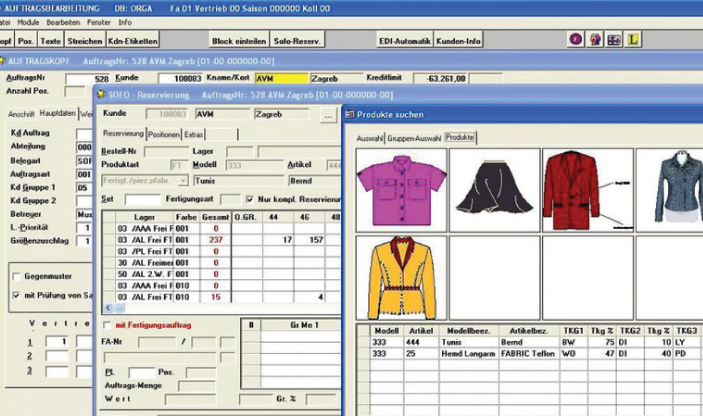
ERP BOS – A guide from the point of sale to shipping
Apparel production is highly dynamic. ERP BOS completely maps the business processes, business structures and plans of apparel companies. And if required, the system adapts itself to market requirements – without expensive modifications.

SAM – ERP all the way to the point of sale
With SAM, apparel companies can perform on-site consulting and planning more efficiently. All the information about customers, products and all orderrelated data are available interactively in realtime. Field sales representatives, for example, can then create offers on-site – and request delivery dates and have them authorised by the office.
Lago – Quality and cost optimization in manufacturing
Lago by AVM ensures optimal quality for apparel manufacturers — and still saves cutting costs. Lago determines the optimal ratio between the actual material and labour costs in the cutting each collection piece.
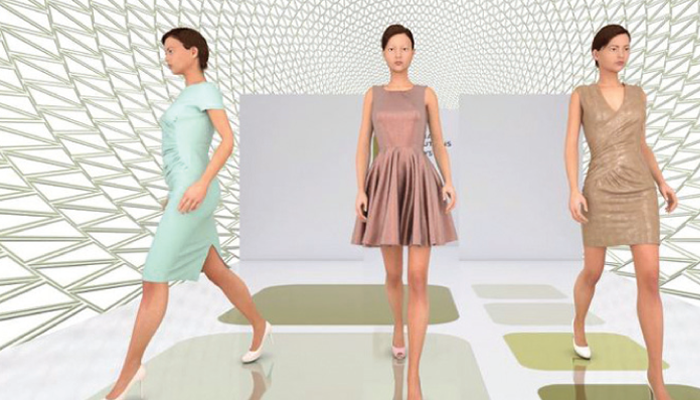
Assyst solutions for efficient collection development in world of fashion

Successful products are customer-oriented and market-driven and the way to get there must be made increasingly faster and more cost-efficient. In intensive development sectors like Fashion and Mobility, this can only be achieved through the right product and size & fit information. Assyst GmbH Integrated 3D, CAD and PLM solutions for efficient collection development in the world of fashion.
Vidya-3D visualization in realtime with real body dimension data
Vidya offers you the best simulation of humans, cuts and fabrics on the market today, all based on realbody dimension data from iSize, CAD cuts and real material parameters. This means that apparel manufacturers can check size & fit, fabric behaviour, drape and prints — digitally and with no loss of time for different sizes — on the static or moving model.

PLM GoLive- Productive and efficient in development
With PLM GoLive, apparel manufacturers can control, manage and network link clothing the entire development process — from the initial idea all the way to quality control. Thanks to a practice-tested reference process, they can start working with the system right away and — only if necessary — precisely tailor the system to match their workflows.

Cad.Assyst- Pattern construction with exact draft quality for beginners and professionals alike
Cad.Assyst is a premium CAD system for product development. You can supplement the programme with function modules like Smart. Pattern for automated pattern development. MtM.Assyst and Lay.Assyst complement Cad.Assyst in customisation manufacture and manual placement.
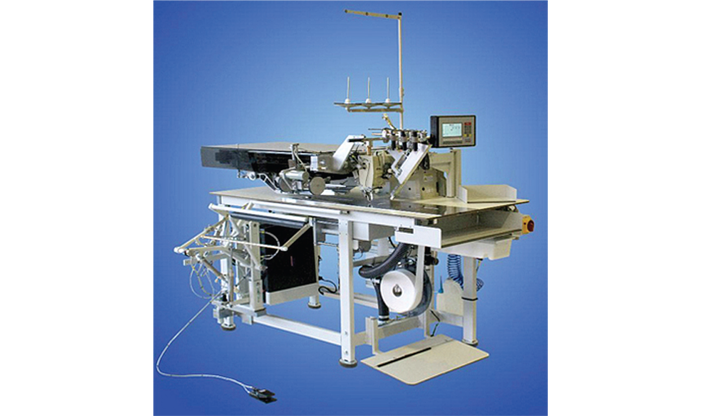
A-S-S Automated Sewing Systems
The A-S-S Automated-Sewing-Systems AG is a specialist for machine construction since its foundation in 2000. What was started with a serging machine grew in the meantime to a portfolio of more than 20 sewing machines for jackets an trousers. By well elaborated and functional process- optimised solutions as well as the highest demands to processing and material, ASS has developed to an internationally successful company.

BASS 3203 universal automatic welt pocket unit
The BASS 3302 is a universal automatic welt pocket unit. This unit can sew all kinds of common welt pockets: straight, slanted, with or without flap. Sewing witz zipper can be integrated without any problem. BASS 3302 sew at a high speed. Clamp transfer and all trimming systems of the sewing unit have their own drive; clamp transfer and corner cutting are controlled fully automatically by step motors. The center knife is driven separately by an electric motor.
- Freely programmable control with a memory of 40 seams
- Pocket length from 20 to 200 mm, optional up to 240 mm
- Needle gauge from 8 mm to 30 mm in steps of 2 mm available
- Stitch length, sewing speed and transfer speed can be programmed individually
- Each pocket seam can be programmed with true back tack or condensed stitches
- Automatic flap sensing by photocell
- Three separate programmable laser beam marking lights for precise and easy loading

BASS 5800 sewing unit for trouser manufacturing
The BASS 5800 sewing unit is designed for small to medium-sized trouser manufacturing companies. It is possible both to sew pocket facing to pocket pouches, and to lap fell the left and right fly pieces to front trouser parts. The operation of the workplace is possible after a very short training period. The machine functions are marked with graphic symbols with additional display of the corresponding parameters in the respective language.
- Freely programmable control unit
- Sewing of pocket facings in all sizes
- Individual stitch length programming
- Optional programming of condensed stitches or back-tacking stitches
- Automatic scanning of the seam length
- Stacking unit