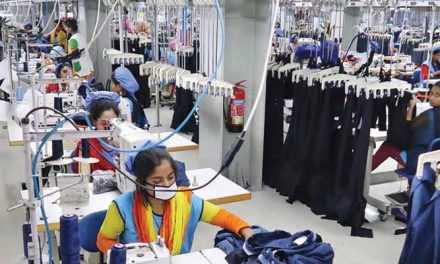
 The Indian textile industry started FY26 on strong footing. Demand trends and operating conditions were showing positive signs for a steady growth year. That optimism was short-lived. The escalation of the Middle East crisis quickly began to cause serious upheaval across the sector, with constant disruptions producing a wave of volatility in raw material prices, import-export flows, and consumer demand challenging the resilience of the entire man-made fibre value chain.
The prices of petrochemical products have surged by 40–45% in a short period, driven by crude-linked volatility and supply uncertainty. The government responded quickly by easing customs duty on key petrochemical inputs, which was a welcome and necessary step. However, the relief has a three-month window, and that is simply not enough time for it to translate into meaningful benefit on the ground. Imports of liquid bulk cargo – PTA, MEG – are not transactions you can turn around in days. Negotiating prices, arranging shipping, managing logistics for these volumes takes weeks. By the time imports contracted under the duty relief window actually arrive and are processed, the window may already be closing. The industry needs either a longer relief period or a standing mechanism that can respond to sustained disruptions of this nature.
The key setback for the polyester industry has been the magnitude of the raw material price increase and the inability to pass it on downstream. Demand has softened precisely because of the war-driven uncertainty, creating a structural imbalance – costs going up at one end, pricing power weakening at the other. Margins across the value chain, from yarn producers to fabric manufacturers, are under heavy strain.
It is important to note that this slowdown is not only price-driven – it is sentiment-driven. The uncertainty around how long the conflict will last, and how much longer raw material prices will stay elevated, has created a cautious approach at every level of the supply chain. From manufacturers to retailers, everyone is delaying purchases and limiting stocking. The fear is rational: if global conditions stabilise and raw material prices fall by 30%, anyone sitting on high-cost inventory will be looking at losses. The industry is currently operating on near-neutral margins, and no one wants to take that inventory risk.
At Filatex India, we have reduced production by approximately 25% to align with these conditions. Across the industry, the focus right now is on stability and workforce retention rather than production volume.
Adding to the complexity is the US naval blockade in the region, which has introduced a new layer of uncertainty into shipping routes and cargo movement. Supply chains that were already under stress from price volatility are now also dealing with route disruptions and unpredictable transit times. This makes forward planning extremely difficult and adds further cost to an already pressured input chain.
MEG availability is another specific concern. India sources MEG directly from Kuwait and Saudi Arabia, and while supply is currently manageable, prices have reached an all-time high. If the conflict deepens or spreads, availability itself – not just price – could become a serious bottleneck for polyester production across the country.
There is also a human dimension to this crisis that is not getting enough attention. LPG shortages in the affected region have created genuine fear among migrant workers about their safety and their ability to get home if conditions deteriorate. We are seeing workers preemptively returning to their home states, creating manpower shortages at a time when operational continuity is already under pressure. This is not a temporary inconvenience – if it persists, it will affect production capacity in ways that go beyond what raw material prices alone can explain.
It is worth noting that the earlier concerns around global tariffs had a relatively limited impact on the polyester ecosystem. Synthetic textile exports to markets like the United States are smaller compared to cotton exports, so the tariff disruption, while real, was manageable. Geopolitical tensions affecting crude oil supply are a far more serious matter for our sector, precisely because polyester is a petrochemical-linked product at its core.
What the textile industry needs in this environment is more than cost control support. It needs predictability – in supply chains, in raw material availability, and in policy response. Short-term duty relief helps at the margins, but it cannot protect the industry from disruptions of this scale and duration.
The encouraging note is that the textile sector has been here before. The pandemic was a severe and sudden shock, and the industry recovered fully because people cannot go without clothing and textiles indefinitely. Demand that is deferred is not demand that is destroyed. When stability returns, the cycle will resume. The task right now is to manage through the disruption with discipline, protect our people and our operations, and be ready to move when conditions improve.
 Madhu Sudhan Bhageria is the Chairman and Managing Director of Filatex India Ltd., a leading Indian polyester filament yarn manufacturer. A graduate from Shri Ram College of Commerce, University of Delhi, he has been actively involved in the company’s management since its inception, contributing over four decades of financial, operational, and strategic expertise in the synthetic and polyester yarn industries. In his role, he oversees the company’s overall operations, production, modernization, and expansion, guiding Filatex through consistent growth and adaptation in the competitive MMF sector.