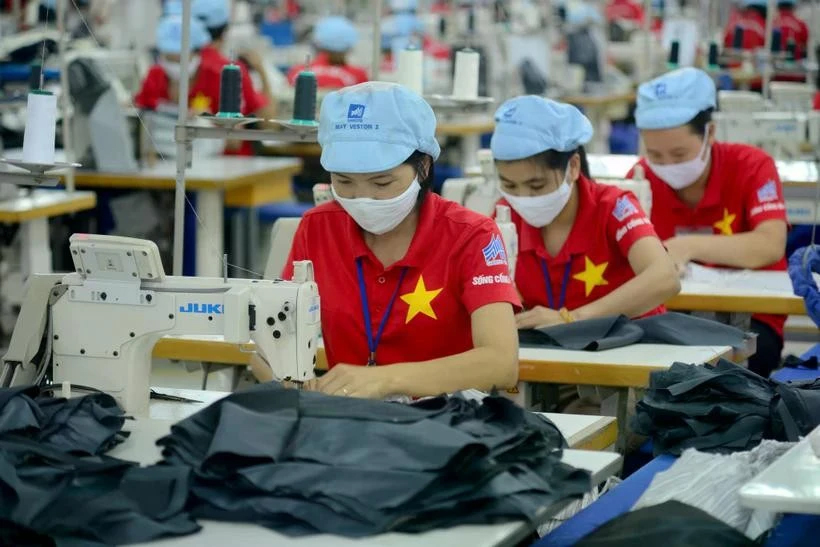
In 2025, Vietnam’s textile and garment exports are estimated at 46 billion USD, up 5.6% year on year, helping the country remain among the world’s top three textile and garment exporters.
The garment and textile sector of Vietnam has recalibrated its development strategy amid rapid changes in policies, markets and supply chains, said Vietnam Textile and Apparel Association (VITAS) Chairman Vu Duc Giang at a seminar held on December 16 as part of the HanoiTex & HanoiFabric 2025.
Giang noted that rising logistics costs, stricter compliance requirements, shifting purchasing policies in major markets, tariff measures and sustainability demands are exerting growing pressure, making strategic repositioning in the medium and long term.
To address these challenges, the sector has successfully implemented three core strategic pillars. Export market diversification has reduced reliance on traditional markets, with Vietnamese textile and garment products now reaching 138 markets worldwide, enhancing resilience to external shocks.
At the same time, enterprises have diversified partners and customers, improving negotiating capacity and reducing dependence on a small number of major brands. Product diversification has also accelerated, with a shift from simple processing to higher-value products tailored to increasingly segmented market demand.
To support these pillars, the sector is rolling out five key solution groups, he stated, adding that prominent among them is green transition, with sustainable development regarded not merely as a compliance requirement but as a prerequisite for deeper participation in global value chains. The sector is also stepping up the application of science and technology, automation, robotics and artificial intelligence to improve productivity, quality and long-term competitiveness.
Strengthening supply chain linkages remains another priority, focusing on developing domestic supply sources, enhancing governance capacity and promoting experience-sharing with international partners. The sector’s trade surplus is forecast to exceed 20 billion USD in 2025, reinforcing its role as a pillar export industry.
Giang said the evolving context is opening up new opportunities, particularly in diversifying markets, customers and products. However, these opportunities can only be realised if enterprises strengthen their capacity to engage more deeply in global value chains, especially in design, technology, materials and brand building.
Tran Thanh Hai, Deputy Director of the Agency of Foreign Trade under the Ministry of Industry and Trade, said that despite continued global uncertainties, Vietnam’s textile and garment enterprises have demonstrated resilience and adaptability. He noted that reciprocal tariffs imposed by the US have prompted the sector to restructure and upgrade value, with many firms shifting towards higher value-added and more technically sophisticated products while expanding market diversification.
However, he warned that the sector still faces mounting challenges, including increasingly complex trade barriers, stringent requirements on traceability, carbon emissions, circular economy practices and social responsibility, as well as intensifying regional and global competition. Persistent weaknesses in the localisation of raw and auxiliary materials, particularly in weaving, dyeing and finishing, continue to constrain domestic value added.
Hai called for restructuring towards higher value, stronger domestic supply chains, more effective use of free trade agreements, green transition as a core competitive advantage, and accelerated human resource development and digital transformation. The Ministry of Industry and Trade will continue to support the sector in maintaining its position as a key export driver.
In 2025, Vietnam’s textile and garment exports are estimated at 46 billion USD, up 5.6% year on year, helping the country remain among the world’s top three textile and garment exporters.