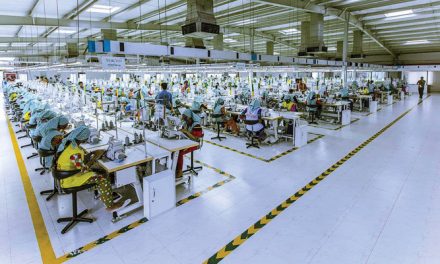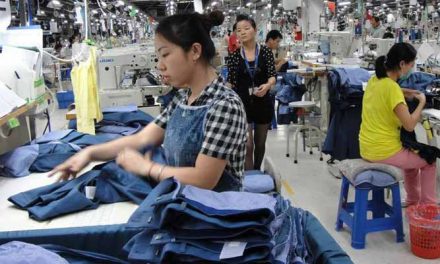
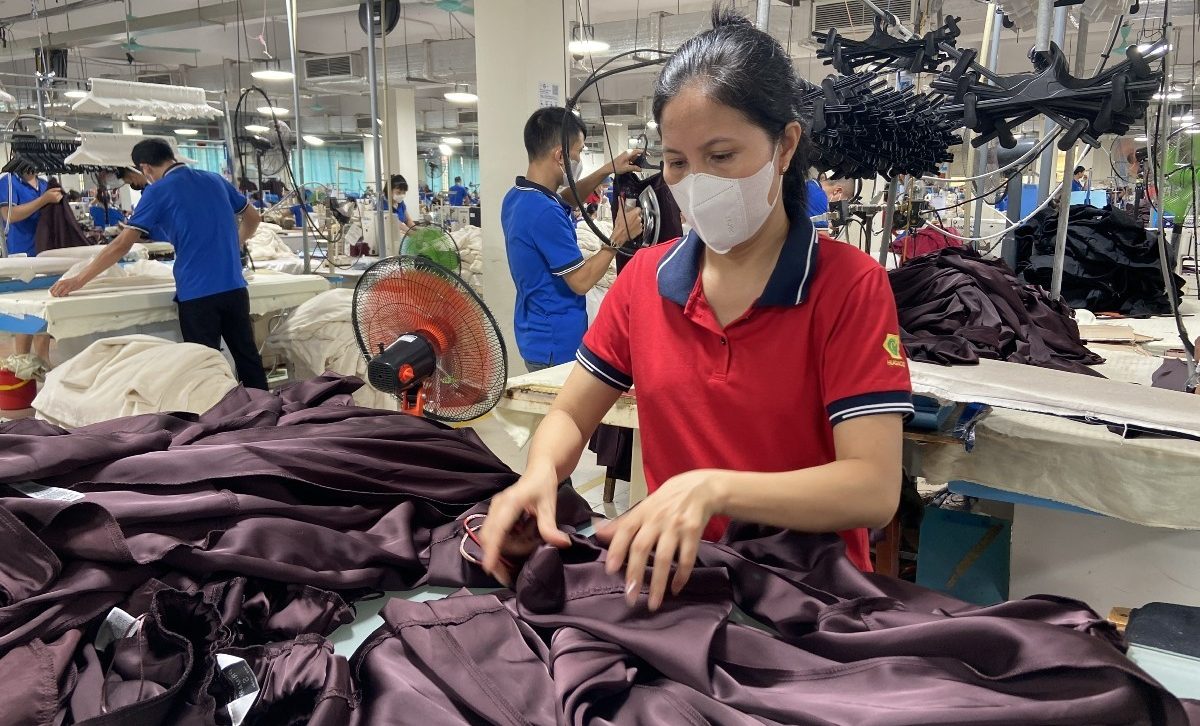
Despite facing numerous global economic fluctuations and stringent technical barriers from major consumer markets, the textile and garment industry continued to record positive growth in exports and imports during the first seven months of 2026.
The steady recovery of global consumer demand, coupled with the flexible adaptability of domestic businesses, has created momentum for the entire industry’s export turnover to maintain positive growth, while significantly improving the value-added ratio in each product.
Specifically, Vietnam’s total textile and garment export turnover in July 2026 reached US$4,672 million, an increase of 8.2% compared to June 2026 and a 4.3% increase compared to the same period in July 2025. This breakthrough in July contributed to bringing the total textile and garment export turnover for the first seven months of 2026 to US$27,020 million, a 2.67% increase compared to the same period in 2025. This result reflects the outstanding efforts of the entire industry in securing orders, diversifying markets, and optimizing production processes to maintain Vietnam’s position on the global export map.
In terms of export structure, garments continue to play a leading role, contributing the largest proportion to the total export value. In July 2026, garment exports are estimated to reach US$3,738 million, an increase of 8.9% compared to the previous month and 2.1% compared to the same period last year. For the first seven months of 2026, garment exports reached US$21,127 million, a slight increase of 0.70% compared to the same period in 2025. This slight growth in the garment sector reflects the fact that traditional markets such as the US, the European Union, and Japan, although having passed the deep recession, still exhibit cautious consumer sentiment, requiring orders with high flexibility in terms of scale and delivery time.
A notable highlight in the export picture over the past seven months is the impressive growth of upstream products and textile raw materials. Exports of fibers and yarns in the first seven months are estimated at US$2,730 million, a significant increase of 11.34% compared to the same period in 2025. Textile accessories also recorded high growth of 11.18%, bringing in US$929 million. In addition, fabric exports reached US$1,763 million, an increase of 9.57%, while non-woven fabric exports reached US$471 million, an increase of 6.56% compared to the same period last year.
The strong growth in fiber, fabric, and accessory product groups reflects the positive shift in Vietnam’s textile and garment industry, moving beyond purely cutting and sewing processes to proactively supply auxiliary materials for the global production chain.
Conversely, total textile and garment imports in July 2026 reached US$2,231 million, a decrease of 6.0% compared to June but an increase of 8.0% compared to the same period in July 2025. For the first seven months of 2026, total textile and garment imports reached US$15,255 million, an increase of 3.27% compared to the same period last year; of which, fabric imports reached US$8,936 million, an increase of 2.08%; textile and garment accessories imports reached US$2,605 million, an increase of 3.60%; and cotton imports reached US$1,885 million, an increase of 1.02%.
Regarding the company’s operational efficiency, Vinatex General Director Cao Huu Hieu affirmed that, although the unit’s production and business results in the past seven months have been relatively positive, the profit margin of both the yarn and garment industries is tending to narrow due to fluctuations in raw material prices, selling prices, order structure, and input costs. For the remaining months of 2026, General Director Cao Huu Hieu requested that the units continue to closely monitor market developments, proactively build and manage operations according to scenarios regarding orders, raw materials, exchange rates, and logistics; while maintaining management discipline, tightly controlling costs, cash flow, accounts receivable, inventory, and working capital, improving labor productivity, ensuring product quality, and meeting delivery deadlines.
Mr. Tran Van Quy, General Director of Trung Quy Textile and Garment Company ( Ho Chi Minh City), said that the company’s orders are currently fully booked until the end of October. Therefore, if the company effectively controls costs while ensuring product quality, adapting to the market remains entirely feasible.
Commenting on the achievements of the past seven months and the prospects for the remaining months of 2026, Mr. Truong Van Cam, Vice President of the Vietnam Textile and Garment Association (VITAS), said that maintaining positive growth and increasing the value-added ratio reflects the strong restructuring efforts of businesses. Although the total export turnover of over 27 billion USD in the first seven months is an encouraging sign, the textile and garment industry is entering a period of fiercer competition than ever before.
Major import markets are increasingly tightening regulations on sustainable development, traceability of raw materials, carbon emission reduction, and social responsibility compliance. The strong growth of fiber, fabric, and accessory product groups in the past seven months demonstrates that Vietnamese businesses have begun to be more proactive in the supply chain, reducing their dependence on imported raw materials.
In the coming period, to achieve their annual targets, businesses need to continue to accelerate green transformation, invest in energy-saving technologies, diversify niche markets, and fully utilize the incentives from new-generation free trade agreements.
To maintain sustainable growth for the remainder of 2026, economic experts recommend that businesses proactively update themselves on changes in international trade policies, especially the stringent regulations of the European market regarding circular textile strategies. Focusing on developing green fashion products, using recycled fibers, and meeting environmental assessment standards will be key to unlocking opportunities for deeper penetration into high-end market segments.
Alongside the efforts of businesses, the Vietnam Textile and Garment Association continues to petition state management agencies to finalize the planning of concentrated textile and garment industrial zones with standard wastewater treatment systems, in order to create conditions to attract investment capital into the textile and dyeing sector and thoroughly resolve the bottleneck in raw materials and auxiliary materials.