
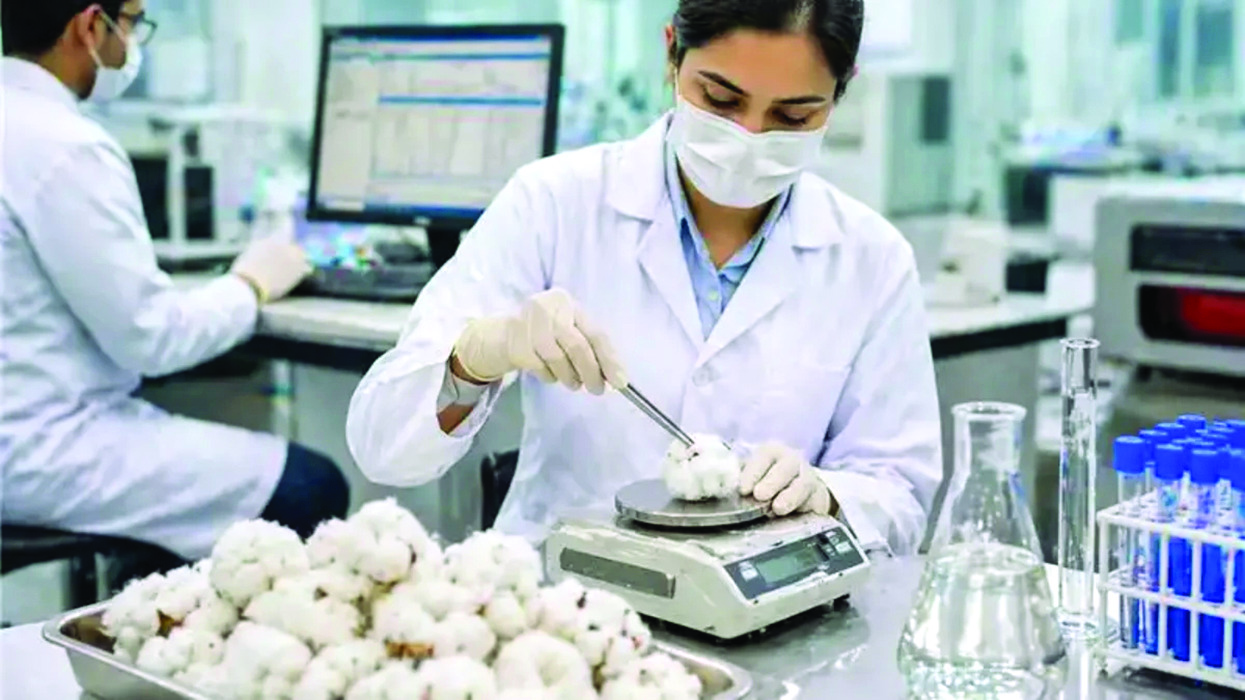
The Bureau of Indian Standards has approved a Rs. 38.72-crore project to upgrade 21 cotton laboratories across major producing states. The move is meant to improve testing precision, standardise quality checks and strengthen the cottonto-textile supply chain. India’s cotton quality infrastructure is set for a major overhaul, with the Bureau of Indian Standards moving to expand and modernise a nationwide testing network that sits at the heart of the textile supply chain. According to The Hindu BusinessLine, the standards body has cleared a Rs.38.72crore project to upgrade 21 laboratories across major cotton-producing states.
Why the laboratory network matters
The project is designed to improve the precision and consistency of cotton testing at a time when mills, traders and exporters are under increasing pressure to prove fibre quality more reliably. The plan covers laboratories spread across the northern, central, southern and eastern cotton belts, giving the testing system a wider geographic footprint than before.
The laboratories are located in Punjab, Rajasthan, Gujarat, Maharashtra, Madhya Pradesh, Telangana, Andhra Pradesh, Karnataka, Tamil Nadu and Odisha, according to the report. That spread is significant because cotton quality can vary sharply by region, crop conditions and post-harvest handling, making local testing capacity an important part of price discovery and trade confidence.
What the upgrade will change
The standards body said it is extending direct financial support to create highprecision testing facilities at these regional nodes. The aim is not only to modernise equipment but also to reduce infrastructure gaps that have long affected quality assessment in the cotton chain, from farm gate to textile mill.
The report said the upgraded network is intended to standardise quality parameters across the cotton-to-textile supply chain. That matters for an industry where even small differences in lint quality, contamination and fibre characteristics can affect spinning efficiency, yarn output and export competitiveness.
In practical terms, better testing can help buyers and sellers rely on a more uniform benchmark, which can reduce disputes and improve transparency in procurement. For growers, the gains could include more accurate grading and stronger incentives to produce cleaner, better-quality cotton. For mills, the benefit lies in more dependable raw material assessment before procurement decisions are made.
Early rollout has already begun
The standards body has already started deploying upgraded equipment this year. The report said 14 high volume instrument testers and 28 trash analysers have been installed and commissioned across 13 laboratories, including 11 laboratories run by the Textiles Committee and two operated by the Cotton Corporation of India.
That early rollout suggests the larger programme is already moving beyond planning and into implementation. High volume instrument systems are widely used in cotton quality evaluation because they generate objective data on fibre properties, while trash analysers help identify contamination levels that can influence both pricing and end-use suitability.
Implications for textiles and farm economics
The timing of the investment is notable. India remains one of the world’s largest cotton producers and a major textile manufacturing base, but the sector continues to face questions around quality consistency, contamination and traceability. A more robust laboratory network could improve confidence among domestic buyers and international customers alike.
For the textile industry, the upgrade may support better raw material selection and reduce variability in spinning operations. For the agriculture side, it could bring more scientific grading into a market that still often depends on local practices and uneven infrastructure. The result may be a stronger link between cotton quality and realised value, especially for growers in regions where testing access has been limited.
By building out a technologically advanced testing framework, the standards body is also reinforcing the role of standards in agricultural trade, not just manufacturing. In a commodity where quality is often judged by a mix of visual inspection and laboratory data, the availability of reliable testing can shape everything from procurement contracts to export positioning.
What comes next
The project is likely to become more visible as the remaining laboratories are upgraded and brought into the same quality framework. If the rollout stays on schedule, the network could help create a more uniform national benchmark for cotton testing across the country’s main producing zones.
For now, the broader message is clear: India is treating cotton testing as strategic infrastructure rather than a back-end technical service. That shift could matter as the country tries to defend its place in global textile supply chains while improving returns for farmers and reducing inefficiencies in the value chain.