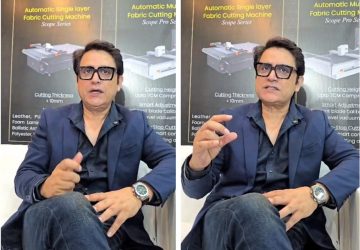
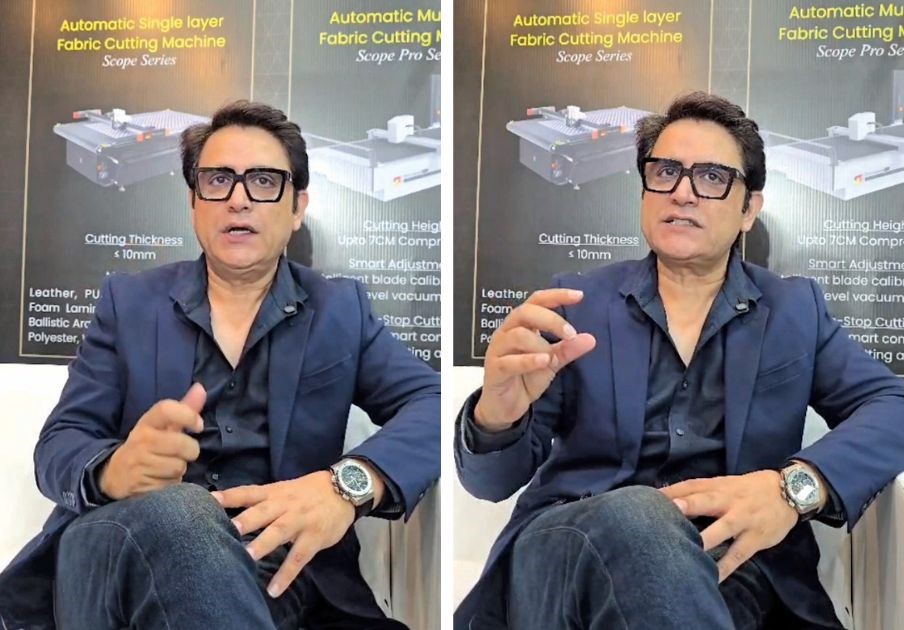
In an exclusive conversation with Arvind Kumar, Editor, Apparel Views, Vishal Sher, Managing Director, Studio Next Technology Pvt. Ltd. discusses the economics of cutting-room automation, the importance of professional implementation and and the growing opportunities for automation in India’s garment manufacturing industry.
Could you tell us about Studio Next Technology?
Studio Next Technology has been in the field of cutting-room automation for the past 22 years. We implement CAD systems, followed by automation through spreading machines and cutting machines. We regularly visit factories to understand their bottlenecks and, based on our observations, provide appropriate solutions customised to each customer that improve productivity, consistency, fabric utilisation and operational efficiency.
Many companies are now offering automatic cutting-room solutions. What advice would you give to manufacturers before investing?
I have seen many players selling automatic solutions without being sufficiently experienced in the implementation process. They sell a machine as a standalone product, whereas the customer needs to understand that this is a complete solution.
We need to study the problems a company faces, the fabrics it handles and the systems it already has. Based on these factors, we should provide an appropriate solution.
If you purchase an off-the-shelf product without considering your organisation’s requirements, it may not fit into your operations, and the investment can fail to deliver the expected results. These products are expensive. If a company invests in technology but cannot use it effectively, it may lose confidence in automation itself.
What are the major challenges manufacturers face after installing automatic cutting machines?
Over the last 22 years, we have learned a great deal. Initially, we also made mistakes while learning the technology. Today, we have a much better understanding of our machines and how to identify problems.
Any production machine needs a strong support system. Even if a machine remains out of operation for a few hours, the entire production line can suffer. Garment manufacturing is an industry that depends heavily on people and coordinated production. If we automate the cutting process but cannot feed the sewing lines, it can result in significant losses for the company.
Therefore, manufacturers must understand their products thoroughly. Service must be up to the mark, and implementation must be carried out professionally. Our technical team has been with us for the past 18 years, and most of them have around 25 years of experience. That experience makes a difference.
Cutting-room automation technology was initially developed in Europe and America. How do you view the technological progress made by Chinese manufacturers?
I understand and agree that this technology was initially developed by Europeans and Americans. However, the production shift towards China has brought about a significant change. Chinese manufacturers have made considerable progress in improving existing technologies originally developed in Europe and America.
You can see this progress in electric vehicles and robotics. China’s technological capabilities have advanced far beyond the older perception that its products were necessarily cheap and unreliable.
I have also seen European machines whose machine heads have been modified to resemble those used in our machines. This suggests that some manufacturers are now looking at similar approaches after developing their own technologies and carrying out R&D.
Around 10 years ago, the entire world sold approximately 3,000 cutting machines, while China alone sold around 5,000. The experience gained through that level of production has been significant. Chinese manufacturers have also made progress in factory setups and compliance. Their manufacturing capabilities have evolved considerably.
What price advantage do Chinese machines offer compared with European machines?
I would not simply describe Chinese machines as cheap. Their pricing is logical and offers value compared with European machines, which generally operate with higher profitability.
At Studio Next, we work directly with manufacturing companies and maintain a close feedback loop. We take what we learn from customers’ factories back to the manufacturers so that the machines can be improved. This direct engagement helps us develop solutions that address actual factory requirements. Overall we can say that they are cheaper around 25-30% compared to European and american suppliers.
Automatic cutting machines were once considered a luxury for factories. Has that changed, and are they becoming a necessity?
Yes, the situation has changed considerably. Around ten years ago, when I approached manufacturers, many questioned why they needed to invest in an automatic cutting machine.
Today, even smaller companies, including those with turnovers below ?100 crore, are approaching us for cutting-room automation because they are struggling with manpower. Consistency and the availability of a suitable workforce have become major concerns. Many businesses are finding it increasingly difficult to depend entirely on manual processes.
Automation helps address these challenges. Manufacturers want to work smarter and improve productivity, and cutting-room automation is becoming an increasingly important part of that transition.
What kind of production and infrastructure savings can a factory achieve by investing in cutting-room automation?
It has been encouraging to see many companies investing to increase their production capacity. We are seeing now factories planning to double their production, something I had not observed to the same extent over the past few years.
For example, consider a company producing 5,000 garments and operating a cutting room of 5,000 square feet. If it wants to increase production to 10,000 pieces, the conventional approach might be to expand the factory by another 5,000 square feet. However, real-estate costs are high. Instead, we can make the existing 5,000-square-foot cutting room more efficient through automation and help the company target 10,000 pieces using the same space and infrastructure.
The cost comparison is significant. An additional 5,000 square feet of space could cost around Rs. 3 crore, whereas this automation system could cost approximately Rs. 75 lakh. The system can help manufacturers increase capacity while improving cutting consistency and precision and controlling the additional expenses associated with expansion.
How much fabric can a manufacturer save by adopting cuttingroom automation?
Compared with conventional cutting methods, automation can deliver fabric savings of around 4% to 5%, depending on how inefficiently the company was cutting its fabric previously. The improvement depends on the existing process and its level of efficiency.
Even a company already using a CAD system can achieve additional fabric savings of around 1% to 2% by moving to cutting automation. That can represent a substantial saving for a garment manufacturer.
What return on investment can manufacturers expect from an automatic cutting-room system?
On average, we have found that a company producing around 5,000 pieces can achieve an ROI within one and a half years. One reason is that the capital expenditure on our machines is relatively low. Even when financing costs are considered, the investment can deliver a return within that period.
Based on our calculations for a setup using our machines, the per-piece cutting cost can be around Rs. 1 to RS. 1.50, compared with approximately Rs. 4 to Rs. 4.50 under the alternative costing basis discussed in our assessment. Manufacturers can compare these figures to understand the potential savings by investing in cutting automation.
Maintenance is another major concern. How does Studio Next address maintenance costs and spare-parts availability?
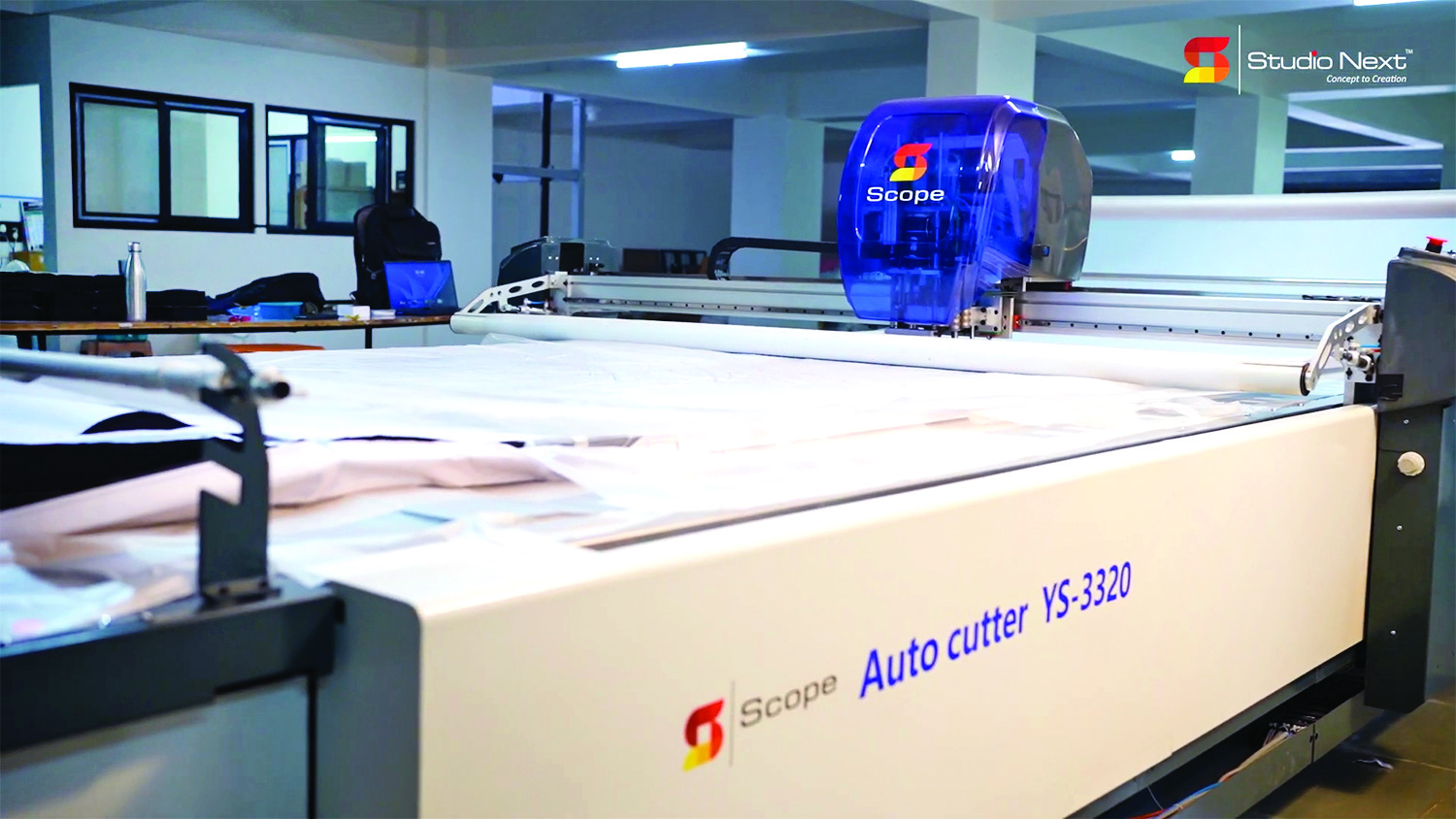
Our approach is to provide machines that require minimum maintenance while ensuring that spare parts are readily available through established support channels. For example, we use Panasonic drives and motors. Panasonic has local support in India, so if an issue arises, customers can contact Panasonic. With the required programming and support, the drive can be replaced and the machine brought back into operation quickly.
Regarding other consumables, the annual expense for our type of machine can be approximately Rs. 1.5 lakh for an entire year. This is substantially lower than the recurring expenses of around Rs. 8–10 lakh that we have seen associated with some European machines.
We try to minimise these costs because garment manufacturers are facing declining profitability. Our responsibility is to provide a solution that is costeffective over the machine’s working life, not simply at the time of purchase.
Can you share an example of a customer that has moved from a European machine to your technology?
We have supplied machines to the Ordnance Clothing Factory, which operates under the Ministry of Defence. They have both European machines and our machines.
Whenever I visit, I am told that they regularly use our machines and have been doing so for the past 10 years. They have indicated that they do not use the other European machine as much because of the expense involved in operating it.
For us, this is a good example of the importance of consistency, overhead expenses and quality. Customers are increasingly considering these factors when selecting machinery.
What are your plans for manufacturing in India, particularly for spreading and cutting machines?
We already have a technology transfer arrangement in place, and we have started with a small pilot project. However, India’s manufacturing ecosystem still needs to develop further. We have built a strong ecosystem in automobile manufacturing, where ancillary industries supply spare parts of good quality. The same level of support is not yet available across machine-component manufacturing.
This is the time to build a stronger manufacturing base, not only for cutting machines but also across other industries. If ancillary manufacturers can support larger factories with quality components, producing machinery locally will become more affordable.
If we have to manufacture every component in-house, the cost of the machine could become higher than that of a European machine, and we would lose our price advantage.
How do you view the future of India’s apparel industry, particularly with increasing global competition?
The geopolitical situation has created an advantage for India, and our large domestic market is another major strength. Domestic players are doing well. Over the past year, the apparel industry has performed strongly, and export orders are also coming in.
Manufacturers still need to remain competitive on pricing. With the dollar rising, Indian exporters have an advantage when buyers place orders in India. With new manufacturing setups coming up, I believe India can meet the world’s growing demand at competitive prices while also serving its large domestic market.
As the saying goes, roti, kapda aur makaan are three essential pillars. The apparel industry is one of them, and I remain bullish about its future.
Do you see any government policies or implementation gaps that are hindering the industry’s growth?
The government is doing proactive work, but the benefits are not always reaching the ground level as effectively as they should. On paper, many schemes look excellent. It is encouraging to see the policies and new initiatives being introduced, but implementation is the key.
There needs to be a proper delivery mechanism. Funds and benefits must flow through the system efficiently. Perhaps this will take time, but I hope we will see policies that are implemented effectively and allow companies like ours to benefit. At the same time Govt. has taken many initiative to promote manufacturing in India and export.
Do import duties make specialised machinery more expensive for the garment industry? What could be done to address this?
Import duties on certain sewing machines have been reduced, while specialised machines are a different matter. However, for garmenting projects, the overall investment is not necessarily as large as it is for a textile unit. A textile project may involve an investment of around Rs. 100 crore, where a 7.5% duty can have a significant impact.
For our type of industry, a project might involve around Rs. 5 crore. In that context, 7.5% is not such a large amount and can be absorbed.
How has Studio Next performed over the past year, and what are your plans for the coming year?
Last year, we were very busy, and we are now implementing many projects involving spreading and cutting. On average, we are currently handling around three projects every month, which is a significant improvement. Earlier, we used to handle around three projects a year. This shows that customers are increasingly accepting the technology.
We now have around 400 installations, which has helped build trust. As more customers see our machines operating in factories, it becomes easier for them to make an investment decision.
Labour shortages are also encouraging manufacturers to adopt technology, and we see a positive future for the business. The encouraging part is that we completed our previous year’s turnover within the first half of this year. We are therefore very bullish about doubling our turnover this year.