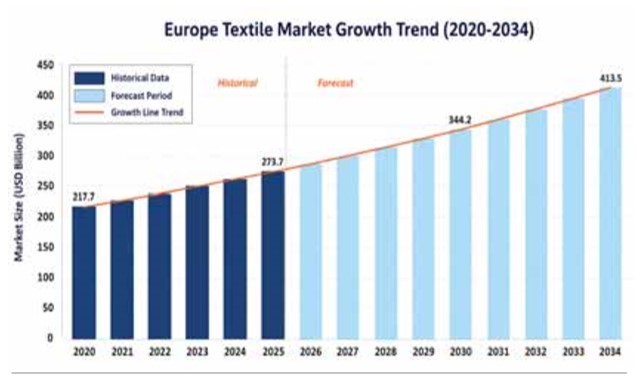
The Europe textile market is experiencing steady growth, driven by rising consumer preference for sustainable and eco friendly fabrics, robust EU regulatory support through the European Green Deal, rapid adoption of digital textile printing, and the strong foothold of luxury and technical textile industries. According to IMARC Group, the market size reached USD 273.7 Billion in 2025 and is projected to reach USD 413.5 Billion by 2034, registering a compound annual growth rate (CAGR) of 4.69% during 2026-2034.
Textiles are indispensable across apparel, home furnishings, automotive, healthcare, and industrial applications, benefiting from consistently non discretionary demand across multiple end use verticals. Strategically, the market is vital to Europe’s economy, with sustainable fashion mandates, industrial textile innovation, and premiumization trends driving growth. The forecast to USD 413.5 Billion captures accelerating circular economy adoption, smart textile integration, and nearshoring driven manufacturing investment.
The Europe textile market is on track to reach USD 413.5 Billion by 2034, expanding at a 4.69% CAGR. Supported by sustainable fashion mandates, digital textile printing, and luxury textile heritage, the sector offers compelling opportunities for manufacturers, technology providers, and investors across the value chain.
Europe Textile Market Summary
The Europe textile market encompasses a comprehensive range of products, including apparel, home furnishings, automotive textiles, healthcare textiles, and industrial applications. The market ecosystem comprises established textile manufacturers, luxury fashion houses, technical textile specialists, and digital printing innovators, supported by well developed supply chains and export networks.
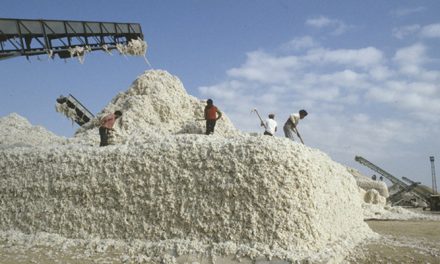
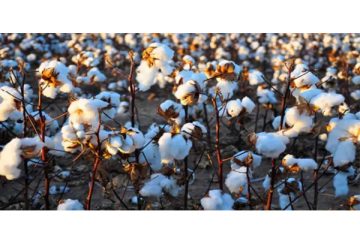
By raw material, cotton leads at 39.8% in 2025, owing to its natural breathability, versatility across seasons, and alignment with EU sustainability mandates under GOTS and OEKO TEX certification frameworks. Chemical fibers at 27.6% are rising due to cost performance advantages in technical applications. Wool (14.2%) retains premium positioning in luxury outerwear, while Silk (9.3%) anchors high end couture.
By product, natural fibers lead the segment at 36.4% in 2025, driven by persistent consumer demand for breathable, sustainably sourced fabrics. Polyesters (31.7%) dominate the synthetic product segment, driven by sportswear and activewear applications. Nylon (18.5%) demonstrates the fastest product growth trajectory through 2034. Regionally, Germany commands a 20.7% share in 2025, underpinned by its advanced manufacturing infrastructure and extensive export network. Italy (18.6%) and France (16.4%) follow, driven by luxury fashion heritage and high end textile craftsmanship.
Key Trends Shaping the Europe Textile Market
Sustainability and Circular Economy Adoption: The European Green Deal and robust EU regulatory support are driving the transition toward sustainable and eco friendly fabrics. Circular economy adoption is accelerating, with textile manufacturers investing in recycling technologies, closed loop production systems, and sustainable material sourcing. The forecast to USD 413.5 Billion captures accelerating circular economy adoption and smart textile integration.
Digital Textile Printing: Rapid adoption of digital textile printing is transforming the industry, enabling faster production cycles, reduced waste, and greater design flexibility. Digital printing technologies are particularly valuable for luxury and premium segments, where customisation and short run production are increasingly important.
Smart Textile Integration: Smart textile integration is emerging as a key growth area, with textiles incorporating sensors, connectivity, and advanced functionalities for applications in healthcare, automotive, and sportswear. This trend is driving innovation and creating new revenue streams for forward looking manufacturers.
Nearshoring Driven Manufacturing Investment: Nearshoring driven manufacturing investment is reshaping the European textile landscape. As supply chains become more regionalised, European manufacturers are investing in domestic production capabilities, reducing dependence on overseas sourcing and enhancing supply chain resilience.
Luxury and Technical Textile Leadership: The strong foothold of luxury and technical textile industries in Europe provides a competitive advantage. Italy’s luxury fashion heritage and Germany’s technical textile manufacturing infrastructure position the region as a global leader in high value textile production.
Market Growth Drivers
The Europe textile market is propelled by multiple robust demand drivers that collectively support sustained expansion through 2034:
Sustainability and Regulatory Support: Rising consumer preference for sustainable and eco friendly fabrics, coupled with robust EU regulatory support through the European Green Deal, is driving market growth. GOTS and OEKO TEX certification frameworks ensure alignment with sustainability mandates.
Digital Textile Printing Adoption: Rapid adoption of digital textile printing is enabling faster production cycles, reduced waste, and greater design flexibility.
Luxury and Technical Textile Leadership: The strong foothold of luxury and technical textile industries provides a competitive advantage. Italy’s luxury fashion heritage and Germany’s technical textile manufacturing infrastructure drive premium value.
Cotton Market Leadership: Cotton dominates raw materials at 39.8% in 2025, owing to its natural breathability, versatility, and alignment with sustainability mandates.
Emerging Growth Categories: Nylon demonstrates the fastest product growth trajectory through 2034 at approximately 5.8% CAGR, while Polyesters follow at approximately 5.5% CAGR.
Nearshoring Investment: Nearshoring driven manufacturing investment is enhancing supply chain resilience and domestic production capabilities.
Europe Textile Market Segmentation
- By Raw Material: Cotton (39.8% share in 2025), Chemical Fibers (27.6%), Wool (14.2%), Silk (9.3%), Others
- By Product: Natural Fibers (36.4% share in 2025), Polyesters (31.7%), Nylon (18.5%), Others
- By Application: Apparel, Home Furnishings, Automotive, Healthcare, Industrial, Others
- By Country: Germany (20.7% share in 2025), Italy (18.6%), France (16.4%), Others
Government Policies and Regulatory Landscape
The European Union has implemented comprehensive regulatory frameworks that positively influence the textile market. The European Green Deal provides robust regulatory support for sustainable and eco friendly fabrics, driving the transition toward circular economy adoption. GOTS and OEKO TEX certification frameworks ensure alignment with sustainability mandates.
EU regulations governing textile safety, labeling, and environmental standards maintain high industry standards and consumer confidence. The focus on circular economy and sustainable production is driving investment in recycling technologies, closed loop production systems, and sustainable material sourcing.
National regulatory bodies across European countries continue to enforce environmental standards, labor regulations, and trade policies that support the industry’s transition toward more sustainable and responsible production practices.
Competitive Landscape
The Europe textile market features a dynamic competitive landscape, with established manufacturers, luxury fashion houses, and technical textile specialists competing across product quality, innovation, and sustainability credentials. The market research report provides comprehensive analysis of market structure, key player positioning, and competitive dynamics.
Key players in the Europe textile market include:
- Major textile manufacturers across apparel, home furnishings, and technical textiles
- Luxury fashion houses (Italy, France)
- Technical textile specialists (Germany)
- Digital textile printing innovators
Competitive dynamics are shifting toward sustainability credentials, digital printing capabilities, and smart textile integration. Companies that successfully develop circular economy solutions and advanced textile technologies are well positioned to capture market share.
Porter’s Five Forces Analysis – Europe Textile Market
Bargaining Power of Suppliers – Moderate: Suppliers of raw materials, including cotton, chemical fibers, wool, and silk, hold moderate influence. The availability of multiple suppliers for standard materials limits individual supplier power. However, specialised sustainable materials may give certain suppliers increased leverage. Major manufacturers mitigate this through diversified sourcing strategies.
Key points:
- Multiple suppliers for standard materials reduce individual leverage.
- Specialised sustainable materials may give suppliers moderate power.
- Established manufacturers maintain diversified sourcing to manage risk
Bargaining Power of Buyers – Moderate to High: Buyers range from fashion brands and retailers to automotive and healthcare manufacturers. Large enterprises with significant purchasing volumes negotiate favourable terms. The growing availability of sustainable and digital printing options gives buyers increasing choice. Brand reputation and product quality remain critical differentiators.
Key points:
- Large enterprises negotiate volume discounts.
- Sustainable and digital options increase buyer choice.
- Quality and sustainability credentials justify premium pricing.
Threat of New Entrants – Moderate: Significant capital requirements for manufacturing facilities, technology investment, and brand establishment create entry barriers. Achieving sustainability certifications and regulatory compliance requires substantial investment. However, the growing market and digital printing adoption offer opportunities for specialised entrants focusing on innovation.
Key points:
- Manufacturing and technology investment create entry barriers.
- Sustainability certifications require significant investment.
- Niche segments remain accessible to innovative entrants.
Threat of Substitutes – Low: Direct substitutes for textiles are limited in most applications. Alternative materials such as leather, synthetic leather, and composites may substitute in some applications but cannot match textiles’ versatility, breathability, and cost effectiveness. For most apparel, home furnishings, and industrial applications, textiles remain the preferred material.
Key points:
- Textiles offer unmatched versatility and breathability.
- Alternative materials have limited application scope.
- Textiles are essential across multiple end use verticals.
Competitive Rivalry – Moderate (Healthy): Competition focuses on product quality, sustainability credentials, innovation, and brand reputation rather than destructive price competition. Differentiation occurs through sustainable materials, digital printing capabilities, and smart textile integration. The presence of both luxury fashion houses and technical specialists creates a healthy competitive environment driving innovation.
Key points:
- Differentiation through sustainability, technology, and brand reputation.
- Luxury and technical specialists co exist productively.
- Innovation drives market advancement without destructive pricing.
Regional Analysis
The Europe textile market exhibits distinct regional dynamics, with Germany commanding the largest share at 20.7% in 2025, followed by Italy at 18.6% and France at 16.4%.
Germany (20.7%): Germany’s leadership is underpinned by its advanced manufacturing infrastructure, extensive export network, and technical textile manufacturing expertise. The country’s machinery export infrastructure and industrial textile innovation position it as a key driver of European textile growth.
Italy (18.6%): Italy’s textile industry is driven by luxury fashion heritage and high end textile craftsmanship concentrated in world renowned manufacturing districts. The country’s premium positioning in luxury outerwear and couture textiles supports high value creation.
France (16.4%): France’s textile market benefits from its luxury fashion heritage and high end textile craftsmanship. The country’s fashion industry and premium textile production support sustained demand.
Key Aspects Required for the Europe Textile Market
- Demand spans multiple applications: Apparel, home furnishings, automotive, healthcare, and industrial applications all contribute to the diversified demand base.
- Strong regulatory support: The European Green Deal and GOTS/OEKO TEX certification frameworks provide clear policy direction and market growth.
- Sustainability is a key growth driver: Rising consumer preference for sustainable fabrics and circular economy adoption are reshaping the industry.
- Digital transformation is accelerating: Rapid adoption of digital textile printing is enabling faster production cycles and greater design flexibility.
- Luxury and technical textiles provide competitive advantage: Italy’s luxury fashion heritage and Germany’s technical textile infrastructure position Europe as a global leader.
- Positive market outlook: The market is projected to grow from USD 273.7 Billion in 2025 to USD 413.5 Billion by 2034 at a CAGR of 4.69%.
Recent Industry Developments
- 2025: The Europe textile market reached USD 273.7 Billion, with IMARC Group projecting continued growth to USD 413.5 Billion by 2034 at a CAGR of 4.69%.
- 2025: Cotton maintained its leadership position at 39.8% of raw material share, driven by alignment with EU sustainability mandates.
- 2025: Nylon and Polyesters emerged as the fastest growing product categories, with Nylon at approximately 5.8% CAGR and Polyesters at approximately 5.5% CAGR through 2034.
- 2025: Germany (20.7%) and Italy (18.6%) continued to lead regional market shares, reflecting their advanced manufacturing infrastructure and luxury textile heritage.