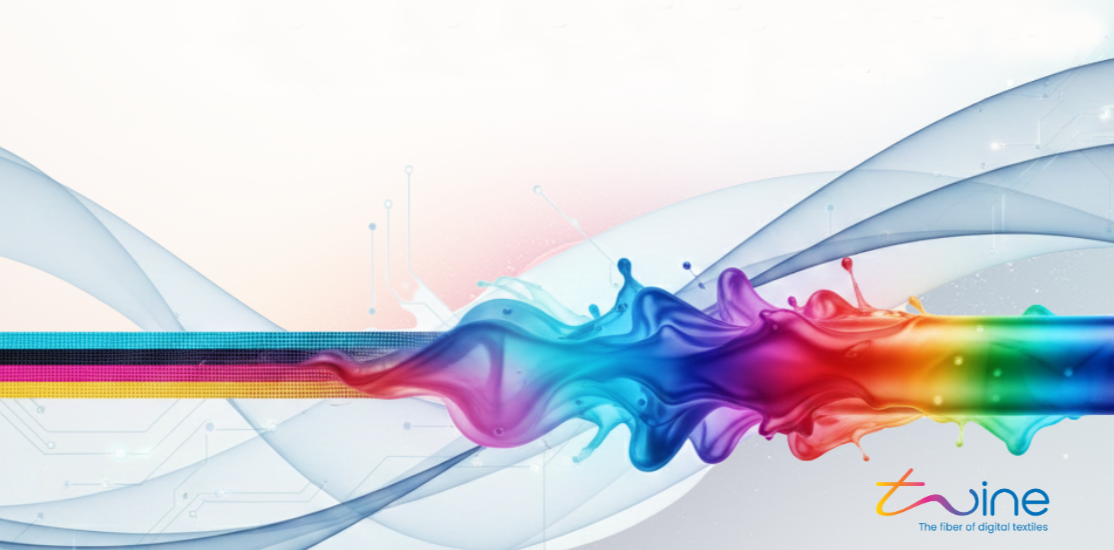
When TWINE’s first machine was conceived, it followed a familiar logic: replicating the proven CMYK model used in the printing industry. Cyan, Magenta, Yellow, and Black offered an impressive theoretical color range and appeared to be an ideal foundation for digital thread dyeing.
Reality, however, proved to be more complex.
Working with thread is fundamentally different from working with paper. Unlike flat surfaces, thread absorbs ink unevenly, responds dynamically to pressure and speed, and presents unique challenges related to consistency, blending, and visual accuracy. As we scaled, tested, and refined our technology, several critical limitations became clear, from imperfect color mixing at the nozzle level to inconsistent results when extremely small ink quantities were required.
One of the most important discoveries was the impact of metamerism. Sewing threads must visually merge with the garment’s fabric under all lighting conditions. A seam that appears perfect in daylight but stands out under fluorescent lighting is not acceptable in high-quality production. Ensuring true color harmony across different environments became a core priority.
This realization led to a fundamental redesign of our approach.
We introduced a pre-head mixing system that allows inks to blend before reaching the thread, ensuring smoother and more uniform distribution. Transparent ink was added to stabilize volume and guarantee consistent coverage. Light versions of Cyan, Magenta, and Yellow enabled precise control even when applying minimal pigment, preventing patchy or uneven results.
Beyond process improvements, we expanded the color architecture itself. Purple and orange inks were introduced to close gaps that CMYK alone could not address. More recently, we added around twelve specialized dyes designed not to expand the theoretical gamut, but to significantly improve metameric accuracy and real-world matching, while remaining fully compatible with traditional dye-house systems. This ensures that threads dyed on TWINE machines can seamlessly coexist with those dyed using analog processes.
In parallel, the launch of the X Series marked another leap forward through our collaboration with Datacolor. This integration transformed color matching from a slow, trial-and-error workflow into a fast, precise, and manageable process, dramatically reducing the time required to achieve recipe accuracy while supporting multiple thread types with distinct behaviors.
Today, TWINE’s X Series supports between eight and ten inks per machine, striking a balance between flexibility, precision, and operational efficiency. We continue to explore configurations that allow greater pigment variety, even if this means rethinking traditional light-ink strategies. Industry-specific solutions, including automotive-grade inks, are already under evaluation, and future development may extend into nylon-compatible and fluorescent dye technologies.
This journey reflects our core philosophy. Digital thread dyeing is not about adapting old models. It is about reengineering color from the ground up for a new era of precision, consistency, and intelligent production.
The path forward is clear: smarter colors, deeper control, and seamless harmony between digital and traditional textile worlds.