
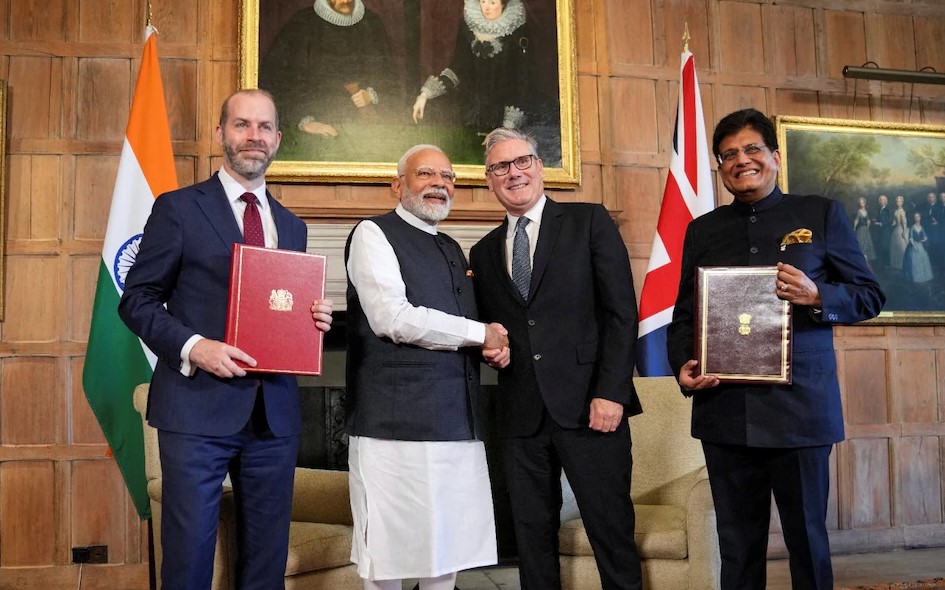
Under the India – UK Free Trade Agreement (FTA), India gets duty free access for most of its goods, whereas China, which has been dominating the UK market, will be charged. MFN rate of duty that is normal duty. So, India has a definite edge over its competitors Bangladesh a least developing country (LDC) is entitled to duty free access in the UK. India and Bangladesh are therefore on the same page as for as free access to one of the top global destinations for investment is concerned. Thus, India will be able to compete more “favourably” with its competitors, including Vietnam.
The FTA with the UK, which finally kicked in on July 24 is already generating a demand pull says, Prabhi Damodaran, Convener of the Indian Texpreneurs Federation. And, according to Commerce Secretary Rajesh Agrawal “We will be able to reach the dollar 100bn bilateral trade target in the next three four years” ahead of the implementation of the comprehensive Economic Trade Agreement (CETA).
Indian textiles leather footwear and engineering goods will be among the major gainers from the zero tariff regime in the UK. The exclusion is for 117 products. The government has agreed to reduce duties on 89.5 percent of the 12,000 products. Over 61 percent of products receive immediate duty-free entry into India under specific bilateral trade frameworks, while total tariff elimination is planned over time for the remaining goods.
Textiles exports are likely to increase to dollar 100 bn in 2031 with tariff parity advantage over key rivals. India has immediate duty free access for 99 percent of its tariff lines. It has systematically dismantled long-standing tariff walls. This structure is built on absolute dynamic security. Strongest exclusion lists are actively deployed to insulate our sensitive agricultural and rural economies from import volatility.
Taking full advantage of duty free access Indian exporters shipped goods worth dollar 140 million on the day the FTA came into effect Prime Minister Modi said the pact and social security deal “will strengthen economic linkages between the two countries and create opportunities for people of both sides. The CETA will give fresh momentum to our farmers, entrepreneurs and MSMEs. Several vibrant sectors will gain strong access to the UK market.
According to Union textiles minister Giriraj Singh textile exports currently pegged at dollar 38 billion is targeted to increase to dollar 100 bn in the next four years, while positioning Tirupur for the next phase of growth through man-made fibre production sustainable measures and infrastructure support. At a meeting with manufacturers association in Tirupur recently the minister dwell on the development roadmap and future expansion of Tirupur textile and garment ecosystem. He praised Tirupur’s evolution from an unorganized base to a globally recognised textile and knitwear cluster and said the shift from cotton-dominant manufacturing to blended and MMF based production is now essential.
The minister assured the industry of the Centre’s support for initiatives, including hostels for women workers new industrial clusters and the adoption of modern manufacturing technologies. He wanted India to become a global leader in building a new generation of entrepreneurs and in producing “new age” fibres, derived from recycled and waste materials.
Senior industry leaders believe the FTA will unlock the substantial opportunities for the apparel sector by providing duty free access and enhancing the competitiveness of products in one of the world’s largest and most discerning consumer markets. It will attract fresh investments generate large scale employment and strengthen India’s integration with global value chain.
The minister said the industry has set a dollar 350 bn target by 2030-31, consisting of dollar 250 bn domestic market and dollar 100 bn exports. The FTA will expand market access for hubs in Tamil Nadu, Maharashtra and Gujarat.
Industry leaders further said the challenges lie in both the value added and high volume segments, including in cotton textile, where India has a stronger domestic ecosystem. Exporters want the government to provide incentives to the MMF fabric ecosystem and strengthen domestic cotton supply chain.
They further said “Medium and small scale units are evaluating incremental automation technologies compare and could begin investments, once there is clear visibility on orders and payback time. Unlike some previous deals Indian exporters have long standing relationships with buyers in the UK, for brands and super markets such as PRIMARK, TESCO and ramp up exports immediately.
Exporters are witnessing a lot of inbound order requests and trial orders as increasing concern about supply concentration and political stability creates a favourable environment. Indian units can immediately tap opportunities and exports are expected to double its share from 6 percent to 12 percent.
The industry struggles to compete on cost due to fragmented supply chains and higher input costs which include man-made fibre and cotton fabric costs and relatively low labour productivities.
The UK is among India’s most important apparel export destinations with considerable potential. The duty free access is expected to improve price competitiveness facilitate deeper market penetration and enable Indian exporters to secure a large share of the UK’s apparel imports.
The FTA creates strongest tariff advantage across cotton garments, home textiles, natural fibre apparel and value added textile products where Indian manufacturers already possess significant production capabilities “according to Southern India textile Mills Association (SIMA).
In 2025, India’s exports of textile and apparel exports to the UK stood at dollar 1.95 bn compared dollar 1.79 bn in 2024 and dollar 1.81 bn in 2023. Tamil Nadu is likely to emerge as a major beneficiary. Exporting clusters like Tirupur and Karur will have tremendous opportunities to achieve exponential growth. Export orders for cotton knitted garments and kitchen linen have already been on an upward trend, after the conclusion of FTA. During 202526 Tamil Nadu’s exports of textiles and apparel amounted to dollar 654.02 mn compared to dollar 632.08 mm in the previous year. The UK remains the second largest textile and apparel export destination of Tamil Nadu.