The “Year-End Review 2025” report released by India’s Ministry of Textiles systematically outlines the country’s clear roadmap over the past year, leveraging large-scale infrastructure development and key policy deregulation to vigorously promote the upgrade of the textile industry and boost export growth.
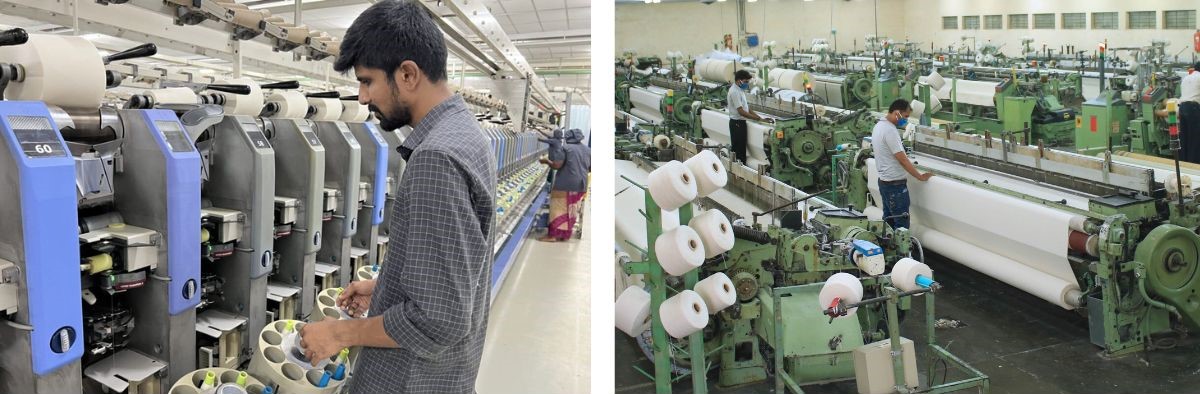
The report indicates that India’s textile and apparel exports for the fiscal year 2024-25 reached $37.8 billion, achieving a 5% growth. Behind this performance is the accelerated implementation of two landmark projects: Firstly, the PM MITRA Mega Textile Parks Scheme has completed site selection for all seven parks, with the foundation stone laid by the Prime Minister for the park in Dar, Madhya Pradesh. State governments have initiated infrastructure construction valued at 259 billion rupees. Secondly, the revised Production Linked Incentive (PLI) Scheme for Textiles has successfully attracted commitments from 74 companies to invest 287.1 billion rupees, with 40 companies already commencing actual investments, expected to create over 250,000 jobs.
The report also indirectly addresses challenges faced by the industry, particularly the external pressure from the recent United States’ imposition of additional 50% tariffs on certain Indian products. This highlights that while India’s textile sector is committed to enhancing global competitiveness, it also faces a complex international trade environment. Moving forward, consolidating the achievements of domestic industrial upgrading and effectively exploring diversified markets to mitigate trade risks will be crucial.
The Ministry of Textiles’ Year End Review 2025 outlines a period of comprehensive and multi-faceted growth, driven by strategic policy reforms, significant infrastructure investments, and a strong focus on empowering the entire value chain from farm to foreign markets. Key achievements centre on promoting domestic manufacturing, enhancing global competitiveness, and ensuring the welfare of millions of farmers, weavers, and artisans.
Reforms (Policy, Regulatory, Structural & Ease-of-doingbusiness Changes)
• Rescinding of QCO on Viscose Staple Fibre (VSF) w.e.f. 18 Nov 2025
• Customs duty exemption on raw cotton (Aug–Dec 2025);
• Deferment of QCO 2023 for cotton bales to Aug 2026
• Enabling Reforms for Sector Supported by the Ministry:
• Rescinding of QCO on MMF in polyester segments w.e.f. 12th Nov 2025
• Rescinding of QCO on textiles machinery w.e.f. 27th August 2025 – Extension of implementation of QCO on textile machinery to 1 Sept 2026
• Major GST rationalisation (56th GST Council): – Garments & made-ups: 5% up to Rs.2,500/piece – MMF fibres 18%–5%, MMF yarns 12%–5% – Carpets, handicrafts, handlooms, sewing machines reduced to 5%
• Extension of Export Obligation period from 6 to 18 months under Advance Authorisation for QCO-covered items
• Key Revision in Production Linked Incentive Scheme for removal of hardships
• Expansion of Eligible Products
• Relaxation from setting up new companies
• Reduction in minimum threshold of investment
• Reduction in incremental turnover Criteria for incentives from earlier 25% to 10%
•Expansion and Digitisation of the Cotton Procurement Systems with strengthened monitoring
• Formulation of Land Utilisation and Allocation Framework for PM-MITA Park
• Approval & rollout of 7 PM MITRA Parks (Rs.4,445 Cr outlay)
• 100% land acquired & handed over to SPVs; Environment clearance for all parks; Land allotment policy approved (MP, TN)
• Extension of RoDTEP to EOUs/SEZs/Advance Authorisation units & RoSCTL for garments/made-ups till 31 Mar 2026
• Decriminalisation of provisions under Jan Vishwas Bill 2025 in Central Silk Board Act, Textiles Committee Act, and Handloom Reservation Act
Performance (Key Execution, Delivery & Physical Achievements)
Strengthening Fibre Chain
• Cotton: Rs.37,450 Cr paid to Cotton Farmers for cotton procurement. Record MSP cotton procurement: 525 lakh quintals (100 lakh bales)
• Jute: Jute MSP procurement: 4.16 lakh quintal, Rs.209 Cr, 83,000 farmers benefited and distributed certified jute seeds to 72,000 farmers covering 23,000 hectare land for enhancing yield and fibre quality
• Silk: Silk production increasing and generating employment. 38 North-East sericulture modernisation projects sanctioned
• Wool: 6 wool CFCs projects sanctioned. 211 shearing machines, Rs.4 Cr revolving wool fund, 400 tents, 300 predator-proof corals provided. Sanction of 6 Common Facility Centres (CFCs) for wool processing
Fast-tracking PM MITRA
• Foundation stone laid by PM for Dhar (MP) park on 17 Sep 2025;
• Infrastructure works Rs.2,591 Cr started (up to park gates) in all 7 states
• Internal Park Infrastructure project Rs.7,024 Cr approved (MP, TN, Telangana, Maharashtra); Rs.160 Cr released to 4 parks
• Investment MoUs >Rs.27,434 Cr signed for PM MITRA Parks and 100% land acquired & handed over to SPV
• Commercial Production started in Telangana with investment of Rs.4,000 cr. And employment of 25,000.
Consolidating Production Linked Investment Scheme
• 40 Units have started investment (22 achieved threshold & 30 commenced production)
Skilling People and generating Employment
• SAMARTH: 5.41 lakh persons skilled of which 88% are women,
• SAMARTH: 75% placement through new partners
• Approval of a new NIFT Campus at Raipur – will start functioning in the next academic year, new courses in existing NIFTs added for the next
India Handloom and Handicrafts
• 307 handloom marketing events, 462 handicraft marketing events, 1,225 CDAP, 746 design programmes, 517 skill programmes
• Raw material supply: 495.33 lakh kg yarn to 5.38 lakh handloom weavers
• 11,544 MUDRA loans & 2.35 lakh new social security enrolments for weavers
• 1.30 lakh artisans issued Pahchan cards; 67 Handicraft Producer Companies approved
Emerging areas of exports
• Textiles & apparel exports USD 37.8 billion (2024-25), +5% growth, trade surplus USD 28.2 billion
• BHARAT Tex 2025: 5,000+ exhibitors, 1,20,000+ visitors from 120+ countries
Others
• 59 textile parks sanctioned and 22 were completed under SITP
Transform (Long-Term Game-Changing initiatives)
• Launch of 5-year Mission for Cotton Productivity (focus: higher yields, ELS varieties, sustainability, 5F vision – Farm to Foreign)
• Kasturi Cotton Bharat programme (Certification + Traceability + Branding) for global positioning of Indian cotton
• Blockchain-based QR-coded bales (BITS) and CotBiz platform for end-to-end digital procurement & sale management.
• 74 applications were selected under the PLI scheme, 56.75% are in field of Technical Textile
• National Technical Textiles Mission extended to Mar 2026: 168 R&D projects (Rs.520 Cr), 24 startups, 45 academic institutes supported (Rs.204 Cr), 8 QCOs on 68 items
• Expansion of the National Institute of Fashion Technology (NIFT) academic footprints – 19 campuses, NIFT Varanasi campus, Begusarai extension centre, new UG programme, international placements, NIFT Fashion Journal
• 12 Handloom Producer Companies, 6 Craft Handloom Villages, 4 new handloom GIs
• ShilpiDidi campaign for women handicraft entrepreneurs
• Vision 2030: USD 100 billion textile exports target
Inform (Digitisation, Transparency, Farmer/Artisan Interface & Real-time Information)
• Kapas Kisan app (cotton farmer self-registration & slot booking)
• Real-time cocoon & raw silk price SMS to sericulture farmers
• Web/mobile platforms for silk seed units & chawki centres registration/ inspection
• E-pehchan online portal for weaver ID cards; online mela & cluster applications
• IndiaHandmade.com & Bharatiya Vastra EvamShilpaKosh e-commerce portals
• Establishment of state-of-the-art Pashmina product testing facilities with DNA analysers (Leh & Srinagar)
• Jute Crop Information System (JCIS) with ISRO for scientific area & yield assessment
• Satellite-based monitoring & mobile procurement in jute
• End-to-end digitisation of RoSCTL
• Data-driven mapping of 520 exporting districts
• The release of the second VisioNxt Trend Book and India-specific size charts under INDIA size by NIFT
In summary, this year-end review demonstrates that India is systematically reshaping the foundation of its textile industry’s competitiveness through a combined strategy of government investment in infrastructure, policy deregulation to reduce burdens, and incentivizing private capital