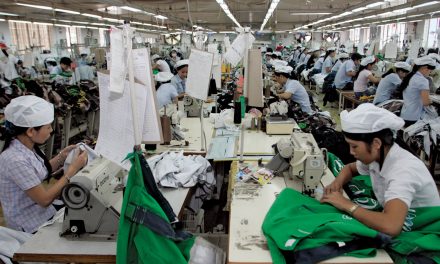
 Indonesia is studying the establishment of a state-owned enterprise focused on the textile industry as part of a broader strategy to revive labor-intensive sectors under pressure, Coordinating Minister for Economic Affairs Airlangga Hartarto said on Wednesday.
The plan was discussed with President Prabowo Subianto and related ministers during a meeting at the president’s private residence in Bogor, West Java. The talks covered challenges facing labor-intensive industries, including textiles, footwear, and garments.
Airlangga said the textile sector has long been a key pillar of Indonesia’s economy, given its large workforce absorption and significant contribution to exports. However, the industry has come under mounting pressure, including from tariff policies imposed by the United States, one of Indonesia’s main export destinations for textiles and footwear.
He said Indonesia had previously operated a state-owned textile company, and the government now plans to revive that role to support a strategic national industry.
“Indonesia once had a textile SOE, and this will be revived with $6 billion in funding to be prepared by Danantara Indonesia,” Airlangga said while attending an Indonesian Business Council event in Jakarta.
To strengthen the textile industry’s performance, the government is also preparing a range of policy measures, including expanding market access through deeper trade cooperation with the European Union under the Comprehensive Economic Partnership Agreement (CEPA).
With stronger production capacity supported by a state-owned textile firm and expanded access to overseas markets, the government is targeting national textile exports to reach $40 billion within the next few years, Airlangga said.
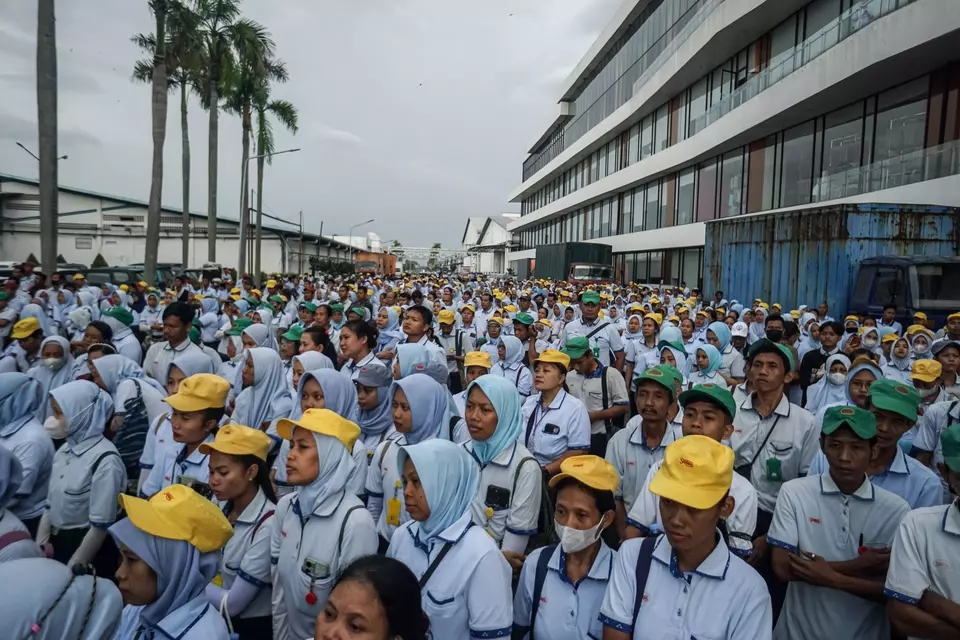
The broader textile and apparel sector employs millions of workers nationwide, with a heavy concentration in labor-intensive manufacturing hubs such as West Java, Central Java, and Banten. The industry absorbs a large share of semi-skilled and low-to-middle income workers, many of whom have limited alternative employment options outside manufacturing.
Because of this profile, downturns in textiles tend to have immediate social and political impacts, including layoffs, factory closures, and rising informal employment.