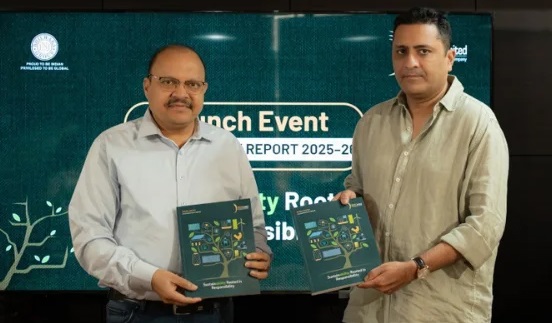
 RSWM Limited, the flagship company of the LNJ Bhilwara Group, has released its Sustainability Report for FY2025–26, detailing its environmental, social and governance (ESG) performance, key initiatives and future commitments. The report focuses on the company’s progress in reducing greenhouse gas emissions, improving resource efficiency, advancing circularity and strengthening its approach to responsible manufacturing.
During FY2025–26, RSWM recorded a 40.5% year-on-year reduction in Scope 1 emissions, which fell to 115,640 metric tonnes of carbon dioxide equivalent (tCO₂e). Scope 2 emissions declined by 10.06% to 299,590 tCO₂e, bringing total Scope 1 and Scope 2 emissions down by 21.27% to 415,230 tCO₂e from 527,400 tCO₂e. The company also reported a 16.50% reduction in total energy consumption, from 4,025.07 TJ to 3,360.98 TJ.
RSWM’s continued focus on cleaner energy and resource conservation reaped greater dividends during the course of the year. The company consumed 126.7 million kWh of green energy and 36,055 MT of biofuel during the year. RSWM has the capacity to source 70% of its energy requirements from renewable sources and currently utilises green energy to meet around 60% of its overall energy needs across operations, reflecting its continued commitment to sustainable manufacturing and reducing its environmental footprint.
Commenting on the company’s sustainability journey, Riju Jhunjhunwala, Chairman, Managing Director and CEO, RSWM Ltd., said, “At RSWM, sustainability is an integral part of how we manufacture, innovate and create long-term value for our stakeholders. Guided by our Panchtatva philosophy, we continue to focus on reducing emissions, conserving resources and advancing responsible and sustainable manufacturing practices. The progress reflected in this report reinforces our commitment to building a resilient business while deepening our environmental stewardship and social responsibilities.”
Speaking about the sustainability efforts of the last year, Rajeev Gupta, Joint Managing Director, RSWM Ltd., said, “Our sustainability priorities are closely linked to operational efficiency and the responsible use of resources. We monitor and track every aspect of our manufacturing processes to identify opportunities for continuous improvement. The reductions in emissions and energy consumption during FY2025–26 reflect the progress made through our ongoing initiatives. As we work towards our FY2026–27 targets for renewable energy and biofuel, we remain focused on translating our commitments into measurable action across our operations.”
RSWM aims to increase the renewable energy share in its overall energy mix to 70% by FY2026–27. Four industrial boilers have completed the transition to biofuel, with work on two others in progress; the company’s target is to achieve 100% biofuel usage across all boilers by FY2026–27.
Circularity and water stewardship remain important areas of focus. RSWM reports recycling approximately 2,372 million PET bottles annually and treating and reusing 2.05 million kilolitres of water. Water withdrawal declined by 4.18% year-on-year. The company also used 17,358 MT of certified cotton and reported a recycled polyester share of 49,128 MT, equivalent to 59.12%, as presented in the report. Zero liquid discharge systems are also in place at applicable wet-processing units.
RSWM has also been working on people and governance priorities. During FY2025–26, the company reported a total workforce of 18,118, including 1,728 employees and 16,390 workers. Women accounted for 16.60% of the workforce, as reported in the social highlights. The company has recorded healthcare coverage for 100% of employees and their dependents, participation by 94.25% of employees in training programmes, and zero complaints under the Prevention of Sexual Harassment (POSH) framework. Governance highlights include 50% independent directors and 100% compliance with BSE and NSE requirements.
Guided by its sustainability motto, “We Only Take What We Can Give Back” and its Panchtatva philosophy, RSWM integrates environmental stewardship, operational resilience, social responsibility and long-term value creation into its business approach. With a long-term target of achieving Net Zero emissions by 2050, the company continues to advance towards becoming a more resource-efficient, responsible and sustainable textile manufacturer.