Sangam (India) reported Q1 FY27 revenue of Rs. 867 crore, registering an 8.1 percent year-on-year increase from Rs. 803 crore in the corresponding quarter last year, supported by healthy demand and steady execution across its businesses. Although revenue moderated marginally by 1.5 percent compared to Rs. 880 crore reported in Q4 FY26, the company’s profitability improved at a much faster pace, indicating stronger operational efficiencies rather than volume-led growth.
The company witnessed a sharp improvement in margins during the quarter. Gross profit increased 26.7 percent year-on-year to Rs. 378 crore, while the gross margin expanded by 640 basis points to 43.6 percent, compared with 37.2 percent in Q1 FY26. Operating performance remained even stronger, with EBITDA rising 59.6 percent to Rs. 112 crore from Rs. 70 crore in the year-ago period.
Consequently, the EBITDA margin improved to 12.9 percent, compared with 8.8 percent a year ago and 11.2 percent in the previous quarter. Management attributed the improvement to better realizations, a favourable product mix, operating leverage, and disciplined cost management. The improvement at the operating level translated into a substantial increase in earnings. Profit Before Tax (PBT) surged to Rs. 55 crore, compared to Rs. 3 crore in Q1 FY26, while Profit After Tax (PAT) increased to Rs. 41 crore, up from Rs. 2 crore in the corresponding quarter last year and Rs. 33 crore in Q4 FY26.
As a result, the PAT margin expanded to 4.7 percent from 0.3 percent a year ago, while basic earnings per share (EPS) rose sharply to Rs. 8.16 from Rs. 0.42. The sharp increase in profitability despite single-digit revenue growth highlights the benefits of improved cost control and higher operating leverage across the business.
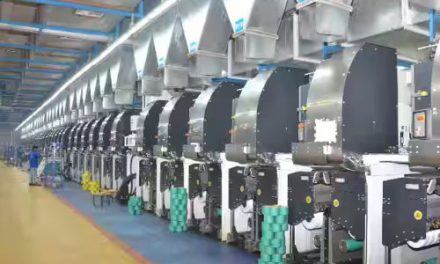
The quarter saw strong operational metrics, indicating strong demand across the company’s core businesses. Denim fabric capacity utilisation was 98% and PV fabric 97 percent, indicating efficient manufacturing asset use. Yarn production was 22,853 MT, denim fabric production was 144 lakh metres, and PV fabric production was 194 lakh metres, one of the strongest quarterly performances. At 14 lakh pieces, capacity utilisation improved to 50% as the company scaled up its garment business.
A high level of capacity utilisation is particularly important for integrated textile manufacturers, as it allows fixed manufacturing costs to be spread over higher production volumes, thereby supporting operating margins. The strong utilisation levels across Sangam’s fabric businesses, therefore, complement the improvement witnessed in quarterly profitability.
The revenue mix remained diverse for the company. Domestic sales made up 67% of revenue, while exports made up 33%. Revenue came from denim fabric (31%), cotton yarn (25%), woven fabric with processing (22%), PV yarn (20%), and garments (2%), reducing dependence on any one product segment or geography. The company exports to over 50 countries, balancing domestic and international revenue.
Beyond quarterly performance, Sangam is working on its Rs. 1,500 crore investment plans, which are expected to be completed by March 2029. The investment will complete the company’s integration across the cotton and recycled synthetics value chains and allow it to move into garment manufacturing, management said. The expansion will be financed through a mix of internal accruals and term debt with disciplined leverage.
The project includes manufacturing capacities of 10 lakh denim garments per month and 5 lakh PV garments per month, allowing Sangam to move further up the textile value chain by supplying finished garments instead of only yarn and fabrics. At full utilisation, management expects the projects to generate around Rs. 300 crore in annual EBITDA, thereby creating an additional growth engine for the business.
This capex involves modernisation of 80,000 cotton yarn spindles, setting up 2,700 new open-end rotors, two denim production lines, 40 TPD expansion of recycled polyester fibre capacity, new energy-efficient PV yarn machinery and addition of 15 lakh metres per month of PV fabric capacity. These investments are expected to improve the manufacturing efficiency and the vertically integrated model of the company.