 The predominantly cotton based Indian textile industry provides jobs to over 45 Million people, particularly the rural masses and women account around 50%. The Ministry of Textiles has set a Vision of increasing the textile trade from the existing level of around USD 172 Billion to USD 350 Billion and increasing a decade stagnated export from USD 36 Billion to USD 100 Billion, attract new investments to the tune of USD 100 Billion and create new jobs for 20 Million people. The industry would need 475-500 lakh bales of cotton, each bale weighing 170 kgs at an internationally competitive rate to achieve the Vision. Every lakh of cotton bale provides jobs to one lakh people.
India produced 398 lakh bales and achieved 565 kgs/hectare average productivity level during the cotton season 2013-14, but is currently anticipated to produce only around 280 lakh bales in the current cotton season 2026-27, as against the industry requirement of around 360 lakh bales. Around 12-15 lakh bales of organic and BCI cotton produced by India is normally exported to countries like Bangladesh. Hence, the country is likely to have a cotton shortage of around 100 lakh bales. It might take seven to ten years for India to reach self-sufficiency in medium and long staple cotton while continue to depend on imports for ELS cotton and other customer specified origin cotton.
Since cotton accounts around 70% of the yarn manufacturing cost, 50% fabric manufacturing cost and 30-35% of garment manufacturing cost, it is essential to ensure smooth supply of required quality and quantity of cotton at an internationally competitive price to take real advantage of the recently concluded FTAs including UK, EU & USA, reap the benefits of TEEM Scheme & PM MITRA Park, achieve a sustained growth rate and achieve the Vision set by the Government of India.
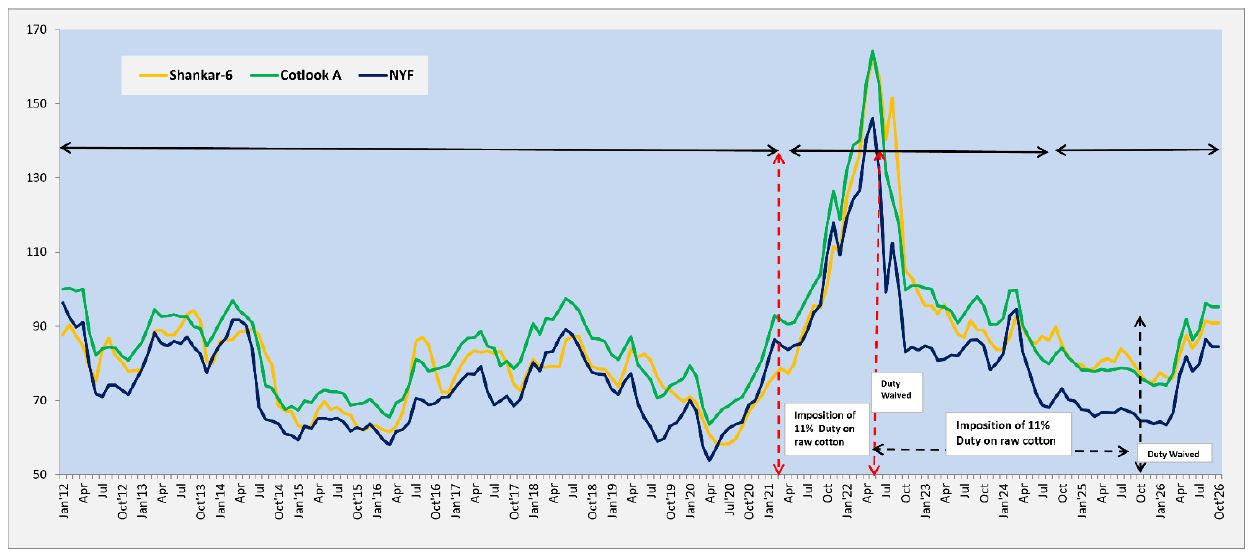
In a press release issued here today, Mr Durai Palanisamy, Chairman, The Southern India Mills’ Association (SIMA) has profusely thanked Hon’ble Prime Minister, Hon’ble Union Ministers for Textiles, Commerce & Industry, Agriculture and Finance for considering the representations made by the entire cotton textile value chain in the Nation and exempting the cotton from 11% import duty till 31st December 2026, that had already been exempted for the period 1st June to 31st October 2026. He said that the industry could import around 72 lakh bales of cotton during the cotton season 2025-26 taking advantage of temporary duty exemptions, mitigated the cotton shortage, avoided job losses and met export commitments. He has stated that cotton duty removal is inevitable for the sustained growth of the textile industry, specifically for concluding long term contracts with global brands.
SIMA Chairman has stated that there was no import duty on cotton during the period 2008-2021 that ensured win-win strategy for both the cotton farmers and the industry. He added that there was a logic for the Government to levy import duty when the country was net exporter (exporting 30 to 70 lakh bales) and the Government had to give temporary exemptions from year 2022 to mitigate cotton shortage and avoided job losses.
With stringent restrictions on the introduction and adoption of advanced seed technologies and defoliants, the constraints to rationalise the number of approved cotton seed varieties from over 2,000 to just 20–30 high-performing varieties & the challenges of matching seeds to specific soil conditions, improving soil fertility, controlling pest infestations and enabling over 6 Million cotton farmers to adopt the best global agronomic practices, the sector is already facing considerable challenges. These are further compounded by increasing weather uncertainties and projections of a cotton shortage exceeding 100 lakh bales in the coming years. Against this backdrop, there is absolutely no rationale for continuing the import duty on cotton, asserted Mr Durai Palanisamy.
He has further said that the private seed producers would continue to face difficulties in bringing latest technology seeds under joint venture owing to licensing issues and supply only low yielding seeds that would take several years to address cotton productivity issues. He has said that Indian cotton productivity is 430-440 kgs/ha as against the world average of 815kgs/ha and over 1500 kgs/ha productivity level being achieved by more than 20 Countries in the World.
Considering the urgent policy intervention for raw material security, SIMA Chairman has appealed to the Hon’ble Prime Minister to intervene and grant import duty exemption for all varieties of cotton till 2030 and review the same thereafter to curb price speculation, bring price stability, ensure level playing field, take advantage of the new market opportunities emerging out of FTAs and enable Vikshit Bharat. He has further suggested that the Government may periodically review the domestic cotton supply-demand position and prevailing price trends and adopt appropriate mechanism to safeguard the interests of all the stakeholders.