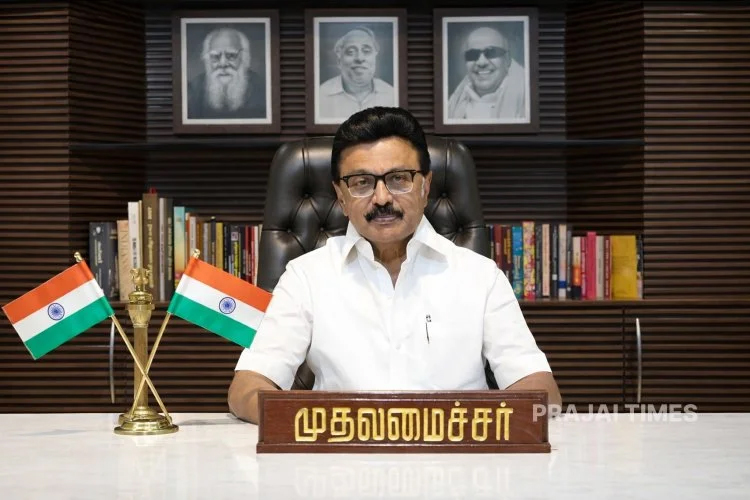
 In a major boost to the Textile industry which was facing hardships due to US tariff hike, Tamil Nadu Chief Minister M K Stalin on Thursday announced 20 per cent capital subsidy for purchase of modern machinery for weaving and knitting units in the State.
Virtually inaugurating the 2-day first ever International Textile Summit-360 in the Textile city of Coimbatore, he said for this purpose Rs 30 crore funds would be earmarked every year. He said while ensuring inclusive growth with social justice under the ruling DMK’s Dravidian Model regime, Tamil Nadu has retained its position as the largest exporter of readymade garments for the lasyt five years in succession.
This accounted for 33 per cent of the country’s total textile trade providing direct jobs to 31 lakh workers of whom 60.12 per cent were women. Highlighting the good infrastructure and investor-friendly ecosystem, Mr Stalin said the State government was taking proactive steps to mitigate the impact of the 50 per cent tariff hike imposed by the US, including identifying new export markets.
While urging the Centre to abolish 11 per cent import duty on cotton, Mr Stalin said the textile sector witnessed remarkable growth on par with automobile, IT and footwear sectors, and promised to elevate the Textile sector to global standards.
Exuding confidence that the conference would play a key role in attracting foreign investments amid the ongoing India-EU trade dialogue, the Chief Minister a total of 55 MoUs are to be signed for Rs 915 crore at the summit. During the summit, an integrated Textile policy 2025-26 was also launched.
Meanwhile, Tamil Nadu Minister for Handlooms and Textiles announced that a textile park was coming up in the southern Virudhunagar district which would attract investments to the tune of Rs 10,000 crore.
In his address at the summit organised by the Tamil Nadu government and the CII at the CODISSIA complex, he said the PM Mega Integrated Textile Regions and Apparel Parks (PM MITRA) at Virudhunagar on 1,053 acres will have common infrastructure developed at Rs 1,894 crore.
In his address, Deputy Chief Minister Udhayanidhi Stalin said known as the Manchester of South India, Coimbatore truly reflects the innovation, industrial excellence and the entrepreneurial spirit of Tamil Nadu’s vibrant textile sector.
Stating that this summit will further reinforce Tamil Nadu’s position as the Textile Valley of India, he said “Our greatest strength lies in the comprehensive textile ecosystem – from fiber to fashion, we deliver everything. Our major textile clusters–Coimbatore, Tiruppur, Erode, Karur, Salem and Chennai have evolved into globally recognized hubs.
Recently Madurai, Dindigul and Virudhunagar together are emerging as key growth corridors for spinning, weaving, processing, garmenting and value-added textiles”. These clusters set benchmarks in quality and innovation, he added.
Observing that Tamil Nadu’s contribution to India’s textile sector was both immense and consistent, Mr. Udhayanidhi said Tamil Nadu accounted for 33 percent of India’s textile business with 46 per cent of yarn production capacity and 70 per cent of cotton fabric knitting capacity.
More importantly, the textile sector in Tamil Nadu provides livelihoods to over three million people, accounting for nearly 28 percent of India’s total textile employment. Notably, 42 per cent of all women working in factories in India are employed in our state from Tamil Nadu which reflects the Chief Minister’s commitment to inclusive growth and women empowerment. With various reforms and support from the state Government, Tamil Nadu is not just competing in the global textile market, but was setting new standards for others to follow.
As the Chief Minister leads Tamil Nadu towards the vision of one trillion-dollar economy, the textile sector will remain a very key pillar. By moving up the value chain, adopting new technologies and expanding global reach, our industries will drive this growth very soon, he added.
From Artificial Intelligence-driven business models, smart automation to robotics and next-generation machinery, Tamil Nadu’s textile industry is accepting the future with confidence and global ambition.
Assuring that the TN government was fully committed to supporting the textile industry ever, he said in response to the request made by the spinning mills from across the state, the State Government will be making necessary amendments to the six per cent interest subvention scheme guidelines.
This will enable the extension of benefits to pre-spinning and post-spinning machinery used in spinning mills. This will also allow the industry to apply under this scheme up to three times.
The launch of the new Integrated Textile Policy 2026 clearly reflects our focus on competitiveness, ease of doing business, sustainability and investment promotion. Observing that TN always offers a stable policy environment, a skilled workforce, robust infrastructure and strong governance, Udhayanidhi said these strengths make TN one of the most attractive destinations for the textile investments in the country and invited global buyers, technology providers and investors to partner with Tamil Nadu to collectively shape the future of sustainable and inclusive growth, especially textile growth.