Bliss Impex becomes world’s 1st to have 4 Durst printers under one roof
Durst is a world-leading manufacturer of advanced digital production technologies. In the active business areas, Durst is the first choice and a preferred partner for the transformation and digitization of industrial production processes. It is a family company with an 80-year history, where the values are focused on innovation, customer orientation, sustainability and quality.
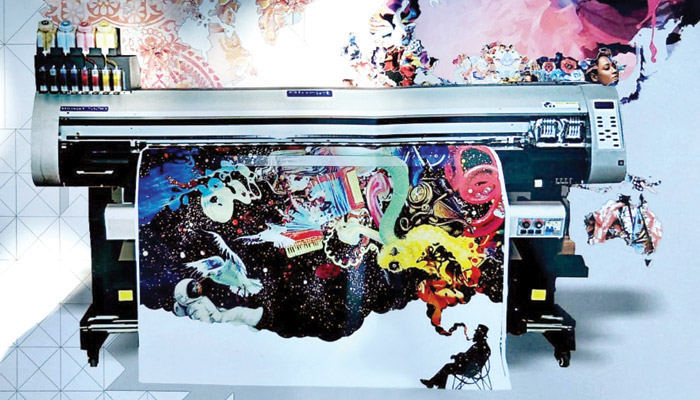
 Few months before, the company installed 4 ‘Durst’ high speed printing machines at Bliss Impex in Gurugram, Haryana. After this installation, Bliss Impex has become world’s first plant having this no. of Durst printers under one roof. Bliss Impex, is a company involved in conventional printing, digital printing and schiffli embroidery. Right now it has installed 3 of Alpha 190 and 1 of Alpha 180 machines; three are reactive while 1 is sublimation cum direct polyester disperse printing machine. These are high speed machines, which have 64 heads and it has been printing on them since post Diwali.
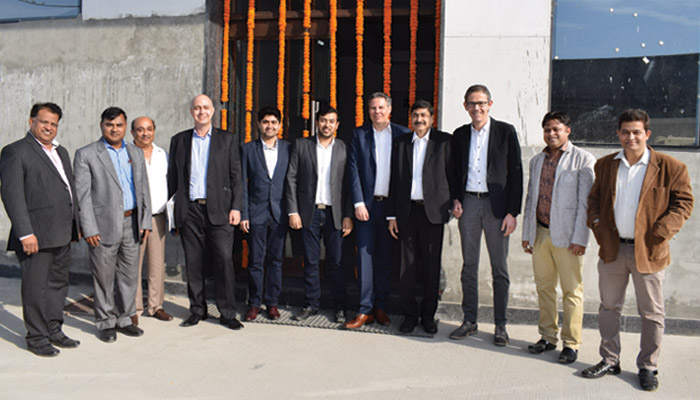
All four machines have been installed at Bliss Impex’s new plant in Gurugram, which was inaugurated by company’s Directors Ravinder Jain, Ekansh Jain, Nawal Khanna and Sawan Khanna along with Axel Stuhlreiter, Product Manager – Textile Printing, Durst Phototechnik AG, Headquarters; Christian Harder, Global Sales Director, Durst Phototechnik AG, Headquarters; Panos Bartziokas, Regional Business Manager, Durst Phototechnik Digital Technology GmbH; Dr. Rajeev N Verma, MD Durst India Pvt. Ltd. in the presence of other senior members from both the companies.
 “Our company is into conventional and digital printing. We got in touch with Durst around 4 years back. They first put their machine in ITMA Mumbai, which was their first exhibition. Finally, after researching for a few years, when we came to the right kind of pricing and costing, we collaborated with them. So now Bliss Impex has the maximum number of Durst machines. I don’t think that in all over world they don’t have more than 4 machines under the same shed,” said Ekansh Jain, while speaking exclusively to Apparel Views, Assistant Editor, Swati Sharma.
“The reason behind going for Durst was one, we wanted to get out of conventional printing, how we see India changing and in another 5 years, we feel that India’s going to completely become digital. Conventional printing is coming to an end and this is a new era of printing, which we were thinking of introducing and we are the first plant producing this kind of printing. Durst gives the right sharpness, and the depth which is not given by any other  available brand in the market,” said Ekansh.
Highlighting about the technology Ekansh said, “We have installed 3 of Alpha 190 and 1 of Alpha 180 machines from Durst; three are reactive while 1 is sublimation cum direct polyester disperse printing machine. The reactive machines are doing 45,000 sq. mtr per day and disperse printing machine is doing 4,000-5,000 sq mtr per day. The best part of digital is that there is no limitation of colours. So from about 8 colours, we get about 3,600 colours and can print anything.”
“Ours is a job work unit, so all of the people who are into the garment printing or reactive printing, they are my customers. The kind of pricing that we are giving is given by nobody in digital. Last month, we did a production of 3 lakh mtr. and that is the biggest advantage of the machine, it has proven its quality and its speed. We are looking forward to more industrial orders. We’ll definitely try to double our turnover in the next 2-3 years from the digital point of view and slightly give an end to conventional. We are already in process of finalizing the order for our next Durst machine, and soon for the first time in India, Durst Alpha 190 – Green Inks (Pigment Inks) will be installed at our plant”.
UNIX joins hands with Zhuji MAYA to open new showroom cum live demo center

Unix Stitch Machines Pvt. Ltd, which started its operations in year 2005, has offices in Surat, Ahmedabad and New Delhi. Unix is one of the most innovative and creative companies emerging in computer embroidery industry. The company has positioned itself as a pioneer technology supplier in the embroidery industry with a distinctive identity. An outstanding reputation for customer service coupled with management commitment to quality has made UNIX, the preferred supplier for a quality embroidery machines. Till day, it has installed more than 12,000 machines, out of which most were repeat orders, which show customers belief in its machines quality.
For last so many years Zhuji MAYA, an enterprise specialised in producing computerised embroidery machines, has been associated with Unix Stitch Machines Pvt. Ltd., which has been successfully selling and taking care of aftersales- service of Maya embroidery machines in the Indian market.
Established in the year 2000 in Zhuji City, Zhejiang Province, China ‘Zhuji Maya’ has an annual output of more than 4,500 sets high quality embroidery machines. Having advanced equipment for manufacturing and inspection as well as excellent work team, the company today has become one of the largest manufacturers of embroidery machines in Asian region. In fact Maya’s share in the Indian market has grown very fast in last nine years and it has become one of the leading suppliers of embroidery machines in India.
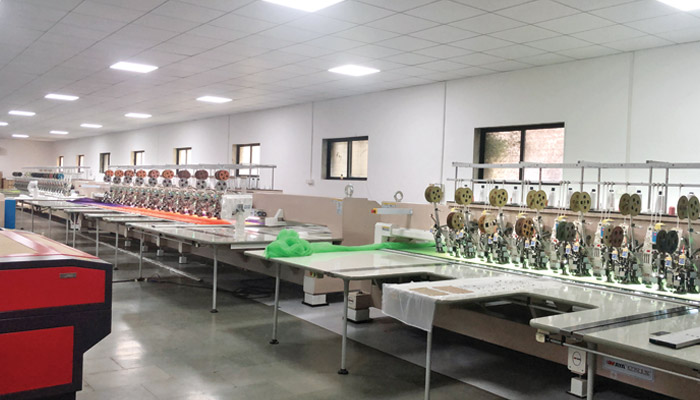
To serve the industry better, UNIX and Zhuji Maya have jointly opened a showroom cum live demo and training center in Surat at Hoziwala, Sachin for showing the actual working of the latest machines and providing training. According to Sanjay Jha, Director, Unix Stitch Machines Pvt. Ltd, “The idea behind setting-up this showroom cum live demo center is to show our new technologies to the customers. Here they can see the machine in actual working condition can develop their samples and send their staff for training on both software and hardware. This will also help the industry to provide trained manpower for new technologies.”
This place will not only work as live demo center to show new technologies but have separate departments for technical training, service, and product samples display facilities for giving best services to its customers. Here, the company has displayed all new variants of machines, which come under UNIX brand, like: Maya Embroidery Machine, Digital Machines, Value addition Machines etc. It will also be having a separate area for end products (samples) display.
SOME OF THE LATEST TECHNOLOGICAL DEVELOPMENTS
Today, Indian economy is largely dependent on apparel & textile manufacturing and exports. India earns around 27 per cent of the foreign exchange from exports of apparel and textiles. India’s exports of textiles and apparel rose 14 per cent on year in November 2018, at Rs. 18,965 cr compared with Rs. 16,707 cr in November 2017. Now to boost the industry’s growth, technologies play a very important role. This is the reason, why all major apparel manufactures have acknowledged the role of applying innovative techniques to help them remain ahead in today’s competitive markets. As a result, technology suppliers are striving hard to innovate and develop new technologies keeping with demands of the industry. In its continuous endeavour to provide the industry informative content, in the next few pages we are covering some of latest technologies introduced for apparel manufacturing…
Gerber innovates to meet personalization and need for speed challenges with AccuMark® Version 12 launch
 Gerber Technology delivers industry-leading software and automation solutions that help apparel and industrial customers improve their manufacturing and design processes and more effectively manage and connect the supply chain, from product development and production to retail and the end customer. Gerber serves 78,000 customers in 134 countries, including more than 100 Fortune 500 companies in apparel & accessories, home and leisure, transportation, packaging and sign & graphics. The company develops and manufactures its products from various locations in the United States and Canada and has additional manufacturing capabilities in China. Based in Connecticut in the USA, Gerber Technology is owned by AIP, a New York based, global private equity firm specializing in the technology sector and has more than $3.0 bn assets under management.
Personalization, convenience and value: Online and offline shoppers want it all. They expect brands and retailers to understand their needs and deliver new styles and trends faster than ever before. “To survive and more importantly thrive in today’s markets, fashion players need to improve their agility, speed and connectivity,” said Mary McFadden, VP of CAD Product Management, Gerber Technology. “Our Version 12 AccuMark Platform release delivers on these demands from product design and development to 3D sampling through optimized production planning and manufacturing.”
This is Gerber’s first of many software releases of 2019. It’s a year that promises to be notable for Gerber, as they deliver on a robust roadmap and work towards the opening of their NYC Innovation Center and Microfactory. Version 12 of the AccuMark Platform solves your business’ need for speed and adds features to address your customers’ demands for personalization. Its robust feature set is capable of addressing both on-demand or digital printing workflows as well as fully optimized mass production operations.
Studio Next presents latest cutting and spreading solutions
 In today’s dynamic economic environment, there is a constant need for improvement in processes. An organisation cannot always rely on past performance to remain successful perennially. In order to remain competitive, an organisation needs to upgrade its technology, rationalize the cost of production, improve the product quality & speed of delivery by maintaining less man power. Organisations will have thousands of job orders per year to accomplish, and thus they will always seek new ways to improve its processes. The focus on efficiency in the apparel industry is mainly on the reduction of the material costs, which often reach up to 75 per cent of the total production costs.
With the help of automation in its process, an apparel manufacturer can achieve its targets. Since 2003, Studio Next Technology Pvt. Ltd. has been playing a vital role in the process of bridging the gap between the industry and its demands in the automation process, by offering the latest technologies.
Pattern Making, Marker Making & Fabric Cutting are considered to be the most important operation in apparel manufacturing process owing to the following factors:
 Firstly, fit is the most important factor leading to the final acceptance or rejection of a garment. – and a good fit is dependent on the Pattern. Studio Next Provides a powerful high end Richpeace Drafting & Grading System for pattern making.
Secondly, laying out the patterns in fabric to prepare for cutting is an important step that must be done carefully and efficiently as it handles the costliest material resource – the fabric and it is vital that one orders the fabric appropriately. Studio Next helps in providing an efficient Garment Marker System along with its Powerful Super nest Module which helps in optimising fabric consumptions.
Thirdly, the spreading and cutting process is irreversible and the concept of repair or alteration does not work here. As such, it is vital that one needs to track the cutting room processes to keep errors to a minimum. Studio Next helps in providing fully automated Spreading and Cutting Machine which ensures that errors are kept to the minimum.
In this GTE edition, Studio Next is happy to announce its launch of new products, ‘SCOPE’, a low-cost semiautomatic spreader which eases the laying process and doubles the production capacity and reduces the man power into half and ‘RP-MJ/4 New Generation’, High Speed plotter for printing the markers for the organisations who wants to go slow on investments like Automatic Spreading & Cutting Machine.
Gemini presents latest CAD Systems

Onyx Solutions is an Official partner for Gemini CAD Systems in India. Gemini CAD Systems is a leading global supplier of technology for industries working with soft flexible materials such as textile, composites and leather. Its activity includes research, development and implementation of software, hardware and workflow solutions for apparel, furniture and automotive, with focus on computer aided design (CAD) and computer aided manufacturing (CAM) applied in the cutting room.
At GTE 2019, the main focus with key highlights of its product will be brand new Gemini CAD X19 Version which was recently launched with some unique and innovative modules compare to some similar products on the market.
The Gemini X19 CAD generation is designed to simplify the processes and to cut the costs and time in the cutting room for industries such as fashion & apparel, furniture & interiors, automotive & aerospace, shaped textile digital printing. It will also display its latest and most innovative Inkjet Cutting plotter with HP-45 Continuous print technology at the show.
 Gemini Pattern Designer X19 includes:
- The base module – Gemini Pattern Designer X17 Pro – a complete pattern design application, which covers in an efficient and pragmatic way the dayby- day needs of the users
- 11 add-ons – advanced software modules for solving:
- Complex general needs – piece connectivity, products’ technical documentation, complex folds development, products on fabrics with repetitive motifs, etc.
- Niche sectors’ needs – digital printed goods manufacturing, on-demand and made-to-measure
production, POS and e-commerce integration, leather goods manufacturing - Functional and organizational needs – communication with production management systems, product traceability, protection of intellectual property rights.
Gemini AutomART solution includes:
- AutomART 2Design – a software add-on to Pattern Designer X17 for processing graphical resources included in patterns; the output is a single file, containing both the model and the artwork, for all the sizes
- AutomART 2Nest – a software add-on to Nest Expert X17 for automatic nesting of parts with graphical resources; the output includes a standard format file with the optimized marker, to be sent to the single-ply cutter, and a PDF file with the artwork, to be sent directly to a wide format printer
- VisionCUT® – an advanced technology for fabric scanning and cutting control, as additional equipment to the cutter
- CutCollect® – an advanced technology for pieces collection, as additional equipment to the cutter
Gemini Pattern Sketch is an additional module for Pattern Designer X19
- Technical information on each part of the model can be set using text bullets, text on lines and contours, details on assemblies, the Piece Information Cartridge, as well as a large number of predefined graphic symbols associated with buttons, embroidery, printed and fused decorations, industrial standard sewing and processing lines, etc.
- The overall graphics of the technical documentation can be customized upon user choice or following the organization’s standards
- The product Blueprint, included in the documentation, is synchronized in real-time with the model, avoiding the risk of errors, saving time and effort
- Some information included in the technical documentation, such as fabric processing, fabric and accessories consumptions, etc., can be integrated with ERP / PDM systems, preparing other manufacturing operations or other stages in the production flow
 Marker & Fiber Laser Marker Machine by Angel India
Angel India Cad Cam Private Limited, established in year 2004, are among the prominent manufacturers, exporter, traders and importer of supreme quality in the world of Lasers, CNC Routers, Imaging & Printing products such as laser cutting, laser welding, laser marking, UV flatbed printers, wide format printers, eco solvent printers, CNC routers, flat bad cutting plotter. Given are some of its latest innovations:
Co2 Marker & Fiber Laser Marker Machine
Product Features:
 The fibre laser marking machine use Raycus or IPG laser sauce, sealed laser structure, output optical fibre, optical isolation, free maintenance.
- Digital scanner can mark as high speed. Powerful control system can optimize different processes according to the various data. Multi-language is available. It supports up to 256 colour layer management functions, meet multiple application.
- Fast speed, small size, low power consumption, out-of-the-box, easy to operate. Applicable materials: Iron, stainless steel, aluminum alloy, zinc alloy, copper, nickel, plastic (PVC/PC/PU), ABS material, epoxy resin etc

Angel Co2 Laser Marker Machine
Angel CO2 Laser marking machine enables optimal marking conditions for a variety of materials. With a wavelength of 10.6um, high precision marking is easily achieved. The Galvo-steered beam designed for marking enable the machine to mark at speed as high as 20,000 mm/sec. CO2 laser systems can be used to mark 2d barcodes, 2d data matrix, logos, or any sequence of characters and numbers on your parts and products. Marking data can be input manually, bar code scanned, or downloaded from your mainframe computer or network system.
Application: Electronic component, craftwork gift, leather, shell nameplate, rubber products, garments accessories, fabric cutting, foodstuff, medicine package printing & plate making, jeans whiskering, damaging and writing.
Morgan presents software solution for pre sew process optimization
Morgan Tecnica produces technology ‘Made in Italy’ and exports it all over the world to the enlightened and modern companies. Its cutting room machinery, software and friendly service network represent the top ambition for those who operate in the textile industry and are willing to innovate. From the country of fashion, the most advanced “Fashion Technology.” Morgan Tecnica provides software solution for pre sew process optimization. Given are some of its latest technologies:
Product Lifecycle Management (PLM)
PLM is a fashion specific product lifecycle management solution. This application is a modern tool for companies in the fashion industry. It is intuitive and user-friendly and at the same time specific/customized to the requirements of the textile industry. PLM covers every process from the point of creating the collection to the point of receiving the end products. The application combines tools for collection planning, product development & specifications, cost calculation, order & delivery management and a flexible work-flow management within a single platform.
Features: Collaboration and Mobility, Collection Development, Material Management, Base Libraries, Product management, Purchase Management, Delivery Management, Sampling, Quality assurance, Transparent progress and Status control, Integration with existing systems like ERP, MDCOP, 3Dress, sketcher, painter.
Benefits of using PLM:
- Simplifying and optimizing the processes
- Simple and effective communication between internal and external stakeholders,
- Using a comprehensive PLM-database
- Better control of each milestone creates transparency
- Reduced costs by direct and fast communication as well as a process automation
- Increase the revenue by saving time and reducing costs
- Immediate identification of critical situations with an easy search option for alternative solutions
- Optimizing of product quality by avoiding mistakes increase of customer satisfaction by optimizing product quality
Cop-Cut Order Planning
COP is an essential tool to organize and automate the cutting room operations resulting in a more efficient work flow. This software optimizes the labour and material cost which is considered to comprise the highest percentage of cost involved in the cutting room. It decides the combination of markers & lays for a particular order. This is a standard process done in every factory. It is the link between the marker room and the cutting room. Morgan Tecnica also implemented MTM COP, the system specific to manage the orders for “Made to Measure” production. MTM COP allows elaborating MTM orders in a fully automatic process, even without any operator, starting from the order collection from retail shops or from web.
Features:
- Work order analysis
- Optimal cut planning creation and production increase
- Time and fabric consumption optimization
- Marker and relative size ratio selection
- Optimization of nesting, spreading and cutting
- Machine remote programming
- Interface able with ERP systems/ Fabric Ware House / CAD
- Detailed reports
3DRESS
 3Dress is the virtual designing software, wherein the look and fit of a garment can be checked. It works on a virtual body form or avatar which can be changed and customized as per the client requirement. The major highlight being how realistic and natural this software is, there are various in built human body motions, resulting in an impactful, true and almost accurate fit of the garment.
All these result in speeding up the design and sampling process, the designs are tested in real time, so there are quick and better design improvisation. It takes utmost care of the special details related to the fit and look of the garment with the avatar movements, expressions, shoes, hair etc. The real time simulation is the USP of this product. Effectively eases and reduces the prototype manufacturing process.
Special features of Morgan 3Dress
- Customization -The avatar is customizable. The software has some pre-loaded commonly used sizes but the avatars are totally customizable morphologically, the body measurements can be entered and saved for future use. With every measurement entered the avatar responds in real time.
- Fabric gravity- Along with the avatar movements, the software also considers the fabric performance according to its specific technical specifications like the weight, elasticity, texture, structure, stiffness etc. According to these fabric properties the software will change the flow and drape of the garment in various motions in a very realistic way.
- Complex movements
The complex movements like walking, dancing, jumping, thinking, turning around, running etc. are very smoothly and naturally replicated by the avatars. The user can check the garment in any angle and condition.
• Additional Features- 3DRESS SHOP, 3DRESS VIEWER
Enterprise material management solutions by ThreadSol
 ThreadSol has announced its acquisition by Coats. ThreadSol will now be a part of Coats Global Services, a dedicated business providing a set of complementary software solutions to the apparel and footwear supply chain to deliver operational benefits in cost, speed and compliance. ThreadSol’s products provide an excellent fit with Coats existing Fast React Systems and GSD range of Evolve™, Vision™, Align™, Enterprise™ and Quest™. This complementary suite of software solutions for the apparel and footwear industries will enable brands, retailers and manufacturers to drive productivity gains, supply chain control and speed to market.
The world has transformed, trades have advanced. With the boom of the new era, apparel business all over the world has witnessed majestic shifts. To manage this change, apparel manufacturers need to accelerate their operations and re-evaluate the legacy of manufacturing practices. The dynamic technologies being introduced each day is a sign of constant development. ThreadSol – the pioneer in enterprise material management for the sewn products industry- takes pride in constantly challenging the present and being part of such a revolution. Its outlook is to introduce technologically driven products to drive manufacturing by targeting material cost and differentiate from the extremely competitive environment. With its innovative solutions, ThreadSol demonstrates an entire range of enterprise material management solutions, which can help apparel manufacturers and brands to boost their topline and bottomline, in an industry that is heavily dependent upon economic priorities.
IntelloCut
IntelloCut is a material planning and optimization solution for the sewn products industry. The flagship solution of ThreadSol has been successfully deployed in 150+ factories worldwide, who plan 1.5 bn pieces per year. With the help of its advanced algorithms, IntelloCut gives the most optimized cutplan and lay plan, in just one click. The cloud computing structure helps to access the solution from any point. It also offers a feedback system which works like GPS: Any variations on floor and the plan can be changed with a single refresh button. With over 150 features, intelloCut is a product ahead of its time and truly defines the new age technology.
In a constant effort to improve, ThreadSol has introduced IntelloGreen: A tablet application which replaces on-floor printed lay slips. The application is based on cloud computing and takes data from intelloCut, transforming business from traditional to environment friendly. The advanced reporting structure of IntelloCut provides an edge to the manufacturers to get complete control over factory’s practices through intelloMobile: World’s first fabric utilization reporting app. It provides 100 per cent real-time traceability of fabric, with all reports on mobile phone.
IntelloBuy
 IntelloBuy is a material estimation solution for the sewn products industry. It is the second product by ThreadSol, taking the enterprise material management model of the company to the next level. It gives accurate buying consumption for a particular style which saves millions of dollars of material cost at the buying stage, every day, for manufacturers worldwide. intelloBuy accesses factory historical database and allows the user to add exact wastage from factory floor to generate the most accurate fabric requirement. This can save up to 10 per cent fabric cost, ultimately boosting profit (bottom-line). Through the advanced reporting offered by intelloBuy, one can get details of the consumption calculation for different style/ order, vendor details for width/ shrinkage, factory process loss, buyer’s details of size-wise order break-up etc.
intello3C
 intello3C is an AI based cost negotiation platform. Intello3C aims to reduce sourcing cost and costing lead time for apparel brands. The current market scenario is very challenging. The lead time and retail prices are constantly decreasing whereas the cost of sourcing continues to increase. Currently, vendor cost negotiations are based on merchant experience. There is little focus on scientifically arrived accurate internal cost benchmarks for various cost components like fabric, CM, trims etc. for each style that is costed. This inflates the sourcing cost. Moreover, most vendor cost negotiations are carried out over email and excel, that is time consuming and adds to the ever shrinking lead time.
With fast fashion, the challenges with vendor cost negotiations are going to multiply. This is already resulting in suboptimal costing. Intello3C uses advance technology like Artificial Intelligence, Big Data, Mobility and Agile Analytics to solve this problem. Intello3C creates scientific and fact-based benchmarks for all the cost components. intello3C uses AI that can automatically negotiate the best cost with the vendors without needing any manual inputs from the merchant teams. intello3C results in 3-5 per cent decrease in sourcing cost and 30 per cent decrease in costing lead time.
Spreading System by Eastman
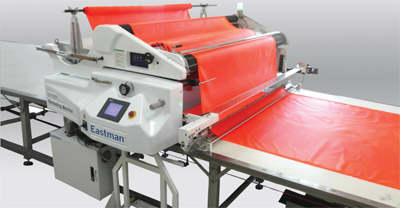 Eastman Machine Company is a cutting machine manufacturer, providing custom engineered solutions and innovative technologies for a variety of industries. Eastman offers the industry’s widest range of classic, handheld and manually-operated fabric cutting machines; as well as a comprehensive line of fully automated, computerized cutting and plotting systems.
Spreading System – ES-1800
The Eastman ES-1800 Series Spreading System is suitable for all types of fabrics and offers multiple functions for fast and easy spreading heights up to 7.9” (20cm). Available in several sizes, the ES-1800 is the perfect solution for accurate spreads.
System features:
• Spread one-way (face-up) or zig zag (face-to-face)
• LCD touch screen control panel with multiple languages
• Ergonomic material loading position Dual extension system for maximum tension control
• Emergency stop control
• Safety zone indicated with highlighted bar
• Advanced end cutter design ensures end cutting quality
• Timing belt and encoder system makes more accurate spread lengths
Technical specifications:
• Spreading speed 97m/min (106 yards/min)
• Max. Spreading Height 20cm (7.87 inches)
• Pass through height 23cm (9.05 inches)
• Spreading Length Accuracy +/- 3mm (.11 inches)
• Edge Alignment Accuracy +/- 2mm (.07 inches)
• Max. Diameter Roll 72 cm (28 inches)
• Roll Weight Capacity 180 kg (397 lbs)
 Automatic and Digital sewing solutions by Juki
Juki advances its activities to create the most suitable factories by making innovative efforts to solve the various problems a customer faces, through the further evolution and systemization of products and IoT.
Digitalization
Juki’s Digital Sewing Machines can respond actively to changes in sewing items and materials. These sewing machines are capable of digitalizing “seam” adjustment functions and setting parameters can be stored as a pattern. The data after adjustment can be transferred through tablet or mobile with a dedicated app (application program) to other sewing machines. The same setting can be shared to other factories, which is running with same style in order to attain same quality seam. This will help the factories reduction of machine setting time during line set up.
 Juki’s Digital Sewing Machines: DDL-9000C, LBH- 1790AN, LK-1900BN, LK-1903BN
Atomization
Due to the raise in global competition factories are required to reduce their manufacturing cost and to support them Juki is coming up all new range of automatic machines which will help them process cost reduction. Apart from cost reduction there are benefits like consistent quality and reduced rejection rate as there is no manual intervention. There is consistent increase use of automatic machine in apparel sector compared to last year. And we have customers using all our automatic machines in apparel, knits as well as non-apparel.
Juki’s Automatic Sewing Machines: PS-700 and MOL-254
Systemization
An IoT based system capable of performing connects all of the machines in a network. Juki meets customer demands by proposing line solutions to overcome production challenges using innovative, high-precision technologies under the “Smart Solutions” slogan. Equipment data such as operation information on individual sewing machines is visualized in real time, analyzed and used for production improvements, speedy response and operator education.
Brother focusing on automation and data exchange
 Industry 4.0 is a current trend of automation and data exchange in manufacturing technologies. It includes cyber-physical systems, the internet of things, cloud computing and cognitive computing.
Brother is focusing towards fourth industrial revolution by introducing Brother Network System IOT in which the Brother industrial DigiFlex sewing machines are successfully connected to cloud server by which we can extract data of production in real time and take real time action resulting in efficiency improvement.
What is IoT? The internet of things, or IoT, is a system of interrelated computing devices, mechanical and digital machines, having the ability to transfer data over a network without requiring human-to-human or human-to-computer interaction.
The industrial machines connected to Brother IoT will generate the useful conditional reports like line balancing Bar graph, hourly production with operator rate, machine status, and machine data by which the production and maintenance team can visualize the data to take real time action towards improvement of productivity and reduction in down time.
DigiFlex feed system is one of the innovation, towards industry 4.0 that Brother has introduced to revolutionise the garment sector as Digiflex grows profit. The DigiFlex models promises to improve quality and productivity as it is a key factor in apparel industry to reduce the cost of manufacturing.
The Brother focusing towrds providing solutions for potential problems that apparels industry has no option to eliminate. Digiflex technology helps the maintenance team to adjust the machine with a touch of a option where feed system is digitally controlled by one pluse motor and providing 3 additional feed motion in which garent factory can reduce roping effect and puckering effect and improve quality of the garment.
The technology also provided with sensor to provide consistent SPI at crossover seams and eliminating the usage of hammers which is one of the major compliance issues. This process also reduces the handling time and reducing of cycle time, resulting in efficiency improvement. And also helps in reduction of manpower in the line.
Pegasus presents latest sewing machine series
 Pegasus Sewing Machine Mfg. Co., Ltd., is one of the leading manufacturers of sewing machines in the world. Given are some of its latest innovations:
FS700P-A series LaRgo
Equipped with independent right and left differential feed ratio adjustment mechanism.
Oil Barrier type, 4-needle flat seaming. Unique design of independent right and left differential feed ratio mechanism produces beautiful and stable sewing result even on different fabric within same garment.
• Easy to seam different fabric material: Effective to seam different right and left fabric material such as sportswear
• Reduce operators’ manual adjustment: This unique feature enables operators to seam two different types of fabric easily
• Stable quality and improvement of productivity: It keeps stable sewing result not depending on operators’ skills, which contributes to stable quality and improvement of productivity.
M900/DDM series (Equipped with direct drive motor)
M952-52H-2X4/D222
M900 series with direct drive motor
• Equipped with Direct Drive Motor: Pegasus original motor: Pegasus guarantees quality and safety; CE marking: Clearing all CE standard; User Friendly: Quick and easy installation; Safety and high efficiency. (Patented Design); Motor design with original bulkhead coupling is UN-necessity and High Power, 550W.
• Dust Prevention: Dust seal at upper looper mechanism prevent from dust problem and no damage on the machines.
Interlock Stitch Machines – WT169P series
WT169P series – “Oil Barrier” type (Variable top feed, interlock stitch machines with an extremely smallsized cylinder bed). Extremely small-sized cylinder bed.
Block oil leakage
The needle bar includes a newly designed oil seal and bushing, exerting dramatic “Oil Barrier” effectiveness, preventing oil leakage and oil splashes. And maintenance is very simple and easy, such as change the oil seal.
This feature reduces oil stains on sewn products, decreasing the use of stain remover. The WT169P series is a reliable sewing machine that creates a clean work environment and contributes to global environmental protection.
• Variable top feed, interlock stitch machines with an extremely small-sized cylinder bed (circumference:113 mm)
• Thanks to this cylinder bed, the sewing of smallsized tubular goods, such as sleeve openings and bottoms of wear for children and babies, which would otherwise be difficult, is easy this features increase the quality of sewn products
• Equipped with the belt type bottom feed mechanism and a top feed dog, these machines sew cross seam sections smoothly, so that no ply-shifting and/or twisting occurs on the fabric during sewing. Neatly finished products are obtained
Twin head, Ultrasonic Automatic Elastic Band joining machine- XJ-C311-CCD2
Main functions:
• Thread wiper
• Production counter
• Double size bobbin
• Automatically stop working when disconnected
• Elastic band hot ironing device
• Ultrasonic welding
• Automatic identification of rubber band joints and cut off
• Unit number set counter
• Automatic stop
• Intermediate presser foot
 Circular Hemming Machine by iSEw
iSEw Brand’s latest innovation is Circular Hemming Machine i.e. BSA – Automatic Circular Hemmer – BSA 1920/SA/IF18 – LHS. This technology is designed for automatic hemming of T-shirt, panties, sport clothes etc. Given are its features:
• 15-32 mm special needle width
• Automatic stacker system
• Works with photocell or switch
• Optional stacking types
 • 200 program memory
• Height adjustable stand
Advantages:
• Optional needle width
• 2, 3 machines with one operator
• 5,000-5,500 pieces in 8 hours electronic edge guiding ystem (EKF)
• EKF electronic edge guiding system will automatically prepare your fabric’s side seams equal
• It has adjustable 15-32 mm needle width. Winder widths are available on demand
• With electronic stacker system, your products stack equally and efficiently. Every piece will be ready for next step
• Thanks to adjustable sewing speed one operator can work with 2, 3 machine
 Automatic Pockets Setters and Sleeve Placket Setters by IMB
Since 1995, IMB is operating successfully in industrial sewing machine segment. IMB has been sticking to R&D and has built up its own styled transformation road successfully. Given are some of its latest innovations:
Automatic Denim Pocket setter (Single Needle) – MB1002C-BR-1-BAS311HN
• Creasing-free one time folding mechanism
• Auto-folding, loading, sewing, collecting, mechanism
• Apply to varieties of different pocket shapes
• Work skills unneeded
 Automatic Sleeve Placket Setter – MB5009B-BRS7300A- 303
• Left sleeve placket & right sleeve placket can be both made on this machine, no any physical change involved
• Innovative new operation system, easy program mechanism, easy jig change mechanism
• Work skills unneeded
• Match up with placket creaser together using
Automatic Shirt Pocket Setter (1 Needle) – MB1002B-1-S7300A-303P
• Creasing-free one time folding mechanism
• Innovative new operation system, easy program, mechanism, easy jig change mechanism
• Auto-folding, auto-feeding, auto-sewing, autostacking mechanism
• Apply to varieties of different pocket shapes
• Work skill unneeded
Vetron direct-drive lockstitch machine with triple transport
 The Vetron brand stands for high-value products developed for processing textiles and leather, multiple awarded innovative solutions focused on the customer´s needs, and the German art of engineering connected with professional service. Products are made from selected components throughout Europe and Asia offering a superior price performance ratio and innovative functionality, setting new standards of process security through the use of high technology. One of its latest offerings Vetron 5000 series is a direct-drive 1-needle lockstitch sewing machine with triple transport.
Through the consistent use of state-of-the-art electronic control it became possible to make all machine settings programmable into memory and thus recallable. This allows the process parameters to be free from operators influence and identical every time the programme is recalled. The innovative dynamic machine parameter, based on the actual speed and the permanent measurement of the material thickness, open new possibilities of production quality, process security and the reduction of cycle times.
Programmable set-up
• All machine settings are programmable and storable: Stitch length, sewing feet pressure, top feed stroke, needle thread tension, clearance under the sewing feet …
• Fast and precise setup of the machine by recall of a stored machine programme
• Easy to understand and intuitive programming concept
• Programme chain function to combine different production steps directly on one machine
• User identification by USB-dongle to avoid access on machine settings – on demand
• Stitch-in-stitch backtacking
Dynamic process
• Permanent measurement of material thickness
• Constant sewing feet pressure reacting on material thickness
• Sewing feet pressure reacting on sewing speed
• Stitch length correction reacting on material thickness
• Thread tension correction reacting on material thickness
• Top feed stroke management via sewing speed with automatic “cross seam function”
Process Reliability
• User identification via USB dongle (activated via parameter)
• Operator does not have access to basic parameters
• Various access codes for Operator / Line Supervisor / Technician/ Technical Supervisor (Administrator)
• Operator can change sewing programmes via scanner (option). The machine automatically adjusts to the preset sewing parameters (Stitch length, speed, thread tension, upper transport stroke, ruler distance … etc.) on
 Button Feeder & Bonding Technologies by SAKHO
SAKHO Group was established in 2011 by an energetic engineer of the garment industry inspired by Korean inventor (Served the garment industry more than 30 years who started his career as a mechanic to consultant). The company’s motto is to bring this industry innovative and unique in terms of machines or applications. It always prefers to associate with the foreign companies who are masters in their respective field. Sakho Enterprises is exhibiting button feeder & bonding technology application and samples form in GTE 2019.
Button Feeder BK-17
Button feeder a product from Korea under the brand BKS BUKANGS model BK-17. It is designed considering industry requirements and users feedback. It strongly says that it is upgraded version among all existing feeders available in industry. Button feeder is a robotic mechanism device used to feed the buttons to the button clamp on the button sewing machine. Operator doesn’t need to align the holes of the button. With its increased feeding speed, the sewing machine head speed can be used up to maximum, which results in higher productivity. Using this device a beginner shows double productivity than skilled operators.
• Colour sensor optional
• Easy button measure
• Easy micro adjustment
• Two times cutting
• Cyclic programme
• Point button
• One body type loosening clamp
• Easy X,Y adjustment
 Bonding Technology
Bonding is very popular in international market these days, and will be the game changer in garment manufacturing. Now you can see bonded applications in all major brands already getting engaged in some way. H&H who introduced a design studio in the name of UNIK TECHNOLOGYZ in Bangalore in 2016 with the concept to design & manufacturing of samples using bonded seam technology with the expertise of their business partner SAKHO and RCG. The idea is to give an option to the Indian brands to add such garments to their collections and if needed, even undertake the actual production, as the infrastructure created at the studio is geared for the same. The company delivers tailor-made solutions to its customers demanding quality considering helping from application engineering and manufacturing point of view. Manufacturing processes with futuristic trends are becoming ever more challenging in present time. New knowledge in this field will aid in the advancement of various technologies that would be needed to achieve industrial competitiveness. Comprehensive and up-to-date, precision engineering is cross-disciplinary.
AMF REECE specialty industrial sewing machines
 The AMF Reece specialty industrial sewing machines can be divided into the following groups – eyelet buttonhole machines, chainstitch machines, hand stitching machines, pocketwelting machines, seriging and side seamer units, sewing automats, sewing units, blind stitching units profile stitching system and newly jeans units.
Lately the most wanted by customers is the newly invented unique technology of the CBS-13 machine. Main features are the patent-protected concepts. Machine is controlled by a unique combination of mechanical and electrical components, allowing sewing at high speed. Full control of all the sewing parameters and button properties is achieved by utilizing several patent-protected concepts.
Needle-Bar – Looper Timing Mechanism controlling the relative position of the needle-bar and rotational looper, thus allowing high-speed neck wrapping by means of the needle-bar bite. This feature eliminates the need of looper left & right movement.
 Universal Flat Button Holder automatically adapting to minor button-hole spacing variances (thus fully covering the standard spacing range), easily adjustable to major variances and firmly holding the button during feeding.
AMF Reece links to its tradition also in jeans industry and brings a broad range of jean sewing machinery. High level automation is comprehended in belt-loop and pocket setters: The belt-loop setter Atlas Mark IV is the world unique machine allowing extreme flexibility due to its fully automatic belt-loop length adjustment. Thanks to this unique patent-protected adaptable system, the machine allows ultra-fast change to various requested belt-loop lengths in only a few seconds. Together with a comfortable belt-loop width change, the machine down-time is significantly reduced when switching between production batches.
 Besides, these machines mentioned above, you may also see other our specialized machines such as the eyelet buttonhole machine S311 LT, the pocketwelting machine LW-7001 and the newest chainstitch special application machine S4001 Indexer.
The S-311 electronically controlled, fully programmable eyelet buttonhole machine provides the user with total flexibility and versatility with a wide variety of models. Machine is equipped with new, faster control system, including 20 per cent reduced cycle time, and new larger touch screen display.
The versatile lockstitch pocketwelting machine LW- 7001 can be used for all types of welted pockets and is ideal for all segments of the apparel industry. Available models and a range of optional accessories make the lockstitch pocketwelting machine capable for use on a wide variety of applications.
The S-4001 ISBH machine is designed primarily for decorative sewing of buttonholes using special threads such as silk thread. The chainstitch imitation sleeve buttonhole machine is programmable to sew automatically up to 8 imitation buttonholes at specific distances between each buttonhole. The machine clamps can be set to sew imitation buttonholes at an angle of 0 to 20 degree from a sleeve cuff. The chainstitch imitation sleeve buttonhole machine is offered with large touch screen display that uses easily understood symbols and graphics to simplify the adjustments.
 Atlanta Attachment Company presents Automatic Hemmers
Atlanta Attachment Company is known in the sewing industry as the leader for standard and custom automated workstations, labour saving devices, folders and ergonomic risk reduction. Given are two of its latest innovations:
Automatic Two Needle Hemmer for Sleeves and Shirt Bottoms (Atlanta-213)
• Patented Serial Bus Control System
• DC electronic motor & controls
• Reliable edge trimmer
• Fold-in-half & stack or stack only
• Stacker & return conveyor for bottom hemming available
• Optional imitation cuff attachment (patented)
Description: An electronically controlled workstation consisting of a conveyorized downturn hemming apparatus with two-or-three needle bottom and/or top coverstitch sewing head, electronic motor, automatic edge trim and cut apart, and selfcontained waste disposal.
Options: 211EG Edge Guide System; Accessory kit (light and blow hose with nozzle); Top cover option: Yamato/Pegasus/Rimoldi; Spare parts kit; 12′ conveyor; Fold-in-Half Modular Stacker; Pick and Stack and return conveyor; Pick and Stack w/push table for sleeves & pockets
Automatic Hemmer/Seamer (Atlanta-411)
• Patented Serial Bus Control System
• DC electronic motor
• Combines hemming and closing operations with auto backlatch
• Sews 100 per cent cotton thread max RPM
• Plain hem or imitation collarette style (patented)
• “No tool” adjustments by operator
• Auto indexing stacker
• Computerized soft touch control system
• Adjustable transfer station for closing straight or contour seams
• Vision system allows operator to inspect each sleeve without stopping sewing
• Unique automatic fold-in-half system allows sleeves to be overlapped during sew cycle, increasing production
• Self-contained waste removal system
• Operator and technician friendly for easy adjustments and maintenance
 High-Speed Overlock Sewing Machine by Hikari
Hikari (Shanghai) Precise Machinery Science & Technology Co., Ltd., which is one of the world’s largest manufacturing and researching center of industrial sewing machine, also is one of the earliest Chinese enterprise to research and manufacture high–end computerised industrial sewing machines.
Computer Direct-Drive Intelligent High-Speed Overlock Sewing Machine (HX6800TD)
• Intelligent identify material: Automatically adjust the sensor mode and light system can protect the sensors from interference and wearing
• Upgrade fully: Integration design can improve performance and stitch quality
• Magnetic controlling system: Superior precision allowing setting stop
Function:
Easily the integrated design helps transportation and installation, Sewing speed Max 8,000 rpm, LED light.
Loiko Global presents Button Feeder attachment
 As we all know that most of the time the garments packing get delayed due to pending Button Hole and Button Stitch operations. To finish these operations factories do overtime and require skilled operators to run such machines. So, to deskill the Button stitch operation, Loiko Global Private Limited has come up with Button Feeder attachment (LOIKO MODEL ST-12 MADE IN KOREA). Normally, a Button Stitch operator can attach 600 to 700 Buttons per hour during shirt production. But if he installs LOIKO’s Button Feeder in the same Button stitch machine he can attach 1200 to 1400 Buttons per hour depending upon the button stitch machine condition.
It means almost double production, and not required any skill operator. The beauty of the button feeder is that it can be installed in any Electronic Button stitch machines without any alternations. The advantage of our button feeder is reducing the manpower, reduce over time, increase the productivity, and reduce break down time. According to the company, in future 70 to 80 per cent customers will order button machines with Button Feeders. The ROI of our Button Feeder will be around 10-12 months. Today, most of its customers are using Button Feeders because of this technology being very user friendly, good quality, performance and strong after sales service support. The company has added few new futures in its LOIKO Button Feeder and its manufacturing company in Korea has got ISO 14001 & ISO 9001 International Certification.
 Computerized overlock and lockstitch machines by Bruce
Bruce industrial sewing machine was founded in 2006. The company is located in Taizhou City, Zhejiang Province, China which is the world’s most important production and R&D base of sewing machines. Given are two of its latest technologies:
New Computerized lockstitch machine- R5
It aims to build a strong industrial sense computerized lockstitch sewing machine. R5 is a new computerized lockstitch sewing machine with stable and reliable performance by adding the function of thread breakage detection, dense stitch, starting auto lifter, one shaft design, no skip stitch etc. It is a world record winning brand for doing longest continuous stitching for 64.8 mtr without thread breakage.This German technology is stable & durable (German industrial design, heel & hearty atmosphere). Its smatter rear cover makes full use of space add self-locking function more convenient to adjust the stitch length.
 Highlights: R5 is with dense stitch function short remaining thread (3.5mm), no need of manual trimming after sewing which saves lot of time and increases productivity. Based on aero dynamics theory large wind hand can increase air inflow, reduce the temperature of motor and control box, which greatly prolongs electronic parts. It will become a hot product in middle level segment market.
Computerized overlock machine – B5
Features:
• Automatic overlock machine
• No thread breaking, also stitch skipping
• Start & end suction device
• Three Operation Modes, Easy to Change: Full Intelligent Mode: Machine works automatically without foot Semi-intelligent Mode: Machine works with automatic sensor, automatic presser foot lifter, automatic trimming Computerized Mode: Machine
• Oil Control Effectively, High Yield: All inclusive needle bar and oil supply system, avoid to oil leakage
• One Key to Reset: Can choose back to user setting or factory setting
• One-shaft Design, Stable and Durable: Reduce machine troque, machine works more stable
• The Highest Speed Can Reach 7000 S.p.m: The efficiency of B5 is 35 -100 per cent faster than normal machine
Jack presents needle feed lockstitch and overlock machines
Established in 2003, Jack Sewing Machine Co., Ltd from Taizhou, China is one of the leading companies in the world involved in manufacturing and R&D of full series of lockstitch, over lock, interlock, special machines, machines for heavy-duty materials and pocket-welting machines.
 Jack Computerized needle feed lockstitch machine (A6F)
• Feed Smoothly, Avoid of Layers offset: Specialized feeding keeps fabric smooth without winkles and layers offset; applicable for yarn, chiffon and silk fabrics
• Beautiful stitches without short thread tail: Beautiful stitches and no need to cut remaining thread. End sewing remaining thread is short within 3 mm, auto lockstitch avoid loose stitch
• Sealed oil pan, No Oil, No trouble: Sealed oil pan, no dust into the oil, perfect lubrication, clean and durable
• Large space, wide range of application: The operation space can reach as large as 300mm, which makes fabric feed more smoothly, applicable for down jacket, shirts and suits
• Easy to learn, easy to sue: Easy to understand, no need to remember parameters
 High speed automatic overlock machine with pneumatic suction device (C5)
• High Efficiency: Max, speed can reach to 7000spm. Efficiency of C5 automatic overlock machine is 35 per cent-100 per cent higher than normal machine, for example, Worker salary =4000 RMB/month*(1+35 per cent)=5400RMB, monthly revenue increase 1400RMB/month, according to the analysis the income percentage of workers and boss is 4:6, then the boss monthly revenue increase 2100RMB/month
• Voice guide, easy to learn and operate: Automatic voice broadcast solution voice guide will help you understand each function
• One key to reset, trouble free: One key back to the user setting or factory setting
• Short thread tail, no need extra trimming: Auto thread trimming can control the thread trail to be within 5mm, no need extra trimming
• One shaft drive, stable and fast: Reduce the machine torque, making the sewing fast, stable and durable
• With start and end suction device clean sewing: Automatic suction device makes clean sewing
 Robotech presents automation sewing systems
Robotech A.G. was founded in 1997 to make design and production of automation sewing systems. It is a speciality sewing automation manufacturer that makes its own R&D, design, programming and production at its own 6.000sqm factory. Robotech’s motto is to provide top quality and maximum efficiency sewing automats with the latest technology for the garments manufacturers around the globe at affordable prices and feasible terms. It is also very pretentious on its fast delivery of spare parts and parts pricing especially compared to the German and Japanese manufacturers. In terms of Formal Jackets and trousers’ automation Robotech has a full line.
 It has some automats, which are very special and unique in their area of work. Such as the LB6000-Care Label Attaching Automat (4/6 and 8 heads options as well as Hot Cut & now Ultrasonic Cutting option) which is a bottle neck operation for exporters since now there are at least 4-5 may be more care-labels on every export garment.
Other, on demand Robotech automation is the AS5100/5100 Hanger Loop Attaching machine (Satin & nylon loop – Hot/Cold Cut or new Ultrasonic Cutting option) which is must machine for mostly ladies garments. Now it has not one but two versions allowing the loop end to face towards outside or inside the garment. Meanwhile, XP-7200 Polo Font Placket Work station with auto-front loader which not only speeds up a very critical operation on the Polo shirt production but also guarantees 100 per cent quality with stitch model variety. PE6000-K Knit Bottom Tubular Hemming Machine is another very fast and productive automat which allows one worker to operate 2 stations at once. In a world where labour costs plus rejected garments cost as well electric utility costs and price and sustainable quality competitivenes are stil some of the biggest worries of the exporters and Robotech automation solves all of those issues at once.
INL presents INA computerized Hanger system
 In growing India market automation is the key for every customer who wants to grow faster as automation always helps to organise the procedure of work where we are lacking. INL International Technology Pte. Ltd. provides the INA solutions for garments & home textiles from cut to pack where customers have the work flow in proper manner to have the consistency in work. We are customised in solutions so always gives the right solution to our customer and we have proven the same in India as well as in overseas market.
With the help of INA computerized Hanger system customer can be able to increase production output by 10-20 per cent with current set-up of machines & labour, Being piece by piece flow method Been adopted, it can reduce semi product upto 75 per cent, which will be able to increase production drastically & can save the labour cost much better and efficiently. With the help of effective software customer can take real time data, quantity & other end numbers of details each and every second, which will be very useful to take immediate action at production floor.
In India the company’s esteem customers are Welspun, D’ decor, RB Wovens, KKP Fine Linens, Asian Fabricx, Orient Fashions, Eastman, Zodiac, KKCL, RK International, Katbro Corporation, Shree Santosh Garments, Cottonking, Matrix clothing, G Surgiwear, New Zeel Rainwear, Shree Santosh International, BKS Textiles.
This edition at GTE the company is showcasing the multi floor concept where it can link the floors in terms of cut to pack if customer is having multi floor factory to reduce the transportation from one floor to another.
Needle detection with YORK Technology
 When it comes to detecting broken needle and other metal contamination in sewn product YORK® Technology continues to push the boundaries of performance. The unique technology developed by YORK® is based on Electro-magnetic Balanced-Coil Bridge and “Phase Detection” techniques to deliver the most robust solution for detecting needle fragments buried inside garments whilst ignoring zips and protecting retailer brand reputations like no other.
Since the electro-magnetic coils encircle the detection tunnel completely, there are no halfmeasures or one-sidedness to its unique head structure – the detector conducts a 100 per cent scan in a single pass at full sensitivity on each passing garment pack. There is no need to pass the garment twice or through two magnet type machines, nor to flip it and turn it in between two detectors. This makes double head magnet detectors redundant and the 9- point calibration check unnecessary.
Coupled with the inherent immunity from interference generated by sewing machine magnetic clutches and other electrically noisy equipment in the vicinity, a balanced-coil needle detector offers the most fit-forpurpose solution to meeting the Buyer’s Compliance, in-house due-diligence practice, brand protection and consumer safety challenges all in one package.
The company’s R&D Centre in UK has recently added to the ND product range, extending it to 6 variants – tunnel heights from 105mm to 305mm in increments of 50mm with tow tunnel widths at 550mm and 650mm are now available. This has broken new ground for achieving industry standard detection sensitivities in larger individual products such as home textile, which has not been possible before.
All machines come complete with conveyor speed control, quick-release belt mechanism, reversing function, production data recording, report downloading via USB port, light stack and a colour touch screen. A foot pedal accessory and many other novel value enhancing features are also being added. International brand retailers who appreciate the Balanced Coil design advantages, such as Nike, prefer it!
 JUITA presents latest sewing machines
JUITA Sewing Machine Co., Ltd. is a professional production of various kinds of sewing machine of modern enterprise, with the product development, manufacturing, testing, quality assurance, marketing, after-sales service as one of the operating system, the company has passed ISO9001:2000 quality management system certification.
Outstretched arm machine head rotate 360° seam series (JTK10)
• Rotate 360° machine head sewing; achieve perfect stitch at any angle
• K10-13085A (Standard Type)
• Heavy materials with machine head lift function
• Operating range: 130x85cm
• Scope of application: Clothing, household sofa, bags, leather goods, home
textile, sleeping bags, tents, seat cushions, car interior and so on
• Powerful CNC system
• Smart + wisdom + experience to compile the new instruction
• Outstretched arm machine head rotate 360°
• Double screw guide module transmission
• The main parts are imported parts
 Toothed belt guide module transmission mode (JTK8)
• Transmission structure design scientific, accurate, fast, simple maintenance, low noise
• Powerful CNC system
• Smart + wisdom + experience to compile the new instruction
• Toothed belt guide module transmission
• The main parts are imported parts
• K8-9A standard type
• Operating range: 120x80cm
Faster embroidery solution by Wilcom
 In 1979 Wilcom’s founders shared a vision for automating the embroidery industry that has changed the way people create and produce embroidered goods. A global organization headquartered in Sydney, Australia, the company has led the industry with ongoing innovations that push the boundaries of creativity in personalized expressions and apparel decoration. With a reputation for excellence, Wilcom has become the world’s favourite embroidery software for quality, productivity, ease-of-use and service.
The latest innovation by the company is Wilcom EmbroideryStudio e4.2, which has following
features:
• 64-bit support, making it faster and more reliable
• Large design thumbnails that generate instantly
• Ability to open and save designs up to 6 times faster
• Ability to open endless large images, limited only by your RAM
 Wide range of embroidery machines from Unix
Established in 2002, Unix Stitch Machines Pvt. Ltd. is one of the most innovative and creative companies emerging in computer embroidery industry. Within a short span of time the company has positioned itself as a pioneer technology supplier in the embroidery industry with a distinctive identity. Given are some of the latest technologies by the company:
 Digital Controlled Pressure Foot for Multi-Cording Embroidery Machine
• Foot height can be settled from computer settings
• Individually digital controlled foot
• Computer setting interface
• Usual flat embroidery machine
• Three dimensional embroidering
• Foot height settled from computer
• Foot remaining time can be settled on computer for fine stitch
• Setting pressure foot parameters individually for each colour
• Variable thickness cording material will be applicable
• Big cording cone can be fit on thread stand
Chain stitch tapping machine – Latest all in one machine
• Big tapping cone
• Motorized controller tapping cone
• Upgraded mechanism and stitch till 15mm wide tapping material
• Tapping combined with multi-color cording
 Multi-Head Multi-Function Combined Embroidery Machine
• Speed: 1200RPM
• Multi-Device: Giant Sequin Device Applicable Size From 3-50MM,Four Colour Sequin Device From 2 mm—9 mm, Loose beads device from 2.0 mm, 2.5 mm
• Device working at high speed
• 1650 Ultra X Stroke for more function combined
Textile Technologies presents high speed mixed embroidery machines
Textile Technologies was established by a team of very experienced embroidery and international trade professionals. We are the biggest and leading supplier of specialised embroidery machines. Now company has established itself as the most trusted supplier of embroidery products. We were the first one to run the Chain Stitch Machines successfully, alongwith our other regular Sequin & Cording Embroidery Machines. Given are two of its latest technologies:
 Mixed Chenille – High Speed High speed Chenille (Chain Stitch) + High Speed Flat Embroidery
• Dahoo control
• Chenille embroidery will be softer and precise due to X-Y servo motors
• 10 different needle heights for auto adjustment, chenille embroidery
• Towel embroidery, chain stitch embroidery can change colour automatically, with auto-thread break detection function
• Machinery structures, transmission structure are simple and accurate, reduces mechanical wear and tear: Easy to maintain
• A new generation of high speed chenille/chain/stitch embroidery head, long service life, easy maintenance, speed at 1200RPM, low operating noise
• Product is applicable in garments, home textiles, lace and most importantly shawls/ stoles suits industry
• Optional Attachments: Cording, coiling, taping, sequin, pearl device, Dedicated taping coiling head
 Mixed Lock Stitch Chenille Flat + Cording + Sequin Mix Embroidery Series Special Function Mixed Machine with Cording/Taping/Flat/Chenille/Towel/ Kiran Dori
• Dahoo control system
• Chain EMB taping embroidery, cording embroidery and other special embroidery
craft, double cording embroidery, double taping embroidery, pleating stitch
embroidery and other function
• The product is mainly applied to curtains, home textile, and garment
Groz-Beckert presents high-quality sewing needles
 As partner for the entire textile industry, Groz- Beckert satisfies the needs and requirements of the sewing and apparel industry. At this year’s GTE, the company demonstrates that not only highquality sewing needles are decisive for success, but also a comprehensive service that supports customers before, during and after the sewing process. This is exactly the approach of the service concept Sewing5, which is based on the five S’s supply, solutions, service, superiority and sustainability. Together, these key factors represent the consistent customer orientation and service competence for Groz-Beckert.
Another competitive edge of Groz-Beckert’s sewing sector is the provision of an online customer portal. Comprehensive information on the sewing technology as well as a digital product catalogue are now available around the clock. The exclusive access to animations on different types of stitch formation completes the versatile presentation.
The latest service highlight offered by Groz-Beckert is the INH Quality Management (=Ideal Needle Handling). It allows a trouble-free and time-saving handling of broken and damaged sewing machine needles. It also helps to meet the different specifications and compliances of brand owners and buying houses in a uniform procedure.
As of late, Groz-Beckert also offers a digital solution for the documentation of needle breakage, which is called Smart INH. It consists of two software components: A mobile app called INH@site as well as administration software called INH@office. They enable the digital storage of needle breakages (in form of picture-data sets) as well as the administration of machines, production orders and inventory.
 Automatic snap button attaching machine by JIAKE
JIAKE has been manufacturing Automatic Snap Button Attaching machines & Pearl attaching machines since 20 years. Also it is producing Patent machines like Automatic Snap Button Attaching Machines. It’s only the technology available in the world like without changing any parts can run the snaps, rivets, centre buttons etc. These machines are totally unique technology machines. HNS is its service & marketing partner globally. Given is its latest machine:
Automatic snap button attaching machine (DKJ-M629)
• Working speed: 40-45 pcs/minute
• Safe protection
• Rate of finished product: 99.9 per cent
• Energy-saving and environment friendly: Automatic power-off whenever stopping overtime can save energy all the time
• Convenient: PLC interface, convenient, easy to learn and fast to exchange the parts and molds
• Suitable buttons size: 9-24mm
• Output countable
• Laser location
• Application: Suitable for industries of garments, cases and bags, leather material, belts, shoes and artwork
 High production dye-sublimation printer by MUTOH
MUTOH Industries Ltd. from Japan leverages the know-how developed over long years of manufacturing experience, while continuing to focus on its core products of large-format inkjet printers, and promoting systematic enhancement with the aim of delivering highly cost-effective products and services that meet the needs of customers.
MUTOH VJ-1948WX (ValueJet made in Japan) Open a new era of high production dye-sublimation printing
Features:
• Staggered 4-printhead setup: Staggered 4-printhead setup enables high-speed printing and improved productivity. The VJ-1948WX achieves a maximum print speed of 1,263sqft (117.3m^2)* per hour.
• Built-in large dual heaters: Built-in large dual heaters provide fast dry times for increased production speeds. The large dual heaters are incorporated on the rear side of the front paper guide. Each heater’s temperature can be set from the control panel individually, and can be checked or changed anytime without interrupting the printing operation.
• Designed with advanced features: A pressure roller hold down system is equipped in both the front and rear side of the printer, and ensures easy handling by the manual lever from either of two locations. There are two pressure settings “standard” and “strong”. The pressure rollers can be raised up and down individually even when printing on thin transfer paper to avoid any wrinkles. An optional feed and take-up system maintains stable media transportation.
 Flat Embroidery and Automatic Template machines by Shanggong Gemsy
Zhejiang Shanggong Gemsy Co., Ltd. is a joint venture company which was invested 216 million RMB from Shanggong Group Co., Ltd. and Zhejiang Gemsy Electrical & Mechanical Co., Ltd. on 2nd Sep. 2015, with the purpose of creating Industry 4.0, carrying out sewing equipment “intelligentization, modularization and platformization.” The company which is located in Taizhou, Zhejiang Province, reputed by “Home of sewing machine in China,” and the construction area is more than 40,000 square meters.
Flat embroidery machines – SG F Series
• Spring type neutral way and lock on-line structure, make the line tension and stitch more stable smooth
• Opto-coupler or spring alarm device. Detect the disconnection problem in time
• Special processing smooth and wear – resistant, more smoothly over the line, longer life
• 2 million needle, 200 figure storage, support 7 country languages
• X drive, servo motor driven more stable running
Characteristics:
• The latest bridge stand design, provide quiet working environment
• Bobbin threads, upper thread, thread breaking automatic detection
• Automatic colour change, the device according to the pattern coding as well as setting automatic operation, improve work efficiency
• Embroidery frame limit: Mood exceed the limit of the embroidery frame, alarm and automatically stop
• Can operational severalty head to realize interval head embroidery
• Power-off protection function
 Automatic Template Machine – SG 13070/ 13098T-L
This model has many functions which cover for sewing down clothes, suits, leisure clothes with zip, tool etc. Foolproof operations with one touch start. Automatic template identity also is equipped. Highly reduced skillness demand of operator. One operator can operate several machines that highly increase the efficiency. Patterns can be easily edited and read.
Advantages:
• 7 inch touch panel with one touch start
• Laser cutting function
• Customized wear-resisting table
• Japanese THK lead rail
• Y: 700mm-980mm
• X: 1300mm-00mm
• TBI lead screw
• High format compatibility: Patterns with format dxf, dst dsb, ai, plt. Tzf etc. all can be identified
• Patterns can be edited easily and read directly from USB
• Bar code identity functions, 999 patterns restored
• Mark Function: Marking points for next sewing step
Application: Down clothes, Jackets, zipper coat, Suits, T-shirt, Seat cushion, sofas, toys, luggage, leatherwear etc.
 Innovative embroidery solutions by Aura Technologies
Founded in 2005 and based in Delhi, Aura Technologies is a trusted brand in the computerized embroidery and textile industry. Being one of the major suppliers of Chinese embroidery machines, its main focus has always been on research and development of best technology. It is a leading one-stop-solutionprovider of advanced cutting-edge technologies, products, services & support.
Its various embroidery machines are widely applied in the fields of fashion, like handbags, wedding dresses, shoes and hats, curtains, bedspreads, accessories, top grade art etc. By using its computerized embroidery machines and some related technologies and attachments /devices you can stand apart in the industry and impress your buyers. It has a full-fledged one of its kind and most advanced solution and training center at Noida serving the garment and textile sector and has branch office in Surat also. The company will be displaying following technologies at GTE this year:
• It is going to introduce the new “Flip / Reversible Sequin Embroidery Design Concept” (1 N 4 S) for embroidery industry
• Multi-color / Size Glass beads technology.
• Boring and Laser cut technology for Applique and High fashion Embroidery applications.
• Some of its widely used machines include flat multi head embroidery machines, mixed head chain stitch embroidery machines accompanied with devices like laser devices, boring devices, single, twin quad sequins devices (2 mm sequins, 3-9m.m. sequins, and jumbo sequins), bead devices etc.
• Value addition machines like Scallop cutting machines, Rhinestones Spreading and Fixing machines, Automatic Bobbin Winder etc.
 Blue Jade Texink presents Freedom printer
Blue Jade Texink Pvt. Ltd. is a fast growing water-based inkjet dye ink manufacturer in India by applying state-of-art technology and equipments in producing sublimation, reactive and disperse inks for Epson, Kyocera, Konica Minolta and Spectra print heads. As a fast-growing company focusing on textile industry, one of its mission is to help new customers to start digital textile printing with comprehensive support, including quality entry-level printers, inks and other consumption medias, pre- and post-treatment chemicals, and engineer training service.
Bluejade – Freedom S1210 6 colour printer
• Max printing width: 1600mm
• Printing speed: Production: 32 sqm/h; Very high resolution: 40 sqm/h
• Print Head: Model: EPSON Dx6
Quantity: 3
Print Head Height: 2.8mm-3.2mm
Print Head clean: Negative pressure pumping
Max printing width: 720 *2400
• Ink: Type: Sublimation Ink; Colour: Cyan, Magenta,Yellow, Black, Orange, Blue; Capacity: 1L; Ink supply
system: External Ink supply system
Media: Maximum weight: 100KG; Type: Transfer
Paper
• System:
• Operating system: Windows xp/7/8/10, 64 bit
systems and high-speed USB2.0 interface
• Drying system: External drying fan
• Language: Chinese/English
• Print Interface: USB interface
• Working environment: Temperature: 18-24°C
Humidity: 40 per cent-70 per cent RH keep the
cleaning and dust free condition
• Power supply: 220V 50HZ
• Power (W): 2.1 KW
• Machine Dimension: 2570*700*1350
• Package Dimension: 2770*960*700
• Package Weight: 250KG
Xaar celebrates ground-breaking technology of its Xaar 5601 Printhead
 Xaar has celebrated the ground-breaking technologies of its high performance Xaar 5601 printhead in a special event for over 300 of its UK staff. The Xaar 5601, based on the Xaar’s silicon MEMS thin film platform, is the culmination of over eight years of Research & Development. The technology platform represents a major step forward in digital inkjet printing and has created a foundation for Xaar’s thin film printheads of the future.
“Understanding customer and market requirements was key to the development of the Xaar 5601,” comments Ramon Borrell, Chief Technology Officer at Xaar plc. “We wanted to create a new platform with capabilities that we didn’t have at the time. Specifically, we wanted to develop an aqueous printhead, with higher resolution, higher printing speed and higher print quality. “This meant we needed to start our development with a blank piece of paper; designing every part from the ground up and not being limited by the previous technologies.”
With over 5,600 active nozzles, the Xaar 5601 printhead is the first printhead from this new platform, providing an exceptionally high-quality print resolution which is capable of jetting up to nine litres of fluid per hour at a frequency in excess of 100 kHz. In addition, the Xaar 5601 printhead incorporates Xaar’s TF Technology to maximise production uptime, print quality and printhead lifetime, while its unique Z profile makes fitting multiple printheads closely together possible, ensuring an exceptionally compact print zone and reduced cost of ownership.
“Critical to success was the time and effort we put into visiting customers throughout the development programme to ensure we captured and delivered solutions to the key OEM and end user pain points,” says Jason Remnant, Product Line Manager at Xaar. Feedback since the release of the Xaar 5601 has been overwhelmingly positive. Customers have been impressed by the performance of the Xaar 5601 in terms of the outstanding print quality, its unparalleled usability and the print speeds that it can achieve – up to two metres per second.
“The Xaar 5601 is the culmination of all the R&D teams’ hard work on the new technology platform,” continues Jason. “We’ve invested in a platform that will produce not just one printhead, but a family of printheads and we wanted to recognise the hard work that has gone into the programme.”
Commenting on the day, Doug Edwards, CEO of Xaar, said “We are immensely proud of what has been achieved in terms of delivering a completely new technology platform, which we expect to deliver a step-change in inkjet printing. Today was about recognising this and reinforcing how each person had a role to play. It is a fantastic achievement by everyone at Xaar and demonstrates our leadership in inkjet technology”.
T-Shirt and Sweater printers from Aura Designs
 Aura Designs Ltd is the latest trendsetter in the digital textile printing technology arena. The company formed by a group of technocrats with more than two decades of wide and varied experience across textile and apparel sectors, aims to change the dynamics of the market. It is striving to bring the best hardware and software technologies together and integrating the same in its product portfolio. This has helped the company to launch state-of the-art, cutting edge products aimed at delivering higher outputs at lower costs thereby providing higher optimisation levels.
Today, the biggest challenge faced by DTG printers is the white ink itself. The white ink always causes problems for print head clogging and consistency of prints. The cost of digital white inks also makes it more expensive for the operational cost. The smaller printer available in markets does not give enough production and the bigger ones are too expensive and complicated to operate. To overcome all these issues; the company came up with “Smart Series of T-shirt Printers.” This printer is a perfect solution for printing on T-shirts / Panels with pigment inks. It works on white, light, as well as dark base.
 Aura Smart T-shirt Printer combines the format of screen and digital printing; reducing printing cost and making use of white ink possible by screen. “Smart” uses a special software and sensor technology which makes the registration easy and can print multiple copies without ripping the designs again and again.
The printer has a speed of printing 80-140 T- shirts/hr and till day, more than 200 such machines have been installed worldwide. Some of its main features are: • Print on light / dark garments • Production: 80 to 140 T-shirts / hour • Fine printing | Brilliant colours • 2X EPSON 5113 Gold generation printheads • White / Glitter, etc. done by screen printing • printing width of the printer: 145 cm • Standard printing table length: 6 mtr (Options available for 9, 12, 15 or 18 mtr) • Glass table / pallets & computer to be provided locally by the customer • Pre-treatment: Not required • White inks are first printed via screen and then CMYK via digital. White ink used is wet on wet • Post-treatment: Heat fixing thru tunnel heater/ heat curing box.
Another major introduction by the company is Aura Grand Sweater Printer. The printer could be installed with low Investment and has low maintenance cost with no limitation of colours. Given are some of its main features:
• Printing on cuffs & collars / ribs • 180 x 260 cm working width • 4X gold generation Epson print heads • 8 colours • Strong Rip • Easy registration • Robust designs
True Colors presents Belt Textile Printer
 True Colours Impex is a leading supplier of products and solutions in the field of digital textile industry. Incorporated in 2011, TCI is engaged in textile machinery trading industry. It is working as exclusive representative for world’s leading manufacturing. The company is a leading supplier for sales and services of superior quality of products in the mentioned field. Its strategy is focused on continuously exceeding customer expectation, by providing best quality product & technology to its valued customer. The latest machine name introduced by True Colors is LARK Belt Textile Printer. Following are its features:
• Printer is equipped with 8 Epson dx5 printhead, printhead is very cost effective and it has longer life
• Speed is 1200 mtr/day with 8 colour
• It has well designed degassing system
• High performance and versatile ink delivery system
• It offers huntsman inks with printer to get better quality results on fabric
• Well-designed blanket washing system
• It has best electronic and software to ensure real time printing and high performance throughout
 Cheran’s latest Crown and Embossing Machines
Cheran Machines India Pvt. Ltd., an ISO 9001 – 2000 certified company and a pioneer in garment/ textile printing machineries is located in Coimbatore, Manchester of South India. With a strong commitment for quality, it has built strong brands recognised for innovation, user friendly features and superior performance for the past 14 years. Given are some of its latest technologies:
Cheran’s crown
Features:
• HMI for easy interaction with the machine
• PLC controller for precise temperature & timer
• Servo drive for better positioning control
• Double heater bed to fuse two jobs at a time for better productivity
• Fast continuous production
• Normal, semi auto, full auto modes for easy operation
•  Two station individual operating system also available
• Suitable for sublimation, fusing and children’s garment
• Robust constructions
• Real time monitoring with shift wise & batch wise production data
• Pre setting for batch quantity can be loaded immediately for production
• Safety frame provided to protect operators
• Reduces labour cost and electricity considerably
• Automatic double stroke operation and production monitoring
• Easy handling and maintenance
• Automatic service intimation system available
• Provision for problem display in case of any failure
in machine
Cheran’s Embossing
Features:
• Suitable for Embossing
• Micro control based digital temperature & timer control
• Separate temperature controller for bath heater bed
• Safety to operate
• Easy to visible for cloth spreading
• Easy to affix the design plates uniform pressure
Indo Asia Machines presents latest printing technologies
 Established in 2007, with a vision to empower the people & society with sustainable technology by bringing best of the two worlds together, Indo Asia Machines Pvt. Ltd. (IAMPL) is a family run enterprise associated with the textile industry since 1950. Over the last 12 years of its existence in the textile machinery trading industry, it has seen growth from being a small textile company to a leading supplier of state of the art textiles & allied machinery. In all these years, it has carved a niche par excellence in the machinery market through consistently providing world class textile machinery with international standards blended with effective and prompt after sales services.
Indo Asia Machines Pvt. Ltd. is the brand owner of ‘WEMCO’ embroidery machines which are highly successful multi-head, sequins and cording embroidery machines. In a span of less time, it has installed more than 10,000 machines all over India in cities like Surat, Ahmedabad, Delhi, Amritsar, Mumbai, Banaras, Tirupur, Kolkata, Kolhapur and many more. The company is best known as the pioneers in the textile machinery industry as it has made many new innovations in the embroidery machines along with the current broad range of configurations to offer in the current models as per the customer’s needs.
IAMPL are the sole selling agents in India for ‘YIINCHUEN’ water-jet looms which is the biggest manufacturer of water-jet looms in the world. These looms are incomparable to any other looms being manufactured in the world today in terms of production. IAMPL are also sellers of the world leader ‘ATEXCO’ digital printing machines for fabrics. They have made the world first industrial digital textile printing machines. It has supplied ‘ATEXCO’ machines in North, East, West and Middle India. However, this year is special for us because it has announced to broaden its product base by adding the ATEXCO Sublimation Printing range to its products to offer.
 The ATEXCO Ajet 3 is our smaller offering in this product range. The Ajet 3 is small but robust unit equipped with two Kyocera Industrial digital print heads. These heads are one of the best offerings in the market with the long life and low maintenance while still giving the best printing results. The printer offers to print using 4 colours and can produce up to 100 linear mtr every hour, all day long. It is equipped with one of the most stable printing mechanisms that further help it in increasing the life of the product, overall.
It’s bigger offering for the sublimation printing industry is the Model X. With no compromise on the quality, the Model X is equipped with the same Kyocera Industrial Digital Print heads but unlike the Ajet, the Model X has 8 print heads. Each of the contributing to a maximum production capacity of 250 mtr per hour while providing incomparable results with high accuracy and colour vividness.
Since it has been in this industry for so long, it has a dedicated and fully trained team of engineers for all the machines it offers. They are responsible for quick and efficient after sales service so that your machines keep running. Its main goal is to achieve the highest level of customer satisfaction by offering the best products and after-sales services.
 Durst presents latest digital printing solutions
Durst is a world-leading manufacturer of advanced digital production technologies. In the active business areas, Durst is the first choice and a preferred partner for the transformation and digitization of industrial production processes. It is a family company with an 80-year history, where the values are focused on innovation, customer orientation, sustainability and quality.
Alpha Series: The process innovation for digital textile printing – Alpha 330
 • 2-Pass 300 x 600 dpi, 230 lm, 735 m2/h
• Print Heads: 32/64 Durst Alpha Slots, 8 colours arranged symmetrically(mirrored) on the print heads and featuring 40,960/81,920 nozzles
• Printing Mode: Binary (7 pl) and variable droplet size with 7/14/21 pictoliters
• Resolution: Standard 300 x 600 dpi, up to 1,200 x 1,200 dpi
• Dimensions: Feed + Printer + Drier + Discharge (Values depend on configuration)
• Length: 15,000 mm; Height: 2,700 mm; Width: 9,000 mm
• Print speed: 1-Pass 300 x 600 dpi, 460 lm, 1.470 m2/h
Rhotex 325
• Printing system: Transfer and direct to polyester based textile with patented roll to roll transport system and Durst WTS printhead technology
• Printing mode and resolution: Variable and binary drop size 400 x 600 dpi (7-14- 21 pl); 800 x 600 dpi (7 pl)
• Production Mode: 170 m2/h (1,800 sq ft/h)
• High Speed Mode: Up to 390 m2/h (4,130 sq ft/h)
 Grafica presents screen printer with touch screen controls
Grafica Flextronica is manufacturer and exporter of screen printing machines, screen making equipment and all types of industrial dryers for textile, industrial, commercial and graphics applications. The company has been continuously innovating in screen printing industry since 30 years.
Grafica’s Nano-print 1015 with touch screen controls
Nano-Print is a semi-automatic screen printing machine for every screen printer across the globe. Print area 10” x 15” (25 x 38 cms).
Technical features:
• Microprocessor with touch screen controls
• High quality electrical and electronic components
• AC Motor of Class “F” Insulation
• VFD (Variable Frequency Drive) for precise speed control
• Imported geared motor (lifetime lubricated)
• High quality steel fabrication
• High quality pressure die-cast aluminum parts
• Hard anodized aluminum extrusions
• All moving parts hardened for longer life
• Honey comb vacuum bed with stainless steel top
• Zero backlash precision micrometer for vacuum bed movement to get accurate registration
• Compact powerful vacuum blower to hold substrate firmly while printing
• Squeegee head motion on precision imported guide rails
• Imported timing belt for squeegee head movement
• Independent squeegee and flood bar pressure control
• Aluminum extruded squeegee holder
• Aluminum extruded flood bar to print consistent halftones thus reduces ink deposition
• Hard nickel plated metal parts to avoid corrosion
• Hardened cams and shafts to increase life of machine thus reduces wear and tear
• Foot switch for easy operation
• Auto mode to bypass foot switch
• Safety bars to avoid accident
• High safety standards
Nano-print advantages:
• Single phase (plug n play)
• No expensive air compressor required
• Reduces manpower
• Minimum maintenance
• Minimum settings
• Quick job changeover, faster production
• No hidden cost, it’s fully featured
• Lower squeegee rubber cost (8 x 30 mm)
• Requires less space 2.7’ x 2.35’= approx. 6.3 sq. ft.
• Screen frame holder compatible with aluminum, metal & wooden frames
• Print with any types of solvent, plastisol and UV inks
• Minimum investment, faster returns
• Electrical consumption (Rs. 5 / Hr / Mumbai) = Rs. 40/Shift = Cheaper than helpers salary
• Nonstop speed 1,550/per hour
Advanced Hydro carbon dry-cleaning and post process machines by XCEL
XCEL is a renowned 24 years old company dealing in complete range of ironing, laundry, hydro carbon machines, perc dry-cleaning machines, specialized machines, sampling machines, processing machines, post process digital printing machines, trolleys & attachments produced at comprehensive manufacturing facilities. Complete processing, from raw sheet to finished goods is done in house to maintain uniform quality & to fulfil delivery commitments.
To add to the innovation, the company is launching the most advanced Hydro carbon dry-cleaning machine in India for the first time. Also it will be displaying the complete range of Post process machines for the digital print setups at GTE 2019. The important aspects of its machines are the highly innovative features there by reducing the dependence on manpower & also systemising the process for higher efficiency & consistency.
Hydro carbon / Perc Dry-clean Machine
 • Most advanced & largest selling
• Two options – Assembled in India (imported as CKD) & Made in Europe (as CBU)
• Heating system is Electrical or Steam or both Elect + Steam (one of its kind in India)
• 10 kg / 15 kg / 25 kg / 35 kg capacity to service smaller to higher industry
• Developed as per Indian operating conditions – Power saver / mainly Stainless steel built / single phasing prevention / overloading prevention / user friendly / Technology / spare parts imported from Europe making it highly efficient
• Fully computerized operated with built in facility for manual operations as well.
• Rapid drying process for shorter cycle.
• Upgraded filtration system – less consumption of Perc chemical
• 10 kg version with three tanks – one of its kind (ideal for hotels, launderettes, drycleaners)
• Used in Garment factories, Drycleaners, Commercial Launderettes, Hospitals, Hotels & Resorts.
Advantages:
• Immediate stock delivery
• Saving of foreign exchange
• Make in India concept
• Ideal for domestic manufacturers, with no facility of import license.
Laundry & processing machines
• Front loading washing machine
• Top loading washing machine
• Drying tumbler
• Hydro extractor
• Washer extractor
• Washing + Extracting + Drying machine (all in one),
• The washing machines & Drying tumbler are available in all versions of heating (Electrical, Steam, Diesel & PNG operated systems)
• Auto programmable also available thru PLC based system
• Capacity – 10 kg to 200 kg
Softener Wash machines
• Programmable thru PLC based system
• Fully Stainless steel machine
• Uses 05 liters of water for softening 50 kg garments
• Dry to dry operative
 Washer + Extractor + Dryer (Three in one / Stack washer Extractor & dryer)
• All in one basket for sampling, production & domestic usage
• Available in mainly complete stainless steel construction
• Highly efficient & cost effective
• Dry to dry operative (Garments goes in dry & comes out dry)
• Saves – Water / Space / Manpower / Detergent
• Auto programmable thru Advanced PLC system
Post Process Digital Printing
• Padding machines – Mangle / Drying chamber / Batching
• Ager – steaming cabinets
• Mangle
• Roller ironer / Calendering
Guruson presents environment friendly processing technologies
 Keeping in mind regarding environmental hazards of garment wet processing, Guruson International focuses on the eco-friendly way of production. It’s new GSJ magic Series Washing/Dyeing Machines does huge saving of chemical as well as dye and Water with Low Liqour Ratio Machines. Its GSJ magic Series washing/dyeing machines are saving 60 per cent of water, as compared to conventional machines. As we all know that the company focuses on saving chemical/ dyes and water at present to save the environment.
Guruson’s new environment, production and pocket friendly “SMART ATOM” machine is in the market, creating Atomized Mist of the chemicals with Pressurized spray on the entire lot of the garments for homogenous effects and better reproducibility with our Inbuilt Smart Programme. “SMART ATOM” Spraying System, which is for whole garment surface is now available for batches with Guruson finishing system instead of one by one processing and it is favourable for chemical process -Potassium Permanganate- Softeners- Binders and all other Spray finishing process for whole garment surface. All the chemicals are processed with Nano bubble Reactor and are Inflated to get the Best Spray form. “SMART ATOM’ is a good chemical & time savings spray system.
Ramsons presents technologies in keeping with today’s requirements of sustainability
 Ramsons a brand from over 30 years known for its innovative cutting edge technology will present new technologies in keeping with today’s requirements of sustainability at the GTE 19. Its mission is to save water, energy, chemical and increase automization. Some of the new products include:
GO GREEN
• The machine is provided with spray nozzles, which will be placed in front loading washing / dyeing machines
• Only apply the required product along with water, which completely absorbed by garment resulting in huge savings of water and products
• Fully automatic operation controlled by PLC. Timing and flow rate can be controlled as per the requirement of the fabric/garment
• This unit can be connected to existing washing / dyeing machines VERTOSTAR
• Low liquor ratio Vertostar 7.7 with jet spray /Sprinkler technology for garment / denim washing and dyeing with liquor ratios as low as 1:3
• Ramsons Vertostar Series uses a state-of-the-art Dual Drainage System that enables the reuse of effluent and can reduce the size of the ETP while reducing the overall cycle time.
• Some of the optional features in these machines are:
• Jet spray technology (recycling of water)
• De-stoner attachment (easier removal of pumice stones)
• Controlled heating & cooling (for uniform dyeing)
• Filtration unit
• Colour kitchen and many other features
Conveyorized Dryer
• Conversed Line drying that utilizes the atmospheric energy and saves drying time by over 85 per cent
• Ramsons would also like to introduce “Sustainable Drying System” called Conveyorized Dryer
• This system takes 85 per cent less energy than standard tumble drying system
• Also it helps you to avoid problems like Back staining, Lycra Damage or Garment DE shape etc.
Automatic Robotic Spray
Robotic spray booths, curing ovens that work on gas in the dry process area to save on energy. Ramsons “YANTRAMAN” Automatic Robotic Spray machine designed for PP spray process on denim trousers. It has a Robot fitted with a spray unit and the machine has 2 trouser Mannequins for continuous operation. Fully Enclosed cabinet with Exhaust blower and filter unit system for compliance and ease of working
• High production with better consistency
• Less dependency on skilled operators hence better productivity
• Totally enclosed cabinet no pollution or suffocation in the working area.
• User friendly programming and easy operation of the robot
• Can be customized with different configuration as per customer requirement
Knit-o-matic auto pressing equipment and low energy high vacuum boards in the garment finishing area in our Joint Venture Ramsons-Veit with Ms Veit of Germany. All these besides its extensive range of over 50 innovative equipments are on display.
 Fabcare presents latest garment dyeing solution
Established in 1995, Fabcare Garments & Textile Machinery Private Limited is one of the manufacturers and suppliers of garments & textile machinery in India. Its range is made as per the set industry norms and guidelines, utilising the finest raw materials and modern machines. This ensures the product’s performance, service line, strength and capacity. The offered range is made up of the finest textile machines, washer extractor and washing machine, which are widely demanded. In addition to this, the offered range is priced at the most reasonable rate possible.
Water is precious – Let’s not waste it on
Garment Dyeing
Today, garment-dyeing units have more options when it comes to both equipment and chemicals—the two main aspects of the business that were traditionally the least eco-friendly. Because of those increased options, and higher customer expectations when it comes to sustainability, what used to be an oddity is now essentially a requirement: According to some reports, 95 per cent of garment dyeing units are now looking for green products and services to appeal to customers.
 When it comes to equipment, the big difference between traditional machines and eco-friendly options is in water and energy usage. There are now industrial garment dyeing machines that provide a superior quality while using up to 70 per cent less water and 50 per cent less energy than what the industry was used to, which is not only more sustainable, but more cost effective. Dyeing processes are also a big piece of the sustainability puzzle. Purchasing environmentally friendly chemicals isn’t enough; you have to be sure the chemical is being used in the proper amounts.
An overall solution
The moral of the story: Yes, garment-dyeing machines can be both effective and eco-friendly, but it isn’t enough to buy machines that claim to be green. We need to rethink the way we do dyeing-washing entirely.
Fabcare Washers use up to 70 per cent less water, 50 per cent less energy, and approximately 50 per cent less chemicals enzyme, and delivers superior cleaning results compared to conventional washing machines. New Fabcare Splash washing machine is able to use less water and deliver a gentler wash, thanks to the revolutionary Splash technology, helping garment dyeing units to save on average almost a million liters of water each year.
Especially designed drum mechanically pressurized liquor to be penetrated into the garments. Said system provides 50 per cent more loading allowance along with 70 per cent saving from water, chemicals, heating energy, waste water, 40 per cent saving from electricity and 50 per cent saving from dye stuff. The result is higher quality, easier operation, more economic and competitive dyeing without any rejection even during the long process time.
The Splash Series drum, as we named it, is a revolutionary drum structure with reverse scopes placed behind the beaters. This drum structure provides homogenous penetration of dyes-chemicals onto the fabrics, therefore increasing the effectiveness of washing quality.
During dyeing & washing, wherein the passage of water is restricted with the help of special drum structure; passed water from the drum through lessened perforations to the tub is pumped back into the drum. With said method the gap volume between inner drum and tub is completely depleted and no water is kept in this area during processes of dyeing & washing or rinsing. Mentioned gap area equals to 40-50 per cent of total required water volume of conventional machines and provides 40-50 per cent savings from required water. By eliminating the unessential water, which normally has to be kept in the gap area, water consumption reduces dramatically and depending on saved water, all chemicals, heating energy and waste water consumptions are reduced as same. Reducing the water filled into drum results in to use smaller motors where friction forces between drum and water are eliminated by keeping the gap area empty. This further allows loading the machines more than usual, which reduces the electricity consumption.
In line garment washing system
One of the company’s latest innovations is Washer Extractor & Dryer, which is an in line garment washing system. This compact, versatile machine is totally freestanding and is highly recommended for in-line washing, advantage of being able to handle wet cleaning for delicate garments & suitable for small capacity requirements. Given are the benefits of inline finishing production system:
• Production and finishing can be done in a same day
• No storage requirement between stitching and finishing process
• Quick response to the market
• Reduced production throughput time
• Each sewing line will have independent finishing workstations as per the output per hour
The Industrial washer extractor, between 15 kg and 28 Kg are user-friendly and there intuitive programming makes them suitable for all types of laundries, dry-cleaners, self-service, commercial or industrial laundries, hospitals and care homes. Especially designed for those laundries where the quality of the process, energy and water saving are a priority. The new Fabcare High spin washer extractor offers a top performance to meet the needs of the most demanding customers.
All washers have the necessary features to use the Wet Cleaning system, avoiding an investment in expensive applications. With this feature many dry cleaning processes can be done with this washer extractor, which also means a reduction in additional cost.
 Professional laundry solution from Wang
Wang Professionals Pvt. Ltd. has been operating in the field of Commercial Laundry Equipment for more than a decade. Its association with Electrolux dates back to Year 1993 where it used to address Electrolux operations in India through a company who were their exclusive distributors in India & thereafter in 2003 with formation of Wang Professionals Pvt. Ltd. It became Electrolux authorized distributor for their entire range of laundry equipment in India.
lagoon® Advanced Care
The perfect complement for any dry-cleaning operation. Features and benefits:
• Keep customers coming back: Outstanding results for garments of every type thanks to specialized detergents and dedicated programmes
• Delicate on the delicates: Gentle on fine textiles and wools labelled dry-clean only, as less mechanical action. Woolmark-approved
• Rapid return on investment: With a better loading factor, less prespotting, easier finishing and faster process times
• Sustainable and eco-friendly: Water-based cleaning with none of the disadvantages of PERC, which can be dangerous to staff
• Dry to dry in 1 hour: Smart chemicals and processes mean garments are fully dried in the dryer – no hang-dry
 Xsoni presents apparel processing machines with Resin Spray Attachment
Xsoni Systems Pvt. Ltd, was established in 1985. It is a well-reckoned manufacturer, leading supplier & exporter of laundry machines and garment finishing equipment with world class technology. It is offering state-of-the-art technology for apparel processing, dry cleaning and steam finishing machinery & equipment. Given is one of its latest innovations:
Apparel processing machines with Resin Spray Attachment ‘NXP’ range & low spin extract.
Front loading, open pocket. For wrinkle-free spray treatment, Enzyme/Stone washing, dyeing & speciality washes. 120, 240 & 360 kg. capacity. Given are its other highlights:
• Digital Time & Temperature Control: A digital timer runs the process for the preset time & gives flash light signal at the end of each cycle. Another digital timer controls the low spin extract time. Auto digital temperature control. Individual controls for cylinder speed, water, steam & drain valve. Easy to operate
• Simple, Efficient Inverter Drive: Single motor inverter drive gets all precision speeds required for enzyme/stone washing, dyeing, turbo dyeing & other speciality washes. Low spin extract is affected by the same motor. The energy efficient drive reduces electric peak load demands.
• Resin Mist Spray: High pressure 7 nozzles manifold atomize the resin into a mist spray for uniform absorption. Tremendous savings on resin costs.
 Garment dyeing and Stone washing machine by DANIS
The Stone Washing Machine – MKM 545 by DANIS Makina Turizm San. ve Tic. Ltd is designed to achieve perfect results in very washing process, such as normal washing, stone washing, bleaching and rinsing as well as in pigment dyeing of garments with various fabric types.
MKM 545 reaches the highest efficiency, in any preferred washing programme, due to its inverter controlled, reduction gear driven motor, and special power transmission system. It works in any desired speed, in range of 10-40 r.p.m. It has a system providing the machine to tilt forward hydraulically for easy unloading.
This machine of “front loading” type, manufactured of AISI 316L quality stainless steel, has a capacity of 250 Kg stone and chemical washing and 500 Kg normal washing. This machine is operated under the control of PLC, which allows managing and controlling all functions and gives possibility to store up to 99 recipes.
Due to its new design and more efficient engineering, MKM 545 has easy maintenance and operation features. Another important feature is that it fits into high cube container instead of a flatrack container which is logistically and commercially a great advantage for its customers.
 Amith Garments presents Digital Pick Counter
Amith Garments is introducing a new product called Digital Pick Counter. This instrument helps to study construction of textile fabrics used in garment making. It is useful tool for casting of garments/fabrics manufacturing & Quality Control.
Highlights
• For fast, convenient and accurate determination of the thread density of woven and knitted fabrics as well as wire meshes
• Very handy size and able to determine even high thread density. Computer and printer connecting option available
• The measuring range of 8 – 300 threads/cm (20 – 762 threads/in) makes it possible to measure most fabrics with a regular pattern
• The instrument can be connected to a PC. With the evaluation program FX 3250-II EVA, test results can be transferred to a PC and a test report can be generated
• The handy pocket size, the low weight and the battery operation allow for flexible use, in and outside the laboratory
Technical Specifications of FX 3250 PickCounter II
• Measuring range: 8 – 300 threads/cm (20 – 762 threads/in)
• Limited measuring ranges divided into 25 overlapping subranges
• Units of measure: 1/cm and 1/in
• Measuring accuracy: Better than ± 1 % of the displayed value *
• Test modes: “STD“ standard test mode
• “WAL“ for wales in knitwear
• “DBL“ for double-faced and double-pick fabrics, and 2/2 twills
• “R=5“ for fabrics with a repeat of 5
• Test length: 29 mm (1.1 in)
• Computing time: Less than 1 second
• Data port: USB 2.0 (Mini-B-connector)
• Power requirements: 2 batteries or rechargeable batteries 1.5 V, size AA or external power supply via USB port
• Battery life time: Approx. 1,500 tests
• Dimensions (w x d x h): 66 x 32 x 128 mm (2.6 x 1.25 x 5 in)
• Weight: 200 g (7 oz.)
 Direct Textile Printer by Negi Sign Systems
Negi Sign Systems & Supplies Co, home of the India’s only specialist distribution company for wide format printing industry with high quality large format printers, software’s, consumables and pre & post solutions since 1995.
Negijet TX series Direct Textile Printer R-1900 | R-2200 | R-3300
The top quality textile printing system innovated with uncompromising passion Designed especially for high-quality, high-productivity and high-performance, the Negijet Textile Printers opens a new possibility of Textile printing with state-ofarts digital technology and customer-focused approach of daily smooth operations and reliable printing. The Printer Series is the solution for customers who are in need of high image quality, low running cost and user friendliness in order to survive intense competitive market of textiles.
Feature and advantages:
• Powered by: Ricoh Gen5 Variable Dot Print heads 8 Print heads and 12 print heads
• Speeds: In 8 colours Upto 65 Sq.m/hr – 8 heads Upto 100 Sq.m/hr – 12 heads
• Width Available:1900mm / 2200mm / 3300mm
• Resolution: 300 dpi / 1200 dpi with Variable Drop 7pl / 14 pl /21 pl
• 8 Colours: CMYK + Red, Orange, Grey and Blue
• 4 types of inks to choose: Reactive, Disperse, Acid or Pigment
• Equipped with best designed: Belt-transporting System, with Auto Brush & Sponge Roller Washing System
• NeoStampa: Bundled with professional textile RIP software for better colour reproduction and print quality
GTX direct to garment printer by Brother
 As a pioneer in direct to garment printing, Brother always seeks to bring new features and advanced technology to an industry the demands to be on the cutting edge. That’s why screen printers, embroidery shops, fashion designers, online fulfilment companies and many other types of business rely on Brother to expand their markets with unique customized products creating new revenue streams. Given are the features of latest Brother GTX printer:
• Print faster than ever before: With brother accelerated next generation print heads that put you in front of your competition • Get the precision you’ve always wanted: Now you never have to sacrifice print quality for speed as GTX prints at 1200 dpi x 1200 dpi. This is combined with our cutting edge Innobells Textile inks that allow you to incorporate a wider colour gamut than our previous inks for amazing clarity
• Never limit your prints: GTX is more than just a T-shirt printer, its optional versatile platens and large gap to substrate allows you to print over seams, across zippers, on pockets and more, allowing you to expand your product offering
• Print bigger with optional platens: GTX has the largest print area of any Brother DTG printer ever with a maximum print size of 406mm x 533mm (16” x 21 “)
• Less maintenance period: Both its wet capping station and white ink circulation system are now automatic, minimizing clogged nozzles. This along with a few other new features helps reduce maintenance costs
• Environmentally friendly: Its newly formulated inks are water based with Okeo-Tex Eco-Passport certified. Scored 4.0 or higher on AATCC wash test, proving that they are durable and washable
Golden Laser presents Laser Cutter for printed sportswear
 Wuhan Golden Laser Co., Ltd. was established in 2005 and listed on the Growth Enterprise Market of the Shenzhen Stock Exchange in 2011. It is a digital laser technology application solution provider and committed to providing laser processing solutions for global users. After more than 10 years of continuous development and innovation, Golden Laser has become one of China’s leading and world-renowned manufacturers of laser equipment. Especially in the field of textiles, clothing and industrial flexible fabrics laser applications, the company has become a leading brand. Keeping up with its practice of using innovation as the most effective tool to impress its clients and leading the suppliers’ market space with launching exclusive products every year. It has yet again kept its promise to the clients & textile industry to give this latest cutting edge product.
The company has recently launched The Master Laser Cutter for Printed Sportswear – CJGV 160200LD. The machine is a Dual CCD Camera enabled online & continuous Vision Laser cutting system specially targeted at ready sportswear industry and printed garments. It is the most effective product for the sportswear industry.
 Chirag International presents premium quality laser machinery
Chirag International is an established name among industry pioneers in wholesalers, suppliers, traders & importers of premium quality laser machinery. Since 2010 it has been constantly engaged in catering to the diversified needs of various industries through its high quality machines. It sources machineries from reputed manufacturers based in Korea, Taiwan and China. Given are the details of some of its latest products:
CO2 Laser Cutting and Engraving Machine
CO2 Laser Machines for Laser Engraving, Cutting, and Etching. … Using similar motion control technology, it take the images you typically print to paper, and instead of printing dots of ink, we fire a CO2 laser beam that laser engraves, cuts, and etches your design into a wide variety of materials.
CO2 Laser Marking Machine
CO2 laser marking is one of the more commonly used forms of laser marking due to their high efficiency and beam quality. It is also suited for a wide variety of non-metallic materials, including wood, acrylic, glass, textiles, plastic, foils and film, leather, and even stone…. CO2 lasers are gas lasers.
Fiber Laser Metal Cutting Machine
A fibre laser is a laser where the active medium being used is an optical fiber that has been doped in rare elements; typically, erbium, ytterbium, neodymium, thulium, praseodymium, holmium or dysprosium. While you don’t need to worry too much about which rare-earth elements have been used, the main thing to note is that it is fibre that is being used at the centre of this laser machine.
Fiber Laser Marking Machine
The small focal diameter also means fiber laser marking is suited for its provision of aptness and fine detail. It is widely used for product traceability and identification, enabling the permanent marking of bar codes and serial numbers, as well as 2D matrix and graphics, onto ceramics, metals, and plastics etc.
Cosmic Trends to present Gio-Lite heat transfer films
 Cosmic Trends Private Limited is a two decade old company, which has been serving the printing industry domain of digital printing & signage, visual merchandising, POP interiors, label printing, screen printing, automotive, construction and packaging. Over the years its team has worked diligently with more than 500 industrial units to cater to their needs of adhesive tapes and plastic sheet products.
The company was recently appointed as the representative of Gio-Lite from Korea, which was established in 1980, and has been producing and developing a wide range of heat transfer vinyl (PU & PVC) & reflective materials. The specialized products such as the industrial wash fabric and the anti-flame reflective tapes raised the rank of the brand name value higher and it makes the customers free to buy whatever they need for their high visibility garments.
To present its offerings to customers together under one roof, Cosmic Trends will be participating in Garment Technology Expo in New Delhi this month. At this show the company will be showcasing latest Gio-Lite products. Two major highlights from the brand will be: (1) GIO-FLEX UR-AD PU CAD-Cut Thermo Transfer Film, which is a made with a thin and soft polyurethane film for light weight and soft touch. Sticky PET carrier perfectly works for the details of artworks and easy on weeding. Recommended Fabric: Cotton, Polyester, Cotton/Polyester Blends, Lycra; and (2) GIO-FLEX VC PVC Cad-Cut Heat Transfer Film, which is a heat transfer PVC film suitable for most of the basic fabrics including many kinds of athletic mesh fabrics. The high technology of matt adhesive layer permits a high speed cutting, ultra-fine detail, and easy weeding.
Apart from these, the company will be presenting wide range of products from international and domestic vendors like Covestro, Avatack Co. Ltd., Lohmann Adhesive Tapes, 3M, Avery Dennison and many others at the show. Cosmic Trends is promoted by Amit Kejriwal and Dhiraj Grover who have domain expertise in their own respective arts. Together they have been able to develop and execute multiple fresh and innovative ideas and products, which have generated endless prospects not only for them but also for the people and industries they work with. An excellent workforce and able team help its customers with providing impeccable quality products in a timely manner as well as in development products to suit their ever changing business needs and requirements.
After successfully catering to industrial & commercial laundry Fabcare enters Home Laundry Retail segment
Established in 1995, Fabcare Garments & Textile Machinery Pvt. Ltd. is one of the leading manufacturers and suppliers of garments & textile machinery in India. Fabcare range is made as per the set industry norms and guidelines, utilising the finest raw materials and modern machines. The offered range is made up of the finest textile machines, washer extractor and washing machine, which are widely demanded by the industry. The company recently announced to enter directly into home laundry retail segment with leading American brand Speed Queen for the first time in India.
Fabcare has already been associated with Speed Queen for their industrial and commercial laundry segment for quite a long time and now will be catering to the domestic customers directly.
Speed Queen has been manufacturing washing machines for domestic and professional use for over 100 years. The company uses cutting-edge technology to create ecologically friendly machines, long lasting, able to cope with thousands of cycles without any maintenance. Its washing machines, dryers and other ancillary equipment are the result of decades of research and development, guaranteeing unmatched quality and durability.
According to Abhinav Arya, MD, Fabcare, “Speed Queen is no. one laundry manufacturer and distributor in America and Europe. This is for the first time we are going to launch it in India in home segment. For Northern side we will be the stockiest and distributors for different segments. Though, right now we have requested upto Maharashtra but slowly we will be covering pan India market.”
 “We are going to open our first flagship store in New Delhi. This will be followed by two more stores in Mumbai and Jaipur. Apart from selling through our own stores we will be getting into some kind of agreements with multi-brand retail outlets like Croma, Reliance etc.. The machine looks good and will last for atleast 15-20 years. Hence, this is one particular thing you can sell in numbers to builders, architects, interior designers, farm houses and new projects as customers today want finished flats with all amenities”, Abhinav added.
When asked about reason behind reason entering this segment, he said, “The product which we are getting into relates to our product. Our existing customers are already demanding these kinds of equipment. We are growing at more than 200 per cent every year in terms of opening up Laundromats and dry cleaning chains. The market is huge, so especially catering to niche segment we need to have a commercial segment kind of equipment, which can cater to joint families and people who live in bungalows, farm houses or have 8-10 family members, as the normal domestic washing equipment doesn’t get to that kind of expectation everyone looks for. In domestic it takes almost 3 hrs for 100 per cent drying. But with our Speed Queen, which is as good as an industrial model you can get the things done within 45 minutes. There are a lot of customers who are into hotels, garment exports and different other trades also need these machines. Besides, lots of builders are planning to put up these kinds of Laundromats in their existing or upcoming society flats.”
Speaking about the sales and after sales service strategy for the India market he said, “We are going to have a complete different team altogether to give different feel to a customer. Best part about Speed Queen is that machine is steadier when compared to any of the German brands. The service back up plan which Speed Queen is having is difficult to match by anyone. The same network which Fabcare is having will be used for Speed Queen also. Our Principal is supporting us in terms of giving training to our existing team. Also we are planning to hire service engineers for our future requirments. It’s not a regular retail thing but will only be for niche market. However, it’s a ready to use equipment just like your existing washing machines.”
When asked about any plan of manufacturing such equipment in India, he said, “We are importing these machines from the USA. But very shortly Alliance will have world’s biggest manufacturing base in Thailand. So, in coming future transportation cost plus manufacturing cost will go down and we can have cheaper version also in terms of pricing. Yes, these kinds of products can be made in India, but for that we need to have bigger volumes. It will be very tough for us in terms of price, if manufactured in India with existing numbers. Till the time we can have numbers around 3,000 per month then probably we can think about setting up a manufacturing base in India,” concludes Abhinav.
Scientists devise eco-friendly textile technology in Bangladesh
Scientists at the Applied Chemistry and Engineering Department in Rajshahi University (RU) have developed an environment-friendly technology that can be used by Bangladesh’s textile industry. The technology will play a role in creating an environment-friendly apparel sector. The textile industry damages environment because its uses huge quantity of water.
The team was led by Dr. Mohammad Taufiq Alam. In a study, Alam revealed that textile industry in the country consumes double the water used by the people of Dhaka city. The textile industry also pollutes the environment. “We have invented a technology that is ‘eco-friendly’ or ‘environmentally friendly’. It will be less harmful for the environment and 45 per cent of water will be saved,” Alam said. Alam and his team had been working on the technology for the past four years. The technology involves an “enzymatic method”. Enzyme is a protein molecule that works to increase the speed of production at any level.
“Once these proteins go into the environment they would be very useful both for the environment and fish. This is why it is ‘environment-friendly’. In this case, the quality of goods and prices will be taken care of,” Alam said and added that before the colouring of the clothes, a textile engineer’s first job is to remove the oil layer from the production line. For that, there is an enzyme for oil hydrolysis. Oil becomes fatty acid when it is hydrolysed. Fatty acids are very beneficial for animals and birds.
However, before the clothes are dried, the clothes have to be a little white. The device to measure the whiteness can be observed by researchers for a certain amount of time. Many researchers can carry such research work at 51.05 per cent to 51.75 per cent. “But, through our ‘Enzyme Activator’, we were able to go up to 90 per cent of the research work. Scientists think that this is the highest level achieved,” Alam said.
Regarding the weight of the cloth, Alam said, “If we lose less cellulose in clothing, the weight is also reduced. And in our ‘Enzymatic Method’, the weight of the clothes will be reduced. We hope the textile industries will be benefited from our technology.” He added, “Foreign buyers buy clothes from our textile industry by weight. Apart from this, many clothes have to be of light shades. If we do light shades, then the cloth gets a kind of yellowish look, which cannot be seen with naked eyes.”
As a result, foreign buyers do not want to take those clothes. “But if we use these enzymes (which is 90 per cent), then there would not be any yellowish tint in that cloth. In this case, they (the textile industries) will be benefited greatly,” he added. Alam and his team have used the technology successfully in several textile factories of Bangladesh over the past few months. Apparel companies have expressed interest in testing the technology.
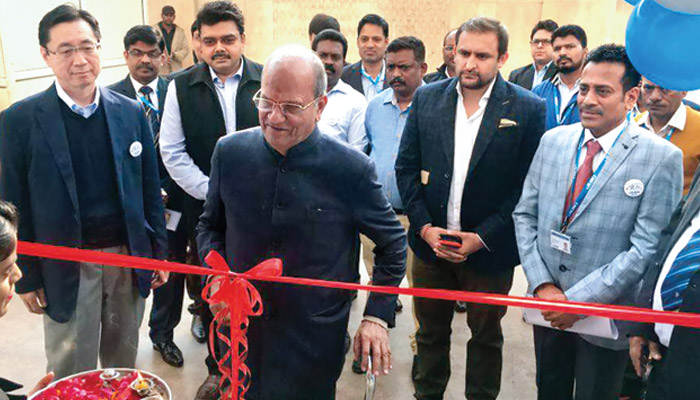
Juki presents latest software and machine for better productivity and labour saving at private show
 Juki Corporation, founded in 1938, is a Japan-based world-leading comprehensive manufacturer in the field of industrial sewing machines having the users in about 170 countries and regions. The industrial sewing machinery major recently organised an event at Fortune Inn Grazia, Noida on December 8, 2018 with a view to showcasing the latest industrial sewing machines and to unveil the cutting edge technology for sewing operations. The event witnessed many new product launches and JaNet Live Show. Juki’s new JaNet system enables quick problem solving, skill up support, reduction of set-up work, quick response for maintenance, visualization of factory.
At this occasion, the company also conducted a seminar about, “Production Improvement and Automistaion in Sewing.” The Chief Guest for the event was Resheb Chand Jain, Chairman, TT Limited. Apart from these, many senior Juki officials including Katsumi Nihei, President & Managing Director of Juki India, Officer in JUKI HQ & President of JUKI South East Asia and Shinetsu Ishida, Chief operating officer JUKI India Pvt. Ltd. were also present at the event.
 Besides, representatives and heads of its agent companies including Raghav Sharma, Director, IIGM Pvt Ltd. and Prabhat Chakrabarthi, Director Capital Apparel Technologies also graced the occasion with their presence. According to the company, the one-day event attracted more than 400 visitors including 150 customers from Delhi NCR, and got good business. Some of Juki customers who attended the event were Shahi exports, Orient craft, Orient Fashions, Richa Global, RMX Joss, PriEmpro and many more.
The Juki Corporation has been conducting various exhibitions and events around the world. At Noida event, the company highlighted its various technologies: JaNet (Juki Advanced Networking System), Auto Bottom Hem, Auto Sleeve Hem, Auto Polo Placket Making Machine and new devices for improved production.
Juki’s JaNeT software control system which enables greater workflow efficiency became the major attraction at the event. JUKI Advanced Network System is a real time production data monitoring system. In this all machine related information and production related information will be collected through WIFI based system. The complete sewing production and as well as bottle neck points will be notified in real time. It will help user to identify the problem points in the sewing floor to take necessary remedial actions.
Basically, the new JaNeT system from Juki is, in essence, an artificial intelligence operative. The computational software has been developed to interlink Juki’s digital technologies – each of which are currently confined to an individual production process. The thinking behind this is that, instead of employing 20+ machines to produce a garment in its entirety, the company can now condense this workflow into fewer (around 7 to 10) highly connected and more versatile machines that complete production both more efficiently and cost effectively.
Besides, the other machines displayed at the event were all its latest Advanced Digital Machines, where all the settings of the machine will be controlled by means of panel. The digital machines comes with NFC enabled (near field communication) which helps user to take machine setting data to mobile and the same setting can be transferred to other machines. It helps in saving machine setting time during style change. Juki also exhibited automatic machines for Shirts, Jeans, Trouser and knits too. Due to the lack of skilled man power it is very important to go with automatic machines where productivity and quality is been attained.