Eastman & ExactFlat collaborate to make textile printing solutions
Eastman Machine Company and ExactFlat, a provider of 3D to 2D digital patterning software, have announced a collaboration to increase the efficiency of preparing and cutting patterns with digitally printed graphics. Eastman is a cutting machine manufacturer, providing custom engineered solutions and innovative technologies for a variety of industries.
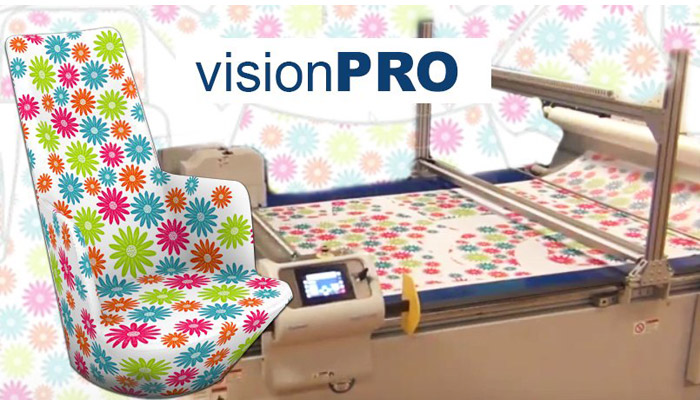
ExactFlat 3D to 2D digital patterning software is the leading tool set for creating flat patterns with graphics perfectly aligned. Once 2D patterns are created, they can be exported and cut on Eastman’s automated cutting systems equipped with VisionPRO. VisionPRO combines a high resolution camera system with state-ofthe- art software algorithms to scan pattern contours. The result is accurate cut paths around printed shapes, registration marks, or repeat patterns. Use of both technologies can save days or even weeks of production time. VisionPRO is an accessory available for Eastman’s conveyor and static table cutting systems, according to a company report.
Companies using legacy drape-tape-cut manual pattern making or those using cutting systems with only 2D CAD will find the new workflow both faster and simpler. The technologies are ideal for realising design and cutting room efficiencies in apparel and sportswear, display advertising, automotive, upholstered furniture, and technical textile workflows.
Mark Jewell, Founder of ExactFlat said, “The VisionPRO system is a major advancement in cutting technology. With VisionPRO and ExactFlat customers can transform to a 100 per cent digital workflow which saves time and improves flexibility. The use of both technologies also leads the way to dramatic cost savings. Collaborating with Eastman is a natural fit for us. They are an innovative, fast moving leader that puts customer benefit first. ExactFlat is delighted to work with companies that are defining and implementing the next generation of manufacturing technologies. Eastman is exactly that kind of company.”
Trevor Stevenson, Vice President at Eastman said, “Time pressured industries are facing challenges that cannot be solved by legacy processes. 3D design is becoming essential and digitally printed textiles are becoming more and more common. ExactFlat is the clear leader in 3D to 2D digital patterning and when implemented with our VisionPRO system, customers find the time pressure will be shifted to competitors trying to catch-up. We look forward to providing a superior offering that helps both companies further our respective leadership.”
Digital Transformation: A view to the future
The digital transformation is revolutionizing countless areas of our lives, and the consumption of textile products is no exception. Daily, we can see how the boom of e-commerce has boosted new purchasing behaviours that require new sales and organisational models.
Brands and retailers react to the demand and take advantage of these changes, making full use of the possibilities that the new technologies offer for the development of their business. It is time for the digital revolution to go beyond the sales point, reach the production centers and translate into new productive models that undertake a commitment to sustainability.

It is time to take leap from analog to digital
Up until now, the garment finishing industry has been marked by its intensive use of hand labour and natural resources, mainly water. Traditionally, the finishing process of each pair of jeans has been done manually, with its subsequent lack of exact reproducibility and through means that often put the workers’ health at risk.
The environment has also not been spared the impact of producing tonne of garments (5 bn jeans are produced globally every year). Taking into account that a single pair of jeans uses, on average, 70L of water and 150g of chemical products, textile production generates an environmental footprint that is impossible to ignore. Currently, the fashion industry has the dubious honor of being considered the second most pollutant industry in the world and, since the same processes will always garner the same results, it is time to change.
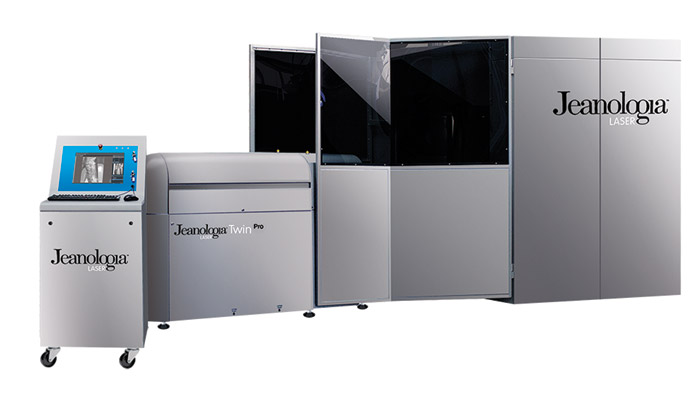
Jeanologia drives and leads this change, developing disruptive technologies for the garment finishing industry, able to introduce a new operating model that will bring the jeans industry to the digital era, by reducing the environmental impact and optimizing the time to market.
The digital revolution is here
Today, it is entirely possible to speak about the digital transformation of the finishing industry as a reality. Using a combination of Jeanologia’s technologies, laser, eco and e-Flow, it is now possible to produce jeans in a sustainable way at an industrial scale, automating and simplifying processes through the use of eco-efficient technologies in the garment finishing process.
Separately, each of the technologies is a powerful tool that allows us to give an answer to some of the most significant problems of textile industry, but it is when we join them that we achieve the total revolution of the manufacturing process. A transformation that breaks the surface to reach the heart of the issue and give an answer to the challenges of adapting garment finishing to the new digital era, where development and sustainability go hand in hand.
A new concept of Laundry 5.0 is born, where we attain authentic products of the best quality, in a sustainable way and without increasing production costs. In this new cost neutral model, what matters is not only the product itself, but also the way it has been made. That is part of the DNA of the product. Sustainability then becomes an additional decision factor besides the look and price.
However, to achieve the full integration of the jeans industry into the digital era, it is not enough to consider the implementation of disruptive technologies, although they certainly play a key role in the improvement of operating models.
A holistic approach becomes a necessity in road to sustainability
In this approach, people have a crucial role to play. Technologies and software displace water and chemicals as the main resources of the garment finishing process, and the need of new professional profiles able to adapt to the new digital environment appears. From design to production, the new professionals work to create spectacular designs in the most sustainable and eco-efficient way through the use of technology.
For this, a change of mindset that complements the advances of technology is essential when it comes to making the most of the opportunities that appear during any process of change. And the opportunities the digital transformation offers are many. Savings of an 80 per cent of water and 50 per cent on chemical products, with exact reproducibility and a 30 per cent reduction of processing times. Cost neutral, more sustainable collections, with shorter time to market, thanks to the connectivity technology provides. It is not only a possibility, but already a reality.
Connectivity enables everyone in the supply chain to work together no matter their geographical location. Designers and manufacturing centers work under the same standards and within the same digital environment, making communication and the scalability of processes an easier task. This facilitates the postponement of decision making and reduces the time to market so that the always changing market demands can be addressed at top speed. The barriers between creativity and technology, fashionistas and technocrats, designers and engineers have already been torn down. Join the digital transformation, with Jeanologia as your technological partner, and step into the future.
Source: Jeanologia
Some of the recent TECHNOLOGICAL DEVELOPMENTS
Nowadays, most of the garments manufacturers are acknowledging the role of applying new technologies to help them remain ahead in internationally competitive markets. As a result, technology suppliers are striving hard to innovate and develop new technologies keeping with demands of the industry. All these technological developments have helped to create an inevitable shift in the apparel industry. In a continuous endeavour to provide the industry meaningful content in accordance with the current trends, in the next few pages we have highlighted some of the latest technologies developments in the apparel industry.
Lectra’s Cutting Room 4.0 for Smart Cutting Room & Connected Development

In early 2017, anticipating changes in our customers markets, Lectra launched the new Lectra 4.0 strategy, driven by major Industry 4.0 principles. With increased investments in research and innovation, it deployed an ambitious transformation program, redefined customer journey and fully aligned its brand identity with a decisive digital value proposition.
Its new mission “For companies that breathe life into our wardrobes, car interiors, furniture and more, Lectra is crafting the premium technologies that facilitate the digital transformation of their industry. Lectra’s offer empowers brands and manufacturers from design to production, providing them with the market respect and peace of mind they deserve.”
Smart manufacturing technology makes it possible for companies to achieve full supply chain transparency. By having process visibility, customers can adopt new business models, improve operational efficiency and produce in larger volumes. With Millennials as the largest working generation, they are turning to services having access to products without the burdens of ownership. With 2 bn & growing millennials in the world and 86 per cent of them in emerging countries, it is predicted millennials will account to 40 per cent of all retail sales by 2020.
Lectra has developed its new Industry 4.0 to the fashion & apparel industry that is founded on digitalization of processes from design to production, connecting participants, objects and production lines, in real-time. Our machines have been connected since 2007 and we have spent years in understanding & analysing the performance of machines at customer sites, which makes Lectra the only player in the industry that proposes a complete value added offer, which is already compatible with Industry 4.0.
The way fashion is designed, developed, produced and consumed has transformed. Decades ago, technology had its own constraints in being either limited or too costly. Today, Digital Technology is an enabler towards a digital and smart world, thanks to four main factors: Cloud, Mobility, IoT& Artificial Intelligence. Though Digital technologies are yet to be widely adopted by the fashion industry – digitalization of information & connectivity, which we are accustomed to, are shaping the future of Fashion.
With the launch of Lectra’s Cutting Room 4.0 for Smart Cutting Room & Connected Development, customers are enabled with an integrated platform from design to product development, while preparing markers and cutting them within minutes saving time, money and aligning multiple orders. Next in line is our new offer to the fashion industry is MTO (Made-to-Order) to address continuous cutting mainly to cater to the growing demands for mass customization. Our offerings in Design, Expert Pattern Making, 3D, Fabric & Cut Planning and Automatic Nesting improve customer experience enabling merchandising & design teams to work hand-inhand with suppliers & buyers, streamlining the product development process. Lectra’s solutions with a combination of SaaS (Software as a Service) & Cloud are the best-in class for planning, design, product development, sourcing fabrics cut planning, industrialization & production, addressing the different stages of the fashion value-chain. The biggest differentiator & the advantage is that its customers are always working on the latest & right data as its software & hardware solutions communicate & collaborate with each other in real-time.
Another champion solution is the Lectra Fashion PLM, which is available in three starter configurations developed to target specific fashion industry processes – Design to Source, Develop to Source and Develop to Manufacture. Lectra Fashion PLM 4.0 embodies Lectra’s mission to empower fashion companies navigate the challenges and opportunities of Industry 4.0. Lectra Fashion PLM 4.0 scored above the industry average in 32 of the 44 functional areas that PLM outlined and assessed. The platform has been judged as a cornerstone solution that connects, processes, systems and supply chains. Drawing on lessons from machine learning, the solution equips users with tools enabling them to work more efficiently and accelerate the product development process.
Gerber Technology CutWorks® modular software system
 Gerber Technology has been helping companies around the world develop, manufacture and take their products to market smarter, faster and more efficiently. The company provides integrated software and hardware solutions to more than 78,000 customers in the aerospace, construction, furniture, fashion & apparel, transportation, technical textiles, packaging, wind energy and sign & graphics industries, including over 100 Fortune 500 companies in 130 countries. Drawing on a rich history of innovation, Gerber Technology’s leading-edge systems help customers reach their optimum by maximising productivity and minimising errors and waste. One of its latest innovations, CUTworks CutWorks® is a modular software system that offers a complete design, nesting and cutting solution for flexible materials.
Improve cut part quality: Fine-tune the CAD data you send to your cutter to further improve cut part quality. Automatically remove extra vertices. Control both the direction of cut and the start point to prevent material from moving during cutting Reduce cutting times: With CutWorks and the ToolPath module, you have full control over the exact order of cutting of both the data within individual parts and the order of parts within the complete nest. Reduce cutting times by following a more efficient cut path.
Faster nesting: CutWorks offers several powerful nesting packages including manual nesting and multiple automatic nesting modules to improve material utilisation and nesting speeds.
Use on any system: CutWorks cut file preparation software works on Gerber cutting systems and virtually any other automated cutting system on the market to dramatically improve cut part quality.
Next Generation of 3D Solutions from Tukatech
 Tukatech’s virtual sample-making software, TUKA3D, is a solution catered to the fit-conscious fashion product developers. “It’s important for a 3D system to help designers use their creativity with design, embellishments, style lines to make a unique looking product but nothing sells unless it fits,” comments Ram Sareen, Founder and CEO of Tukatech. “Brands and retailers who have begun implementing 3D have been stuck using it only in the design stage; they can’t use it for fitting, which ends up wasting time and resources, because they still need to see the fit samples in real life.”
What makes Tukatech’s TUKA3D application unique is the built-in motion simulation, which allows for the garment to be worn by the virtual fit model while they perform various movements such as bending, jumping, flexing, etc. These movements are customized by Tukatech as part of their implementation package. “We include custom virtual models and motions because it’s really the only way to use a 3D system for fit analysis. If you’re not analyzing fit with real-time motion simulation, then you’re not getting the most out of your 3D system,” adds Sareen.
To develop fit, one must have the digital fit model that is a true replica of not just the measurements, but also the live model’s shape and posture. This replication plays a major role to correctly evaluate the drape and fit of a product. With over 650 fit model replicas of brands and retailers, each TUKA3D user is empowered to make a great fitting garment virtually. With the retail sector shifting to a consumerdriven market, agility is the name of the game for brands and vendors. Brand loyalists expect a consistent fit from the brand each time a product is purchased. “Hanger appeal can only go so far. If a garment does not fit well, the ‘look’ will not be there when the consumer wears it,” explains Chris Walia, Tukatech’s VP of Sales & Marketing.
“TUKA3D is built on the most powerful 3D CAD platform developed by Autodesk, 3D Studio Max. This platform enables our users to not only eliminate physical sample-making, but also to make powerful presentations to buyers or even endconsumers,” says Savannah Crawford, the Chief Collaborator at Tukatech. “At the PI Apparel conference in Berlin, we will be showcasing these 3D systems specifically from a fit development and collaboration perspective,” she added.
Other systems in Tukatech’s product development suite include TUKAcloud, the web-based digital sample room, and TUKA3D Designer Edition, the new assetbased design room. Tukatech is the garment and apparel industry’s leading provider of fashion design software and technology solutions. Founded in 1995 by garmentindustry veteran Ram Sareen, Tukatech offers award-winning 2D pattern making, grading, and marker making software, automated marker making software, 3D sample making/virtual prototyping software, as well as garment plotters, and automatic spreaders and cutters for production.
Enterprise material management solutions by Threadsol
 The world has transformed, trades have advanced. With the boom of the new era, apparel business all over the world has witnessed majestic shifts. To manage this change, apparel manufacturers need to accelerate their operations and reevaluate the legacy of manufacturing practices. The dynamic technologies being introduced each day is a sign of constant development. ThreadSol – the pioneer in enterprise material management for the sewn products industry- takes pride in constantly challenging the present and being part of such a revolution. ThreadSol’s outlook is to introduce technologically driven products to drive manufacturing by targeting material cost and differentiate from the extremely competitive environment.
With its innovative solutions- intelloBuy, intelloCut, and intello3C, ThreadSol offers an entire range of enterprise material management solutions, which can help apparel manufacturers and brands to boost their topline and bottom-line, in an industry that is heavily dependent upon economic priorities.
intelloCut is a material planning and optimization solution for the sewn products industry. The flagship solution of ThreadSol has been successfully deployed in 150+ factories worldwide, which plan 1.5 bn pieces per year.
With the help of its advanced algorithms, IntelloCut gives the most optimized cutplan and lay plan, in just one click. The cloud computing structure helps to access the solution from any point. It also offers a feedback system which works like GPS: Any variations on floor and the plan can be changed with a single refresh button. With over 150 features, intelloCut is a product ahead of its time and truly defines the new age technology.
In a constant effort to improve, ThreadSol has introduced intelloGreen: A tablet application, which replaces on-floor printed lay slips. The application is based on cloud computing and takes data from intelloCut, transforming business from traditional to environment friendly.
The advanced reporting structure of IntelloCut provides an edge to the manufacturers to get complete control over factory ’s practices through IntelloMobile: World’s first fabric utilization reporting app. IntelloMobile provides 100 per cent real-time traceability of fabric, with all reports on mobile phone. intelloBuy is a material estimation solution for the sewn products industry. It is the second product by ThreadSol, taking the enterprise material management model of the company to the next level.
IntelloBuy gives accurate buying consumption for a particular style which saves millions of dollars of material cost at the buying stage, every day, for manufacturers worldwide. IntelloBuy accesses factory historical database and allows the user to add exact wastage from factory floor to generate the most accurate fabric requirement. This can save up to 10 per cent fabric cost, ultimately boosting profit. Through the advanced reporting offered by intelloBuy, one can get details of the consumption calculation for different style/ order, vendor details for width/ shrinkage, factory process loss, buyer’s details of size-wise order break-up etc.
intello3C is an AI based cost negotiation platform. Intello3C aims to reduce sourcing cost and costing lead time for apparel brands. The current market scenario is very challenging. The lead time and retail prices are constantly decreasing whereas the cost of sourcing continues to increase.
Currently vendor cost negotiations are based on merchant experience. There is little focus on scientifically arrived accurate internal cost benchmarks for various cost components like fabric, CM, trims etc. for each style that is costed. This inflates the sourcing cost. Moreover, most vendor cost negotiations are carried out over email and excel that is time consuming and adds to the ever shrinking lead time.
With fast fashion, the challenges with vendor cost negotiations are going to multiply. This is already resulting in suboptimal costing. Intello3C uses advance technology like Artificial Intelligence, Big Data, Mobility and Agile Analytics to solve this problem. Intello3C creates scientific and fact based benchmarks for all the cost components.
intello3C uses AI that can automatically negotiate the best cost with the vendors without needing any manual inputs from the merchant teams. intello3C results in 3- 5 per cent decrease in sourcing cost and 30 per cent decrease in costing lead time.
ThreadSol solutions- intelloCut and intelloBuy, currently used by manufacturers in India, Sri Lanka, Bangladesh, Pakistan, Vietnam, Thailand, Indonesia, China, Philippines, Cambodia, Jordon and Turkey, have already set standards amongst Sewn Products’ automation solutions worldwide. The revolutionary solutions are presently benefiting more than 150 apparel factories like Hirdaramani, Luenthai, MAS, PtDaese, Raymond, Pacific Jeans, Omegaline etc., helping them save up to 10 per cent fabric cost.
Eton Systems providing accurate real time information
 Eton Systems was founded in 1967 as an offshoot of Eton Fashions, a Swedish manufacturer making shirts since 1928, under the name Skjortfabriken Specia. This led to the development of Eton Systems – the world’s first Unit Production system (UPS). Today there are more than 4000 Eton installations in more than 60 countries and in different production areas, including apparel, home textiles, furniture and automotive industries. The company is headquartered in Gånghester, a small town outside Borås, where everything started.
ETON is an automated material handling concept allows you to improve productivity, track, measure and fine-tune every step of the production flow to ensure supreme product quality.
- The garment production systems are designed to eliminate manual transportation and minimize handling, allowing the operators more time for adding value to your products
- Eton provides a real-time information system and the necessary tools to improve the manufacturing processes through powerful software programmes
- Eton globally provide material handling systems designs / models consisting of overhead conveyors with individually addressable work stations
- Eton provides interactive training courses for all levels of manufacturing companies to help you achieve excellence and generate useful information for balancing production lines
Generates useful information
The Eton 5000 system is the only Unit Production System in garment industry that offers you the accurate real time information to make the right decisions. A completely Computer guided system with RFID readers in combination gives you full control of your production line including:
• Improved productivity & quality • Traceability • Real Time Decision making • Improved balancing • Production planning & cost accounting • Information transmission to external MIS for payroll and production control • Individual operator realtime feedback and motivation.
 Zund presents G3 Cutting system
Zünd Systemtechnik AG is a leading manufacturer of multifunctional digital cutting systems used in different industries, including graphics, packaging, leather, fabrics, technical textiles, and composites. Focused on continuous innovation and superior technology, Zünd offers advanced products and services to meet its customers’ needs.
Uncompromising performance & precision
Whatever textiles or patterns made of paper, cardboard or plastic you may need to cut, its multi-functional cutting systems help you do it faster and more efficiently. Zünd can not only offer precise, productive and durable cutters but can also supply you with just the right cutting technology for your specific application. Its driven rotary tools, for example, are designed to cut a variety of textile materials with flawless precision. Every Zünd Cutter includes standardized interface options. With industry-specific solutions offered by its partners, you can easily expand your cutting system for custom applications.
Modular design concept
Zünd‘s modular tool and material-handling systems make it easy to tailor your G3 cutting system to specific cutting needs. Define your production requirements, and select the building blocks that will make up the perfect configuration for you. Additions and upgrades are possible any time.
Return on investment
Innovative technology and superior manufacturing are guaranteed to result in reliability and low maintenance costs. Because of their modular design, G3 cutting systems can adapt to ever-changing needs and retain their value exceptionally well. Cut quality and precision: Zünd G3 cutting systems excel in delivering both exceptional productivity and unsurpassed cut quality. This is the result of a perfect symbiosis between intelligent control technology and precision mechanics.
Industrial use: With the technology and build designed for high volume production, the G3 flatbed cutter is uniquely qualified for industrial use and multi-shift, 24/7 operation. A worldwide service network ensures the availability of spare parts at any time.
Efficient material hold-down: Energy-efficient, adjustable vacuum generators provide optimal material hold-down. No longer do you have to worry about materials moving during processing. And besides the perfect cut quality, you will no doubt enjoy the reduced power consumption.
Productivity: The unsurpassed productivity of the G3 cutter series stems from the use of intelligent control technology, robust system components, and sophisticated tooling. Perfectly coordinated, all system components are guaranteed to optimize your production workflow.
 Juki direct drive, high speed, sewing system with automatic thread trimmer
Juki, Japan is committed to customers satisfaction. In an effort to understand the needs of the customer, Juki manufactures the entire range of sewing machines for woven and knit fabrics, leather and heavy duty machines and automatics. Juki is present all over the world and supports its customers through top quality products, parts and service. IIGM is among the top three agents and distributor, across the world.
DDL-9000C Series Direct Drive, High Speed, Sewing System with Automatic Thread Trimmer (Digital Type)
Features:
- World first computer-controlled vertically and horizontally-driven feed mechanism
- Remaining thread at the end of sewing reduced to 3 mm
- A both-blade driven rotary knife system is adopted
- Sewing machine management utilizing “”IoT” (Internet of Things)
- USB port is provided as standard
Dürkopp releases QONDAC network solutions for sales
 The sales launch of QONDAC, the IoT networks platform for textile machines from Dürkopp Adler was conducted recently. The biggest European manufacturer of industrial sewing technology connects entire plants with own QONDAC high-tech servers, even crossing country borders. By real time analysis of the gathered machine data, the availability of machines, the production performance and the quality of the resulting product can be significantly increased.
Customers especially liked the possibility to connect not only Dürkopp Adler machines but also all other machines in a factory by sensor technology or open access interfaces to enable central monitoring of the whole production process. Industrial sewing machines like the M-TYPE PREMIUM lockstitch machine or the brand new pocket welting sewing unit class 756 can be adjusted centrally from the server, and maintenance processes can be digitized based on real usage.
Connections to ERP systems are developed, too. Perfectly combining to that, Dürkopp Adler has also launched the new smart touch control panel QONDAC Commander CSP. The panel for M-TYPE PREMIUM machines can show on-demand HD videos and HTML pages and enables new communication options to the central QONDAC server. This innovation will be introduced step-by-step to other machines of the Shang Gong Group, Mother Company of Dürkopp Adler AG.
 Pegasus presents latest sewing machine series
Pegasus Sewing Machine Mfg. Co., Ltd., is one of the leading manufacturers of sewing machines in the world. Given are some of its latest innovations:
LaRgo, the FS700P series
Pegasus has released “LaRgo,” the FS700P series equipped with a right and left independent differential feed adjustment mechanism, hereinafter called “LaRgo”. The new product, LaRgo is most suitable for sewing functional fabrics, employed for sportswear and similar garments. The focus on sportswear with designs employing mesh fabrics with excellent breathability and stretchable fabrics with excellent stretch ability has increased markedly in recent years. However, these designs require highly skilled operators when sewing these fabrics with different features. In order to solve these problems, Pegasus has developed the LaRgo, equipped with the world’s first, right and left independent differential feed adjustment mechanism. Thanks to these excellent features, this flatseamer consistently produces beautifully finished products regardless of the skill of the operator.
No matter what the circumstances, no matter the operator. Needle and threads advance smoothly at the sewer’s own pace. Stitching is straight and beautiful without worry. This precise and soothing rhythm prevents right or left misalignment of the fabric. LaRgo, with needle and thread, seams smoothly, drawing on long cultivated technical skills and the daily genesis of imagination.
M900/DDM Series
Features:
- Cost saving: 70 per cent electric saving with direct drive motor
- High power: High performance 550W Pegasus made motor as compared to normal 400W
- Dust Prevention: Dust seal at upper looper mechanism prevents dust from entering the machine via the upper looper shaft
- Dust seal at upper looper mechanism prevents dust from entering the machine via the upper looper shaft
- CE certification: “CE” meaning European Conformity, conforms to the strictest healthy, safety and environmental protection standard for products sold within Europe
- Prevents installation mistakes and minimises installation time
- Concealed casing design prevents dust from entering the motor coil, eliminating maintenance problems
- Maximize direct drive motor transmission by original factory installation
Vetron direct-drive lockstitch machine with triple transport

The Vetron brand stands for high-value products developed for processing textiles and leather, multiple awarded innovative solutions focused on the customer´s needs, and the German art of engineering connected with professional service. Products are made from selected components throughout Europe and Asia offering a superior price performance ratio and innovative functionality, setting new standards of process security through the use of high technology. One of its latest offerings Vetron 5000 series is a direct-drive 1-needle lockstitch sewing machine with triple transport.
Through the consistent use of state-of-the-art electronic control it became possible to make all machine settings programmable into memory and thus recallable. This allows the process parameters to be free from operators influence and identical every time the programme is recalled. The innovative dynamic machine parameter, based on the actual speed and the permanent measurement of the material thickness, open new possibilities of production quality, process security and the reduction of cycle times.
Programmable set-up
- All machine settings are programmable and storable: Stitch length, sewing feet pressure, top feed stroke, needle thread tension, clearance under the sewing feet
- Fast and precise setup of the machine by recall of a stored machine programme
- Easy to understand and intuitive programming concept
- Programme chain function to combine different production steps directly on one machine
- User identification by USB-dongle to avoid access on machine settings – on demand
- Stitch-in-stitch backtacking Dynamic Process
- Permanent measurement of material thickness
- Constant sewing feet pressure reacting on material thickness
- Sewing feet pressure reacting on sewing speed
- Stitch length correction reacting on material thickness
- Thread tension correction reacting on material thickness
- Top feed stroke management via sewing speed with automatic “cross seam function”
Process Reliability
- User identification via USB dongle (activated via parameter)
- Operator does not have access to basic parameters
- Various access codes for Operator / Line Supervisor / Technician/ Technical Supervisor (Administrator)
- Operator can change sewing programmes via scanner (option). The machine automatically adjusts to the preset sewing parameters (Stitch length, speed, thread tension, upper transport stroke, ruler distance … etc.) on.
 Shirt front placket pressing & Creasing machine by EPA AKIN
The Akin family is one of Turkey’s most vital manufacturers of shirts. In an effort to solve difficulties with shirt manufacturing, the company collated their experience accumulated over the years and decided to produce machinery in 1980. With over 35 years of experience EPA successfully solved all the needs in this field. The EPA AKIN brand was registered in 1990 and today is a major brand, providing excellent service and dealing with the worlds most renowned leaders of shirt manufacturers. EPA AKIN today exports textile machinery to 21 countries. The company represented in India by HCA.
Shirt front placket pressing & creasing machine (EP205)
Features:
-
- Perfect shirt front pressing from 1,6 cm up to 7,5 cm
- Capable of fusing interlining during folding process With the help of optional interlining cutting device you are able to make perfect interlining cutting and reduce interlining consumption to a minimum level
- Able to produce separated front strips for shirt or blouses
- Perfect pressing of short sleeve hem the special laser device provides easy line tracking to obtain standard products
- Touch screen panel provides quick and easy adjustments on the machine
- Easy to obtain hourly and daily production reports from the optional graphic panel
- Optional: Error control on the screen
- Accurate stacking of the products via automatic lifting device on the back of the machine
- Specially designed heaters with digital thermostats provides perfect quality and reduces electricity consumption This machine is produced with all necessary safety equipment for the users
- It has built ‘’Programmable Logic Control’’
- This machine has certificate of CE
Loiko presents Button Feeder attachment

As we all know that most of the time the garments packing get delay due to pending of button hole and button stitch operations. To finish these operations customer do overtime, for operate these machines we need skill operators. Just to deskill the Button stitch operation Loiko has developed Button Feeder attachment (Loiko Model ST-12 made in Korea). Normally Button Stitch operator can attach 600 to 700 Buttons per hour in shirt production, if customers install our Button Feeder in the same button stitch machine they can attach 1200 to 1400 buttons per hour depend upon the button stitch machine condition. It means almost double production, and not required any skill operator. The beauty of our Button Feeder is we can install in any Electronic Button stitch machines without any alternations. The advantage of its Button feeder is reducing the manpower, reduce over time, increase the productivity, and reduce break down time.
In my opinion in-future 70 to 80 per cent customers will order Button machines with Button Feeders. The ROI of our Button Feeder will be around 10-12 months. Loiko is very proud to say that last year it got 100 Button Feeders order from one customer in Bangalore, and also happy to say that most of the customers using its Button Feeders because of the technology, user friendly, quality, performance and service support after sales.
CNC-controlled large-area sewing technology by PFAFF
 The PFAFF 3587 CNC-large-area computer stitcher with a sewing area of 500 x 300 mm is designed for manufacturers who process reliability and production outputs are equally important. At the core of the stitching automat is the intermitting material feed system featuring a patented drive. Because of the intermittent feed (feed stop when the needle enters the material) a positional change of the cuts in the clamp are avoided. This way, the PFAFF 3587 ensures the highest stitching accuracy and very high sewing performance. The PFAFF 3587 is the one and only in the world which performs 3,200 s.p.m. with intermittent feed.
The sophisticated sewing technology based on a seam-optimization system (needle-turning device + bobbin thread slide) ensures superb seam quality and a perfect stitch pattern in multi-directional sewing operations. The needleturning device in combination with the bobbin thread slide and the vertical hook prevents slip stitches in highly decorative seam patterns with a circular seam contour.
The unique automatic clamp-changing system permits a completely overlapping fully automated operation. Only the material still has to be inserted manually. ”Ergonomics in the workplace” is of great importance in the PFAFF 3587. The machine features a height adjustment which may be adjusted to the respective operator at the push of a button (optional). Sewing programmes and corrections of the seams may be generated resp. executed right on the machine via a logically designed touch screen. The PFAFF 3587 has all technical requirements to tackle even the most sophisticated and challenging sewing operations, e.g. in the sections shoe production, small leather good production or in the automotive interiors.
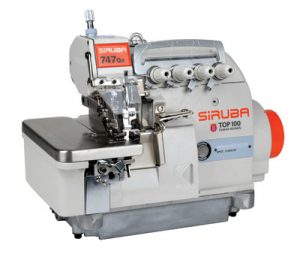 Siruba presents latest sewing machines
Siruba has developed new products in 6 areas: Overlock Series, Interlock Series, Jeans Application, Underwear Application, New Concept Area, and Knits Sewing Automation. Moreover, Siruba APP is launched already. With the function of product trace and registration, it provides more protection to its customer.
Overlock series
Brand new 700L overlock machine is based on the direction of “Performance First,” was launched in Q3 of 2017. In pursuit of the production precision, 700L has a big lift of the core sewing performance, which the excellent thread-tension control and material feeding realize the perfect sewing quality. With the coherence between mechanism and electronics, Direct-drive type 700LD series has the speed of 7500 RPM to realize high efficiency, and the extended functions of sensor-cutter, auto back latch, and anti-curly edge…, etc. with the brand new high performance sensor.
Interlock series
Brand new C007L cylinder bed interlock machine will be launched soon, which includes the subclass as auto thread trimmer, right edge trimmer, left edge trimmer…, etc. With beautiful seaming, new oil stain-free design, it is Siruba’s newest high performance interlock machine.
Jeans application
It will introduce Jeans overlock to show Siruba’s capability in heavy fabric sewing. New 6-needle double chainstitch waistband sewing machine HF008L has flexible needle gauge combination, and the adjustable angle rear puller. Auto Jeans bottom hemming machine ASL-JBH Series has lockstitch and chainstitch, 2 specifications, to extend the application range. Besides, based on small cylinder bed interlock machine S007K, it has RF hemming model, which is with differential feeding for elastic light jeans fabric.
Underwear application
700KS cylinder bed overlock machine, with ESK device, makes blind hemming easy. Skill is not very necessary when hemming over the overlock seam. Underwear’s elastic tape or lace tape sewing: Overlock has LFD6K feeding device, Interlock has FSC metering device, STC tension control device, which make the sewing operation easier. Underpants elastic waistband: it has C007LD/CR/CX right edge trimmer model with RLP tubular extending roller set. Besides, we have an auto sewing station for the same operation in Knits Sewing Automation Area.
New concept area
We apply new concepts into the common machines. For example: 3-strap attaching multineedle machine has the presser foot of tape feeding control. Bartacking machine has a compact control panel. Button sewing machine has auto feeding function. Interlock machine’s thread trimmer is powered by stepping motor.
Knits sewing automation
Siruba focuses on knits wear sewing automation. Its tubular bottom hemming, 3 kinds of elastic waistband sewing, elastic band joining, and circular collar attaching, etc. will be displayed during upcoming industry exhibition.
 Versatility tension type computerized metering device by Hurg
Hurg Co., Ltd was established in 2006 which in order to raise all the technology of the sewing machine and to improve the quality of products. Hurg Co., Ltd is manufacturer of supplementary device for sewing machine and products are 100 per cent made in Taiwan. In order to capture that developing opportunity, its management & technical teams have devoted all its resources to R & D and manufacture for that “HURG” market. The main purpose of all the efforts is nothing but providing a satisfactory sewing equipment and related service to those global apparel manufacturing enterprises.
Versatility tension type computerized metering device (HCT-E9U-C)
Feature:
• Specialized in sewing the elastic tape • 12 section per speed changed • 99 Program Memory • Knee Switch (Standard): For manual section changes • LCD and manual section changes. (Optional Parts) • Free tape function switch (Standard) • Fit on the machines hand wheel to control automatic section change (Optional Parts) • There are two ways to adjust program. One is adjusting through the screen. The other is adjusting through the control box.
Direct drive lockstitch machine (All-in-one head) by Zoje
 ZOJE , founded in 1994, registered capital of 567.8 mn yuan, the total assets of 2.6 bn yuan, has become a leading manufacturer of industrial sewing machine, with assembly, coating, casting, machine processing automation equipment in the world advanced, with the industry “Provincial Research Institute” and the two R&D center, R&D institutions in Europe. The internationalization of technology, advanced equipment, condensed into the superior quality, the formation of industrial clusters unique, provide a good platform for the development of many sewing equipment enterprises, a high degree of concentration, high technology content of products, high brand awareness and reputation, the global industrial sewing machine comprehensive strength leading production base. Annual production capacity of 1 mn units. One of the latest innovations by the company is Direct Drive lockstitch machine (All-in-one head) (ZJ9513 series).
Given are its features
- Cost-effective direct drive energy saving lockstitch sewing machine (All-in-one)
- High efficiency, energy saving, environmental-friendly
- Easy operation
- Improve the maintains performance
- Improve the sewing performance
- Designed by wide voltage, adapting to the global electric system
- Improve the control system self-check performance
 Intelligent template sewing machine by Juita
Juita Sewing Machine Co., Ltd. is a professional production of various kinds of sewing machine of modern enterprise, with the product development, manufacturing, testing, quality assurance, marketing, after-sales service as one of the operating system, the company has passed ISO9001:2000 quality management system certification. Given is its latest innovation:
JTK9 (Intelligent Template Sewing Machine)
- Automatic template machine, three shaft rigidity, precise and quick, high-speed operation, low noise
- Automation in garment manufacturing provides systematic and comprehensive insights into this multifaceted process Industrial automation is all about working smarter, faster, and proficiently. This makes automation more powerful and that’s why customers are looking for pioneering, endto- end technologies with open, modern architecture and new data from new connections. The major advantages of using automation are: Reduced direct human labour costs and expenses, enhanced consistency of product, delivery of quality products, increased productivity.
 Industrial sewing machine attachment by Sakho
Sakho Technocraft Pvt. Ltd. is providing sales & service of Korean make Sakho Brand special type industrial sewing machine & attachments. The company provides best machineries and service to garment industries with its highly dedicated technical & commercial. Its automated garment machineries & attachments are well known across the world for its low cost, best quality, durability, outstanding performance & services.
BK-17 – Industrial sewing machine attachment Digitally controlled button feeder attachment
Features:
- One body type loosening clamp: Automatic loosening clamp position so easy loading of button manually also
- Easy button measure: Easy button change, just one touch, one time can set button width and thickness together
- Easy micro adjustment: To control facing of button in-vibrator
- Two times cutting: Can select after single or double trimming to supply button to work clamp
- Cyclic programme: One can select the number of button patterns where it needs regular button supply & whenever we don’t need button supply so we can fix button manually
- Point button: Can be programmed to load the other size button by hand
- Supply button: Automatic button supply in absence of no button in work clamp
- X, Y adjustment: Easy to set the X & Y axis for transfer pin setting to needle Application: This robot mechanism device is used to feed the buttons to the button clamp on the button sewing machine. Operator doesn’t need to align the holes of button. With its increased feeding speed, the sewing machine head speed can be used upto maximum, which results in higher productivity. Using this device a beginner shows double productivity than skilled operators.
- Represents based on shirts production under standard conditions
- That 25mm and above Dia are depend on its thickness and convexity
- Special button machine work clamp is provided along with BK-17 as per machine make
- Transfer pin of different sizes provided with BK-17 as standard accessories.
Latest seam bonding technologies from H&H
H&H Asia Group Ltd. is specialised in thermoplastic technology for sew free adhesive and waterproofing applying on the industries of clothing, bags, shoes, medicals, gloves,… that include waterproof seam sealing, sew free pocket adhesive, zipper bonding, front zip sealing, fabric joining, line bonding, overlay taping, and also adhesive backing for woven label and embroidery. Given are some of its latest innovations:
 AI-001 – Hot air sealing machine
- New generation
- Stretch fabric ready
- Narrow tape ready
- 3-layer sealing mode
- 30 per cent faster
- 5 per cent tape saving
- Software upgradable
- Hardware upgradable
Highlighting features:
- 3D electronic nozzle positioning system
- Differential speed top/bottom roller
- Variable speed seam sealing
- Digital tensioning device
- Multi-language support
- Data memory bank
- Ergonomic
 CS-722 – Pneumatic flat press machine
- Consistent temperature
- Good for all fabric
- Uniform pressure
- PLC controlled
- Simple to use
Highlighting features:
- Both hands push button activation for added safety
- Independently heating of upper and lower
- Foot pedal activation
- Dual time shift mode
- Vertical press motion
- Key locking function
- Dual counters
Tajima presents latestembroidery solutions
 Tajima has launched new technology in various concepts, which were not possible in the past. Now the machines are very user friendly and can do embroideries with various kinds of threads starting from 7 tex to 700 denier in one setting and 710 denier to 900 denier in another setting in one given frame through the needles. If one has to use thicker thread or cord then one can use 6 kind of multi cords in the same design.
Other than this our ESQ called as easy sequin devise can do sequin much comfortably now without any hassles in settings. With different devise and settings one can use sequin from size 2mm to 22 mm both centric and essentric, while 2mm essentric is not possible. It has also launched glass seed beads devise which can fix the glass beads on size 2mm and 2.5mm at approx 800 beads per minute. Now most of the hand work of beads is now possible on machines which are fixed on the garments with lock stitch which gives firm fixing on the garments.
Now one can use any kind of threads twisted or non-twisted, 4 COL sequin or 2 COL sequin 2 colour glass beads, or 4 colour glass beads in 2 sizes, or original 5mm sworosky and glass beads, 6 colour multi cord. All the above can be fixed in one garments in one given time depending upon the attachments you opt for while placing the order.
ZSK Compact single head bridge style machine
 It has the same open back frame design as multihead machines and is the most industrious commercial single-head on the market. With the bridge-type build style on a single head, the ZSK offers the most versatile frame – providing a sturdy and virtually vibration-free piece of equipment. This frame style is the most preferred model for customers who are using the equipment as a production machine.
The Sprint 7 is a 18-needle single head class 4 style (bridge style) embroidery machine. This machine can adapt speciality devices (such as sequins or cording) without changing any electronic board components or altering any electrical component – ZSK produces the most compatible & versatile machine in the world. This machine is recommended for start-up embroidery businesses as well as any size embroidery shop.
Not only does this equipment provides embroidery decoration, but also allows for a wide range of embellishment options. Use it as embroidery only or add unique options to diversify your business.
Tubular Arm – The ZSK has the smallest tubular arm in the industry worldwide! The curved design now allows for the narrowest of textiles to be embroidered and those hard to embroider areas such as shirt pockets, fronts of shoes, baby items, shirt cuffs, etc. In addition to the size, the arm is also longer to fit a wider range of materials as well – it has been extended 20 mm for narrow textiles.
Options: High speed sequins, cording decoration, boring decoration, barcode design input, braille embroidery, adaptable specialty frames, shoe embroidery, automatic design software, xl expanded frame, automatic name feed, adjustable rolling stand, belt/name tape embroidery, auto design feed and modular design & networking software.
Balanced-Coil Needle Detector by York Technology Ltd
 “When it comes to detecting broken needle and other metal contamination in sewn product YORK® Technology continues to push the boundaries of performance. Ever since the concepts were pioneered in 1995 by the current founders of the Company, the technology based on “VLF* Electro-magnetic Balanced-Coil Bridge” in conjunction with “Active Phase Detection” techniques continue to deliver the most robust solution to detecting needle fragments buried inside garments that may have other metal components such as zips attached.
Since the electro-magnetic coils encircle the detection tunnel 360°, there are no half-measures or one-sidedness to this unique structure – the detector conducts a 100 per cent scan in a single pass at full sensitivity on each passing garment pack. No need to pass the garment twice or through two magnet type machines, nor to flip it and turn it in between two detectors. This makes double head magnet detectors redundant and the 9-point calibration check unnecessary.
Coupled with the inherent immunity from interference generated by sewing machine magnetic clutches and other electrically noisy equipment in the vicinity, a balanced-coil needle detector offers the most fit-for-purpose solution to meeting the Buyer’s compliance, in-house due-diligence practice, Brand Protection and Consumer Safety challenges all in one package.
The Company R&D Centre located in UK has recently added to the ND product range, extending it to 6 variants – tunnel heights from 105mm to 305mm in increments of 50mm with two tunnel widths at 550mm and 650mm are now available. This has broken new ground for achieving industry standard detection sensitivities** in larger individual products that have not been possible before.
All machines come complete with conveyor speed control, quick-release belt mechanism, reversing function, production data recording, report downloading via USB port, light stack and a colour touch screen. A foot pedal accessory is being tested as we speak, and there are many other novel value enhancing features in the pipeline to come.
The international brand retailers who know about the design advantages of Balanced Coil machines prefer it!
* VLF – Very Low Frequency.
** Sensitivity figures given in ‘free space’, subject to environmental and product effects beyond the control of the manufacturer.”
 Providing quality solution for all your embroidery needs DUKEJIA
DUKE JIA was founded in 2001 specialising in electrometrical integration of high-tech product embroidery machine. Since its foundation special attention has been given to research and development of new products and cultivation of technical talents.
Advantage of DUKEJIA
Automatic oil system: Automatic oiling can lubricate the hook and other core parts in the form of oil mist. Besides it can reduce the heat by high speed operation of hooks and other parts as well as eliminate the dust in the process of its operation. What’s more, it reduces the line broken ratio. It can extend the life of machine and can improve the quality of embroidery and also reduces the damage by people oiling.
- Machine Body: Single piece beam body to support high speed
- Lubrication of needle bar and head: Uniqueness also lies in the complete lubrication of the needle bar and the machine head with little oil by special design
- Threading: Threading by air gun quickly, especially applicable for machines with wide tables or with many colours embroidery
- Upper thread holding system: Unique upper thread holding system can effectively prevent cutting the thread out after trimming or colour changing
- LDC Display: It can offer direct display, prevent the dust from the entering so as to extend the life of the parts
- Special cover: More convenient more beautiful
- Multifunction cover: More secure, more convenient
 Shirt Folding Tables from Ngaishing
Ngaishing Development Limited is a company that specialises in garment machinery that adds value and precision to various types of apparel. Their distribution networks and service partners cover more than 40 countries, around the world. The headquarters is in Hong Kong and manufacturing facility in Shenzen has a production plant size of 40,000 sqmtr with an employee strength of over 600 individuals.
Shirt Folding Table NS – 650U
Features:
 Suitable for industrial shirt folding
- Adopt fixing folding plate to standardize the size of every piece of folded shirt
- Button guide keeps button always on the center line in order to get a balance finish, working together with a shirt fixing scale for high efficiency
- With adjustable height and gradient of machine table, suitable for different operators
- The size of collar creasing mould could be adjusted depending on the size of collars, so the folded shirt has a more beautiful three-dimensional effect
- Easy and fast operation, small occupation area and good folding effect, etc. Collar & Cuff Press Machine NS-8243-MP-L
Features:
- Suitable for pressing shirt collar and cuff
- Apply PLC and human-machine touch screen for operation
- The upper mould adopts multi heater groups, temperature of different areas could be controlled by independent thermostats for better temperature control
- Flexible operation, swift action and high efficiency
- The lower mould with the function of vacuum (need to purchase a vacuum pump additionally), which is helpful for garment fixing, cooling down and fine shaping effect
Coloreel to launch their revolutionary thread coloring unit
 The advanced fair Avantex has a good geographic location, in the middle of Europe, which makes it easy for all markets and prospective customers to come. On the 17-20th September, Coloreel will launch their revolutionary thread coloring unit for industrial embroidery machines at Avantex, the fair where high technology meets fashion industry. At stand Z428, the customers will be able to meet with both Coloreel and the European distributors.
Barbara Kuntzel, Avantex & Texworld Paris Show Director said that, ”It feels great that an innovative company like Coloreel chooses to do the product launch of their thread coloring unit for industrial embroidery machines at Avantex.
The Coloreel technology permits high-quality instant coloring of textile thread while the thread is being used in textile production. The first product to be launched based on this technology is an innovating thread colouring unit that works with any existing industrial embroidery machine. By instantly colouring a white base thread during the embroidery production, Coloreel enables complete freedom to create unique embroideries without any limitations in the use of colours.
Joakim Staberg, Founder & Innovator at Coloreel, said that, “Avantex is the right place for us to launch our product the right people are here, and we have a great history with them. We had our world premiere here in 2016 and presented the technology with great results. We then came back in 2017 to show our prototype in action and the market response was enormous. And we are now very excited to return in September 2018 for the product launch of our revolutionary thread colouring unit.” This revolutionary product that will launch 17-20th September at Avantex, the gathering of hightech fashion, in stand Z428 and world leading companies in textile, fashion and sportswear are standing in line to use it.
Magnus Hellström, VP Sales & Marketing at Coloreel comments, “Come to Avantex and be the first to witness the beginning of our revolution of the textile industry. There will be live demonstrations of the groundbreaking thread coloring unit that will produce designs never seen before, you don’t want to miss it.” The product launch of the revolutionary Coloreel unit will take place at the high-tech fashion fair Avantex in Paris, 17-20th September. Coloreel will present the final form of the groundbreaking thread coloring unit, ready to order. Shipping will start at Q4 of 2018.
Cheran’sDigital’s latest Oval Textile Printing Machine (Pigment)
 Cheran Machines India Pvt. Ltd., an ISO 9001 – 2000 certified company and a pioneer in garment/ textile printing machineries is located in Coimbatore, Manchester of South India. With a strong commitment for quality, it has built strong brands recognised for innovation, user friendly features and superior performance for the past 14 years. Oval Textile Printing Machine (Pigment) is one of the latest machines by the company. Given are some of its features:
Features:
• Print heads: Industrial printing heads • Colour: CMYK 4 colours • Printing resolution: 600*800dpi, 600*1000dpi, 600*1200dpi • Max printing resolution: 600*1200Dpi • Fabric types: Cotton, hemp, Silk, Nylon, Polyester, Wool, Cashmere • Printing Height: 3-15mm • Max printing size: 650*850mm • Ink type: Pigment • Thickness of fabric: 25mm • Ink system: Automatic negative pressure ink system • Ink capacity: 5ltr. • RIP software: Photo Print, Neostampa • Printing head maintenance: Self moisturizing, Self-cleaning, Auto ink scrapping system • Power supply: 220VAC, 50/60 hz • Work environment: 25-280C, 55 per cent
Mouvent brings its revolutionary digital textile innovations
 Mouvent – the Swiss start-up company focused exclusively on delivering the future of digital printing using pioneering digital technology – will participate in this year’s Gartex tradeshow, taking place from August 18-20 in New Delhi, India. Having recently showcased its solutions in China and Turkey, Mouvent is confident that its revolutionary TX801 digital textile inkjet printer will be a star of the show at Gartex in India. The very compact TX801 – which prints with up to eight colours and can complete up to 50 per cent of the print jobs in a single pass, boosting productivity up to 200 sqm/h – has been receiving a lot of attention at high-profile tradeshows lately.
“We are delighted that the industry reception of the TX801 has lived up to our high expectations,” said Ghislain Segard, Marketing and Sales Manager, Textile Machine at Mouvent. “Industry experts have been impressed with the extremely high print quality at very high production speeds, as well as its precision and scalability. We are looking forward to demonstrating our technology in India, particularly so shortly after we announced a vital strategic partnership in the country.”
Mouvent recently announced strategic partnerships with the principal distributors of textile printing solutions in four key countries, including India where the company will partner with Fortuna Colours & Prints LLP. Vinod Krishnamurthy, one of the Co- Founders of Fortuna Colours & Prints LLP, started digital printing on textiles in 1998. The company launched Mimaki, Reggiani, Hong Hua, Kornit, Huntsman and almost a dozen brands, ranging from ink over software to machines.
“It is a privilege to be partnering with Mouvent and we are very excited to help bring the TX801 to customers in India,” said Krishnamurthy. “The Indian textile market is so varied and interesting – with everything ranging from exclusive high-quality textiles to huge-scale mass production – and the solutions that Mouvent has are very well suited to this market. Gartex will be the launch event for the TX801 in this country, and represents the first ever opportunity to witness a live demonstration of this machine in India. It promises to be a very exciting few days.”
The TX801 uses a compact proprietary print engine based on Mouvent™ Cluster technology, and processes knitted, woven and non-woven textiles with a maximum fabric width of 1,820 mm, with roll diameters of up to 400 mm. It is the first printer to be launched by Mouvent, which has a full product pipeline of digital printers to be introduced in the months ahead.
MonnaLisa Evo-Tre digital textile inkjet printer
 Print is undoubtedly one of the most varied, creative and innovative industries in the world. Due to the different types of work on offer, one of the most diversified markets is textile print. Ranging from T-shirts and dresses, to soft signage and home furnishing. DCC Print Vision is one of the most respected solution providers in the digital textile print market and is able to offer latest technology solutions for various textile print requirements.
DCC in collaboration with EPSON launched Monna Lisa Evo-Tre, a remarkable digital textile inkjet printer in Indian market to cater various printing requirement of the industry. Monna Lisa EvoTre revolutionised the textile market by offering a digital tool that could shift from the sampling phase to reliable industrial production. The Monna Lisa is an industrial inkjet digital textile printer jointly developed by Epson and the leading Italian textile manufacturing equipment manufacturer Robustelli s.r.l.
Epson provided Robustelli with inkjet technology such as Micro Piezo print heads and ink supply mechanism components, enabling the two companies to
commercialize a digital textile printer that can handle volume printing. Combined, the printer and ink enable the beautiful gradations and colour reproduction typical of inkjet printing, with the flexibility to print on a range of fabrics including silk, cotton, nylon and polyester.
In addition, in the high quality mode (1200 dpi – 4 pass), it achieves high-speed printing of about 147 m²/hr with 32 print head model. Monna Lisa EvoTre 16 print head model offers high speed of 63 m²/hr with high resolution printing (1200 dpi – 6 pass) and with the robustness to operate around the clock, it offers high productivity for volume printing. The Monna Lisa’s success is due to several factors. Not only is its quality and reliability crucial, and the printheads, inks and mechanics unique, continuous research ensures its excellence.
Monna Lisa is a viable alternative for the textile market due to several key characteristics including reducing production time, ability to print on any type of fabric or using any design variant. It is possible to streamline sampling and prototyping production at a drastically reduced cost and with the best quality. Lower energy and water consumption make it a cutting-edge printer in the extraordinary evolution of printing technologies used in the textile industry.
Epson’s belief in the potential of textile printing is based around a shift in the industry from analog to digital techniques. While traditional analogue printing techniques require plates to be pressed against the fabric, digital techniques mean that fabric can be printed out without the need for expensive plates. This ensures that digital textile printing can be achieved at lower cost and in shorter times.
 Unix presents pearl attaching and printing machines
Established in 2002, Unix Stitch Machines Pvt. Ltd. is one of the most innovative and creative companies emerging in computer embroidery industry. Within a short span of time the company has positioned itself as a pioneer technology supplier in the embroidery industry with a distinctive identity. Given are some of latest innovations:
UN-6149E Digital Sublimation Textile Printer
Features:
• Speed of 2 pass can reach up to 150sq.m/hr supporting 4 Epson printing heads
• Updated integrated capping station module
• Equipped with constant tension taking-up system with improved motor, which ensures that media taking-up is stable from beginning to end
• Introduce Gigabit data transmission port, which can meet the demand of huge high resolution file transmission and guarantees the stability
• High quality core parts like THK guide, NSK bearing, IGUS chain, LEADSHINE servo motor etc., which composes stable printing system and giving excellent output
 Roll to roll paperless rhinestone printing machine
The company has recently launched a revolutionary technology of printing rhinestone without any film or paper, directly on the fabric. The machine saves a lot of labour, time, power and cost as it doesn’t require prior paper usage as the rhinestones are directly printed on the fabric. The machine’s production capacity is 3000-4000 mtr per hr, which is ideal for roll-to-roll fabrics and sarees that require faster bulk production. It comes with two units, wherein the first unit puts the rhinestones on the fabric, and the second unit does fusing to fix the rhinestone permanently on it. So, ultimately, the new technology eliminates the one complete step in this procedure, which earlier used to require fixing the rhinestone on film and then transferring it on the fabric.
 Shape Pearls fix machine
Features:
• Speed over 300 pearls per minute, only 50 per cent air content is consumed compared with same product manufactured by averages so as to save electricity by 40 per cent.
• Originally imported cylinder and chips ensure high quality
• Full digital control and LCD display. Multiple languages are supported such as Chinese, English Russian, Arabic etc.
• Can running all type different shape pearls and half pearl, also running round pearls Double colours pearls fix machine
Features:
• Speed over 350 pearls per minute, only 50 per cent air content is consumed with same product manufactured by averages so as to save electricity by 40 per cent
• Originally imported cylinder and chips ensure high quality
• Full digital control and LCD display. Multiple languages are supported such as Chinese, English, Russian, Arabic etc.
• Automatic colours change
Aura launches T-Shirt and Sweater printers
 Aura Designs Ltd is the latest trendsetter in the digital textile printing technology arena. The company formed by a group of technocrats with more than two decades of wide and varied experience across textile and apparel sectors, aims to change the dynamics of the market. It is striving to bring the best hardware and software technologies together and integrating the same in its product portfolio. This has helped the company to launch state-of the-art, cutting edge products aimed at delivering higher outputs at lower costs thereby providing higher optimisation levels.
Today, the biggest challenge faced by DTG printers is the white ink itself. The white ink always causes problems for print head clogging and consistency of prints. The cost of digital white inks also makes it more expensive for the operational cost. The smaller printer available in markets does not give enough production and the bigger ones are too expensive and complicated to operate. To overcome all these issues; the company came up with “Smart Series of T-shirt Printers.” This printer is a perfect solution for printing on T-shirts / Panels with pigment inks. It works on white, light, as well as dark base.
 Aura Smart T-shirt Printer combines the format of screen and digital printing; reducing printing cost and making use of white ink possible by screen. “Smart” uses a special software and sensor technology which makes the registration easy and can print multiple copies without ripping the designs again and again. The printer has a speed of printing 80-140 T- shirts/hr and till day, more than 200 such machines have been installed worldwide. Some of its main features are:
• Print on light / dark garments • Production: 80 to 140 T-shirts / hour • Fine printing | Brilliant colours • 2X EPSON 5113 Gold generation printheads • White / Glitter, etc. done by screen printing • printing width of the printer: 145 cm • Standard printing table length: 6 mtr (Options available for 9, 12, 15 or 18 mtr) • Glass table / pallets & computer to be provided locally by the customer • Pre-treatment: Not required • White inks are first printed via screen and then CMYK via digital. White ink used is wet on wet • Post-treatment: Heat fixing thru tunnel heater/ heat curing box
Another major introduction by the company is Aura Grand Sweater Printer. The printer could be installed with low Investment and has low maintenance cost with no limitation of colours. Given are some of its main features:
• Printing on cuffs & collars / ribs • 180 x 260 cm working width • 4X gold generation Epson print heads • 8 colours
• Strong Rip • Easy registration • Robust designs
Colorjet to debut digital textile printer METRO
 Colorjet, India’s largest manufacturer of digital printing technologies will be launching and showcasing live demonstrations of Direct to fabric printers at Gartex which runs from August 18-20, 2018 at Pragati Maidan in New Delhi. This year Colorjet is showcasing Metro and VastraJet at the show.
“The METRO” is a truly advanced industrial grade 1.8 mtr wide digital textile printer, which fantastically incorporates the latest technology and efficient engineering to meet the ever-growing demands of the textile industry. With upto 16 Kyocera print heads by contrast, is a full-fledged production machine. It stands apart in terms of: Maximum printing speed of upto 200 m2/hour, Linear motor technology for fast and precise ink jetting, Water efficient cleaning of sticky belt.
This robust printer lends itself to highest accuracy and precision for high speed and ultra-sharp printing. Its rigid structure provides stability. The stability ensures high productivity with the ability to print small or large quantities on demand which is a huge advantage when time is a factor and take the production to the next level, driving the profits higher
Colorjet is the advanced digital textile printer manufacturers in India, emphasises strongly on low energy consumption & minimal waste. ColorJet’s printer uses a dry heat curing method, leaving no air pollution and saving water resources due to water recirculation and filtration system. This results in efficient consumption of resources,
Recently, Colorjet bags the “Industrial Excellence Awards 2018”, presented by Ajay Tamta, Minister of State for Textiles for being the largest manufacturer of digital textile printers in India and contributing aggressively towards Narendra Modi’s Make in India initiative.
Colorjet maintains leading position in India as per the latest IDC 2018 Q1 Super wide format report and assiduously pursued excellence in digital printing since 2004. Over 4000 machines are in operation around the world, across India, Middle East, Australia & Europe.
 New GSM Cutter by Amith Garment
Amith Garment Services is working since 1999 with the intension to serve Indian textile industry and trade for ensuring their quality of final product made. One of the latest innovations by the company is GSM Cutter. This machine accurately evaluates grams/sqrmtr. It helps to find out GSM of fabric without incurring any maintenance cost of the instruments. The newly developed cutter has following features:
• The GSM cutter is used for determining the weight of the fabric woven/knit/paper etc. for 100 sq.cm.
• The instrument is a circular fabric sample cutter with which a uniform circular fabric is cut
• Easy to handle & economical
• It is a single solid machine with durable cutting wheels
• The area of specimen cut is 100 mtr2
• Finest grade of aluminum used in the main body for light weight and robustness
• There is no replacement of blades & pads periodically. There is no running cost and no trouble and time loss changing of blades and pads frequently
In line garment washing system by Fabcare
 Established in 1995, Fabcare Garments & Textile Machinery Private Limited is one of the leading manufacturers and suppliers of garments & textile machinery in India. Its range is made as per the set industry norms and guidelines, utilising the finest raw materials and modern machines. This ensures the product’s performance, service line, strength and capacity. The offered range is made up of the finest textile machines, washer extractor and washing machine, which are widely demanded. In addition to this, the offered range is priced at the most reasonable rate possible. One of the company’s latest innovations is Washer Extractor & Dryer, which is an in line garment washing system.
This compact, versatile machine is totally freestanding and is highly recommended for in-line washing, advantage of being able to handle wet cleaning for delicate garments & suitable for small capacity requirements. Given are the benefits of inline finishing production system:
• Production and finishing can be done in a same day
• No storage requirement between stitching and finishing process
• Quick response to the market
• Reduced production throughput time
• Each sewing line will have independent finishing workstations as per the output per hour
• We can check the live production on hourly bases and we can get the complete data sheet for quarterly and monthly bases The Industrial washer extractor, between 15 kg and 28 Kg are user-friendly and there intuitive programming makes them suitable for all types of laundries, dry-cleaners, self-service, commercial or industrial laundries, hospitals and care homes. Especially designed for those laundries where the quality of the process, energy and water saving are a priority. The new Fabcare High spin washer extractor offers a top performance to meet the needs of the most demanding customers. All washers have the necessary features to use the Wet Cleaning system, avoiding an investment in expensive applications. With this feature many dry cleaning processes can be done with this washer extractor, which also means a reduction in additional cost.
 Stalwart Engineering presents garment process and finishing machines
Stalwart Engineering Co. Pvt. Ltd. was set up in 1992 with the aim of becoming Stalwarts in the chosen field. The services offered in addition to supply of process and finishing machines, installation, commissioning, also includes system counseling, project planning, design layouts, fix utility system and executing a complete turnkey project.
Seco’s Mist Spray Generator
• Designed to assist in spray processes using minimal water, chemical & energy
• Stainless steel high precision pump creates fine bubbles by sharing in air in carrier elements
• Dosing pump ensures preset quantity of bubble
spray
• Four nozzle spraying system, finely tuned, makes mist spray of chemical chosen
• PLC – HMI touch screen control allows variation in spray quantity and time
• External body of SS 304 L / MS powder coated Fully automatic front loaded garment washing / dyeing machine
 SECO’s Low Speed Dyeing Machines
• Available in 25kg, 280kg, 380kg & 480kg capacities
• Choice of Gear / Timing Belt Pulley drives
• Choice of Manual – Pneumatic / Microprocessor / PLC Controlled touch screen
panel
Options Includes:
• Indirect Heating Coil
• Central Spray Arrangement
• Upto 4 chemical Tanks
• Dye Tank with Stirrer
• Chemical / Dye injection through bottom / central spray
• Heat Exchanger (indirect heating)
• Shower
PLC Machine Includes:
• Loading upto 100 recipes, 100 steps
• USB Port for programme input and transfer to other machine Standard Features Includes:
• Forward tilting (Hydraulic) in larger capacity machines
• Pneumatic Door locks
• Manual Hopper
• Water level controller
• Temperature controller
• All stainless steel parts in contact with liquor of SS 316 L Drying Tumbler steam heated with forward tilting arrangement Choice of:
• Steam / Oil / Gas Heating
• Top / Bottom Heating with dual radiators
• Hinged / Sliding Door
• Fixed / Forward tilting for 150 kg / 200 kg
• Manual – Pneumatic / Microprocessor / PLC – Touch Screen Control
• Variable speed drive in 150 kg / 200 kg
Standard Features includes:
• Dual Bottom mounted exhaust system
• Large Lint Collectors
• Preset Temperature, Cool Down features
• Forward tilting in 250 kg machine
• Variable speed in 250 kg machine
Ramsons bringing customer closer to eco-friendly garmenting
 Ramsons approach towards sustainability brings customer closer to eco-friendly garmenting. The company has been producing more innovative & sustainable equipment’s some of which are mentioned here under.
Vertostar front loading machine (With Jet Spray Mechanism)
• Robust design outer frame with rigid basket mounted on heavy duty self-aligning ball bearings
• Epoxy coated bottom frame with powder coated guards and FRP side covers
• This versatile machine has both the outer and inner drum made of tested stainless steel sheet 304 grade
• The unique system of indirect heating through a stainless steel jacket below the outer drum to maintain and control the rise in temperature without affecting the liquor ratio
• 2 nos. of water inlets are provided one for fresh water and the second for recycle water
• Variable speed controlled by Japanese inverter drive
• The machine is operated hydraulically for tilting and easy unloading
• Large opening door with a sampling port provided
• One dosing tank with control valve and stainless steel pump for chemical dosing controlled by the PLC and also with manual option
• 2 nos. of large drains for fast draining of water and also second drain can be used for water recycling
• Online PH testing port in the front of the machine For Dyeing: Controlled heating & cooling (Colour kitchen)
Go Green Nano Technology
The latest innovation of Ramsons – Go Green Technology is a greener and earthfriendlier alternative for the fabric finishing and is undoubtedly an innovation for the future. Ramsons Go-Green technology uses high pressure system to convert the water and additives into a fine mist OD Nano particles, which penetrates
uniformly on surface of the fabric
Ramsons Online Go Green Nano Technology
Zero discharge, No cost of e-fluent treatment
Ozone Technology (Ozonator)
With the help of Ozone we achieve bleaching effect with one step without using any water.
Conveyorized Dryer
This system takes 70 per cent less energy than its standard tumble drying system. Also it helps you to avoid problems like back staining, Lycra Damage or Garment DE shape etc.
Robotics Spray System
Shortening the cycle time has been realised by increasing the combination speed by approx. 30 per cent compared with the conventional models.Reduce the number of cable between the controller and the robot to improve the maintainability and to provide tidy facility.
Hot air seam sealing and Seamless zipper heat pressing by Jiangmen Vim Machinery
Jiangmen Vim Machinery Limited is a research and development, production, sales, service as one of the garment machinery and waterproof sealing tape, waterproof sealing tape, waterproof clothing materials production enterprises. Cosmetics industry produces its own brand “VIM” hot air seam sealing machine, seamless zipper pressing machine, seamless positioning machine, waterproof zipper machine, Hydrostatic tester series, ultrasonic seamless bonders series ultrasonic gem thermal paste machine, laser cutting machine and hot air tape series and other related waterproof garment accessories series. Products are widely used in raincoats, poncho, army field wear, climbing, down jackets, sportswear, casual clothes, sealed tents tents, waterproof shoes, waterproof bags, travel covers, medical protective clothing and other products processing suture.
 Hot air seam sealing machine series (VIM- V2)
Features:
1. Controlled by programmable PLC with HMI soft-touch display, process can be modified according to users’ requirements
2. Auto controllable temperature with high stability slightly varies between+2C. Warning device for temperature upper limit is installed to protect heating wire
3. It has the functions of synchro drive of the upper and lower wheel chain, auto compensation, and auto reverse
4. Double pedal control is designed according to human mechanics, simple and comfortable, suitable for long-time operation
5. It is possible to work 24 hours continuously with high efficiency
6. Blowing-in wind can be filtrated without oil or water by unique heater tube
7. Super-thin lower column is suitable to sealing product with various sizes
8. The functions of auto tape clipping, sending and finishing reduce the wastage
of raw material
 Seamless zipper heat pressing machine series (V-388B)
Features:
1. Cold pressing system is well equipped to cold down fabrics so as to finalize the design without corrugating
2. Heat/Cold pressing plate shift automatically. Also, Laser Positioning System is designed to ensure the accurate and quick operation
3. It applied with semiconductor refrigeration technology, durable, safe, and environmental-friendly
4. Controlled by programmable PLC, accurate and stable. HMI, clear and visual.
5. Precise temperature setting system keeps temperature constant automatically
6. Heat/cold pressing plate resets automatically after heating and cooling
7. Automatic reset function is set in case of the sudden power cut
8. It equipped with optical sensor safety protection system, which pressing plate would move up automatically to ensure operator’s safety whenever the operator’s hand or other object enters to dangerous area.
Water is over, air is the future with Jeanologia
 e-Flow technology is the sustainable textile solution to transfer chemicals onto garments made of any fabric. Conventionally water is used as the carrier and, at the end of every cycle that water, still brimming with chemical products, goes to waste. Jeanologia’s disruptive solution has been to create a new system in which air from the atmosphere is transformed into nanobubbles where water and just the right quantity of chemical products naturally distribute themselves forming the nanobubble skin. They become the carriers of the chemical products and transmit them homogeneously onto the garment. e-Flow technology can accomplish a considerable number of finishing effects with the highest quality, a minimal amount of water and zero discharge. This is why e-Flow technology is the only one certified as ecological by an independent laboratory.
E-Flow
e-Flow is the perfect fit for every industrial washing machine. It can be connected to Jeanologia´s Contact Box or your own washing machines and its processes can be applied to denim and other fabrics like knits. Among the many finishing effects are softening, tinting flow, 3D effects with resins, stone flow and random flow. You will be able to optimize the resources needed to give your garments the properties you wish, saving water and chemical products while you also shorten the process in time and steps.
E-Flow Lab
e-Flow Lab has been developed for testing and sampling. It functions just like the production machines but at a smaller scale and will enable you to experiment with all the finishing effects that can be accomplished in industrial conditions. A perfect reproducibility from lab to bulk is granted since the recipes can be transferred from one to the other ensuring the results are the same.
E-Flow Mix
e-Flow Mix allows you to expand the possibilities of your processes by having two separate tanks that can be filled with different chemicals that could never feature together in the same wash by conventional processes, releasing them at the precise moment to get the perfect interaction and grant the desired results. This way, you will save both resources and time.
Sportswear Processing Laser Machine by Golden Laser
 Wuhan Golden Laser Co., Ltd. was established in 2005 and listed on the Growth Enterprise Market of the Shenzhen Stock Exchange in 2011. It is a digital laser technology application solution provider and committed to providing laser processing solutions for global users. After more than 10 years of continuous development and innovation, Golden Laser has become one of China’s leading and worldrenowned manufacturers of laser equipment. In the field of high-end digital laser equipment manufacturing, The company has established its leading technology and brand advantages. Especially in the field of textiles, clothing and industrial flexible fabrics laser applications, the company has become China’s leading brand.
Integrated Gantry + Galvo Sportswear Processing Laser Machine (ZJJG (3D) 170200 LD)
Keeping up with its practice of using innovation as the most effective tool to impress its clients and leading the suppliers’ market space with launching exclusive products every year. The company has yet again kept its promise to clients & textile industry to give this latest product an integrated laser cutting and high speed laser engraving system ZJJG (3D)- 170200LD model, which is most effective product for the sportswear industry. With the present scenario boom happening in the sportswear industry this product has seen several installations all around the country and hope to be its top selling product in the coming two years.
Richpeace automatic non-stop sewing machine
 Richpeace, a supplier of complete embroidery quilting, garment and laser CAD/ CAM software, hardware and mechanical and electrical integration equipment has released latest embroidery and printing solutions. Today, Richpeace provides a solution for non-stop working with high precision – Richpeace automatic nonstop sewing machine.
- This machine has thin material type and thick material type, it is widely used for garments, down jackets, sleeping bag, hand bags and all kinds of high – quality leather products, heavy material product, such as seat cover and furniture, etc.
 Not only can sew in divided small frame, but also can sew line one joint big frame + Easy to operate + Automatic Thread Trimmer + Japan Jumbo Rotary Hook + Lifting head + Richpeace own computer control system + Richpeace own Auto-sew CAD Software + Bridge type – more stable + Automatic Oil System + Quality Spare Parts.
- Richpeace part Solutions for leather products – Richpeace Automatic Sewing Machine, Richpeace Universal Rotating Sewing Machine, Richpeace Automatic Sewing and Perforation Sewing Machine and Richpeace Computerized Embroidery and Perforation Machine.
- Those machines can be used in car interior, aerospace, bag, bed leather decoration, furniture, garment, shoes and gloves, etc.
- All the machines equip with Servo Motor + Richpeace own software + Richpeace Computer Control System + Japan Rotary Hook + Automatic thread trimmer, etc.
- According to your different requirements and product, the company will provide the suitable solutions to customers
- Richpeace Group has two Indian offices for providing the good service to customers. One is in Noida, another is in Bangalore
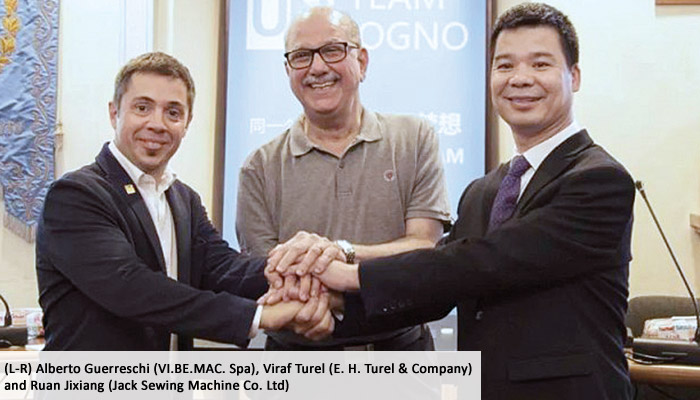
Jack expands its intelligent sewing profile by acquiring VI.BE.MAC.
Established in August 2003 in China, Jack Sewing Machine Co. Ltd., started sewing machine business from July 18, 1995. And ever since 2010, the sales amount of Jack is leading in global sales with the absolute advantage of lockstitch, overlock and interlock sewing machine. On 3rd July, 2018 Jack and VI.BE.MAC. finished the equity delivery ceremony, which took place in Vero, Italy. The acquisition of VI.BE.MAC marks Jack’s globalization made another historic progress. Today, Jack focuses on industrial intelligent sewing machine, automatic cutting machine and motor & control box. It is the only Intelligent manufacturing complete solution service provider integrated pre-sewing equipment and mid-sewing equipment in the global sewing equipment industry. Its products serve many industries, such as autos, aviation, cloth, shoes, suitcase, furniture, advertisement etc.
Jack has more than 5,000 agents and service center in more than 120 countries. Jack’s overseas acquisition co-operation began in 2009. German Automatic cutting machine Bullmer company enjoys the “Mercedes-Benz” reputation in pre-sewing industry and has more than 80-year history, which became a member of Jack in that year. In July, 2017, Jack acquired Italian MAICA, which is the only professional manufacturer to produce shirt automatic equipment in the world for more than 40 years. VI.BE.MAC with 38-year history is the leader of industry sewing machine for jeans. However, many factors constrain the development of VI.BE.MAC. foreign markets. In the Asian market, especially in the Chinese market it faces challenges from other peers.
Today, Asia is the main production area of jean clothing. China, Bangladesh, India, Indonesia, Pakistan, Cambodia, Vietnam, Myanmar, etc., are the big countries in jean clothing production. And China is the world’s largest denim clothing production base. The company, who owns the Chinese market, is equal to half the sky in the jean clothing production market. Jack’s co-operation with VI.BE.MAC. will achieve this possibility. Both the companies have same target that not only provides products but also offer the solution to meet customers’ need. After the acquisition of VI.BE.MAC., Jack will give full play to advantages in supply chain, production, technology, channels etc.
Improve automation and intelligent development through technology; Reduce production costs of VI.BE.MAC. through production; Expanding its global sales network through channel; Improve its global after-sales service system; Improve the competitiveness of VI.BE.MAC; Create more development opportunities for VI.BE.MAC; and Open up a bigger market and achieve new glory.
Jack is committed to becoming the Intelligent Manufacturing Complete Solution Service Provider with “Intelligent cutting bed (pre sewing)+intelligent sewing machine (mid-sewing)+Intelligent ironing(after-sewing)+IPMS Intelligent production management system. The acquisition will enrich Jack’s automation and intelligent product categories and expand intelligent sewing field, which accelerates the realisation of the world’s first brand of sewing equipment.
According to Jixiang Ruan, President, Jack Sewing Machine Co. Ltd., “We share with VI.BE.MAC.’s philosophy and values and are grateful to the mutual knowledge in these years. This agreement will bring growth to both partners. After the acquisition – due to the added value that Jack can bring in terms of supply, production and distribution in China and in the world, with its more than 5,000 sales and service channels in more than 120 countries – we will share with VI.BE.MAC. an even wider market. Moreover, thanks to the brand, the experience and the technological know-how of the VI.BE.MAC. units, we will enrich the automation of our products with the aim of quickly entering the market for the denim clothing automation, establishing a position of leadership in this area.”
“The agreement marks an important milestone in the history of our company and gives full effect to what I like to define as a successful model of internationalisation. This venture allows us to further invest and increase the dissemination of VI.BE.MAC. products in the world and in the Chinese market. Innovative stitching pioneers, we are the Ferrari of industrial sewing machines for speed, quality and service. We have made experience, passion, technological knowhow and innovation the soul of society and the key to winning the challenge of competitiveness. We have developed new high tech solutions; new information control distribution management systems; consulting services on production plants, training on the use of the product and systems of forums, chat and clouding for the exchange of information. All this to satisfy the demands of an increasingly demanding and competitive market,” said Alberto Guerreschi, CEO of VI.BE.MAC.
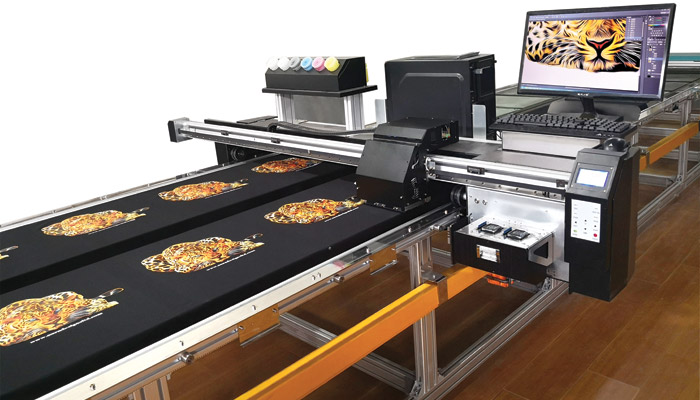
Aura launches T-Shirt and Sweater printers
Aura Designs Ltd is the latest trendsetter in the digital textile printing technology arena. The company formed by a group of technocrats with more than two decades of wide and varied experience across textile and apparel sectors, aims to change the dynamics of the market. It is striving to bring the best hardware and software technologies together and integrating the same in its product portfolio. This has helped the company to launch state-of the-art, cutting edge products aimed at delivering higher outputs at lower costs thereby providing higher optimisation levels.
Today, the biggest challenge faced by DTG printers is the white ink itself. The white ink always causes problems for print head clogging and consistency of prints. The cost of digital white inks also makes it more expensive for the operational cost. The smaller printer available in markets does not give enough production and the bigger ones are too expensive and complicated to operate. To overcome all these issues; the company came up with“Smart Series of T-shirt Printers.” This printer is a perfect solution for printing on T-shirts / Panels with pigment inks. It works on white, light, as well as dark base.
Aura Smart T-shirt Printer combines the format of screen and digital printing; reducing printing cost and making use of white ink possible by screen. “Smart” uses a special software and sensor technology which makes the registration easy and can print multiple copies without ripping the designs again and again.
The printer has a speed of printing 80-140 T-shirts/hr and till day, more than 200 such machines have been installed worldwide. Some of its main features are:
- Print on light / dark garments • Production: 80 to 140 T-shirts / hour
- Fine printing | Brilliant colours • 2X EPSON 5113 Gold generation printheads
- White / Glitter, etc. done by screen printing • Printing width of the printer: 145 cm
- Standard printing table length: 6 mtr (Options available for 9,12,15 or 18 mtr)
- Glass table / pallets & computer to be provided locally by the customer
- Pre-treatment: Not required
- White inks are first printed via screen and then CMYK via digital. White ink used is wet on wet
- Post-treatment: Heat fixing thru tunnel heater/heat curing box
Another major introduction by the company is Aura Grand Sweater Printer. The printer could be installed with low Investment and has low maintenance cost with no limitation of colours. Given are some of its main features:
- Printing on cuffs & collars / ribs • 180 x 260 cm working width
- 4X gold generation Epson print heads • 8 colours • Strong Rip
- Easy registration • Robust designs
Groz-Beckert organises 3rd textile symposium “The Fabric Year”
19 June 2018, Groz-Beckert invited international guests to Albstadt for the textile symposium for the third time. Under the title “The Fabric Year 2018,” the company provided insights into the current market developments. Around 150 guests from over 20 countries from Asia, America and Europe followed the invitation.
Eric Schöller, Member of the Executive Board Groz-Beckert, who opened the Fabric Year, welcomed the participants. The first presentation of the day was given by Dr. Josef Braml, Deutsche Gesellschaft für Auswärtige Politik e. V., and focused on the global competition between the US and China, as well as the implications for Europe.
Andreas Engelhardt, Groz-Beckert Product Marketing and Innovation, then presented key messages from his established yearbook “The Fiber Year,” which he has been publishing as the owner of the company of the same name for many years. He reported that the global fibre industry achieved a growth of around 4 percent in 2017, after four years of falling growth rates. Although synthetic fibres continued to build on their prominent market position in the sector, natural fibres also experienced a more dynamic growth – a development that has not been seen since 2001.
Once the foundations had been laid with the extracts from the Fiber Year, Andreas Engelhardt and Martin Weiler, Groz-Beckert Market Research, moved on with the Fabric Year with the observations of the development and the current status of the national fibre and fabric production – always divided into knitted and woven fabric, as well as nonwovens. The markets in Vietnam and Indonesia were addressed first. An important common feature of both markets was the growing dependency on imports of fibre material, which is particularly relevant in light of the extremely dynamic expansion in fabric production.
This information was the ideal basis for the subsequent presentation held by Gail Strickler, President of Global Trade Brookfield Associates. She was a key player in the negotiations for the Trans Pacific Partnership (TPP) and the Transatlantic Trade and Investment Partnership (TTIP) for textile-related issues and has been active in the private textile sector for many years. Her presentation addressed the Transpacific Partnership from the Asian perspective, the status of negotiations and the expected implications of the agreement for the global textile trade.
Over the course of the day, Andreas Engelhardt and Martin Weiler gave insights into the developments of further key textile markets. The developments in China, India and Bangladesh, as well as the US, were outlined in a block of presentations. A second presentation from Gail Strickler followed on the topic of the US. In this presentation, she provided exciting insights into the US trade policy and the status of negotiations for the North American Free Trade Agreement (NAFTA).
There then followed a detailed examination of the markets in Germany, Italy and Turkey. Production in Germany has stabilised over the past few years at a comparatively high level and the textile industry in Italy – as a renowned fashion center in Europe – has also experienced a revival recently. An interesting outlook on the Italian fashion market was also provided by Dr. Davide Bonassi from the Italian Hosiery Association.
Engelhardt and Weiler completed the block of presentations with a worldwide summary, complete with an outlook through to 2022. Growth potential has been highlighted for all fabric production technologies, with particularly high growth levels in knitwear and nonwovens. The “The Fabric Year 2018” concluded with an evening buffet dinner, which offered space for discussions and exchanges.