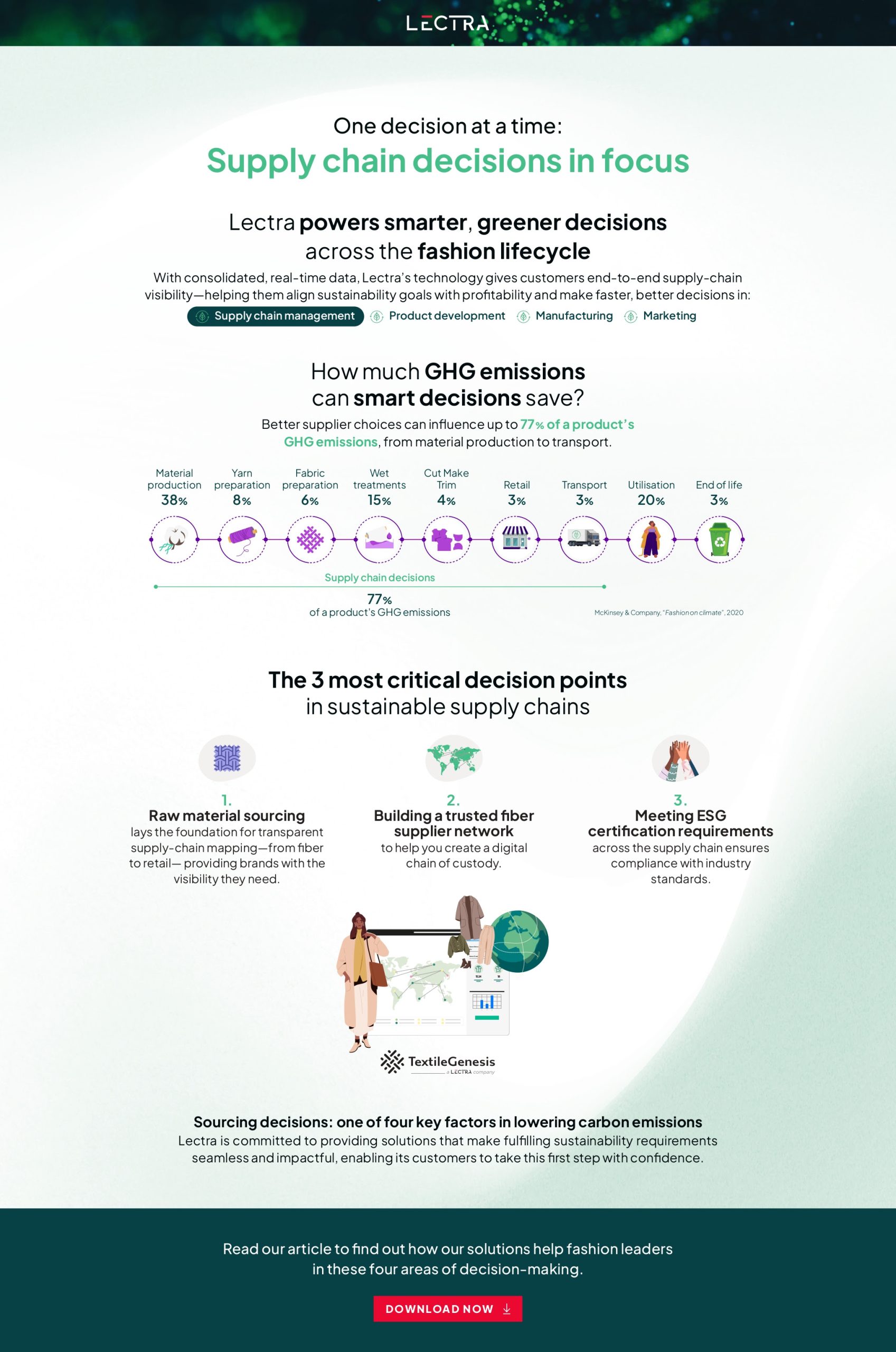
 Transparency, traceability, ESG compliance: while the fashion industry is making progress, but the path forward remains complex. To shed light on the practical challenges facing brands, Lectra has unveiled a new exclusive infographic exploring supply chain traceability and the key decisions that shape a product’s environmental impact.
In an industry where commitments are increasing but visibility remains fragmented, the infographic highlights a key finding: decisions related to raw materials and suppliers can account up to 77% of a product’s greenhouse gas emissions, long before it’s use or end-of-life stage. A reality that is still poorly understood, even though raw material production alone accounts for 38% of emissions across the entire life cycle.
Three major barriers to value chain traceability
The infographic highlights three structural challenges currently hindering progress towards more transparent and responsible supply chains:
• Scaling up, as the production of sustainable materials struggles to keep pace with volatile volumes
• Certification, which remains largely based on manual processes, is vulnerable to fraud, and ill-suited to growing regulatory requirements
• Change management, which involves a profound transformation of operations, workflows, and information systems, both upstream and downstream
Rethinking sustainability from the outset
Beyond the diagnosis, the infographic outlines a clear approach: sustainability cannot be built retroactively. It must be integrated from the outset—at the fiber and material level, but also through supplier selection, cutting and manufacturing processes, and from the very first marketing decisions. A targeted strategy based on product, price, placement, and promotion enables the design of the right product, at the right time, and at the right price, automatically reducing unsold inventory and, consequently, environmental impact. It is at these key decision points that the most effective levers for addressing environmental, social, and compliance impacts are concentrated. By mapping these critical decision points, Lectra illustrates how technology and data can enhance visibility, secure workflows, and restore trust at every level of the value chain.