
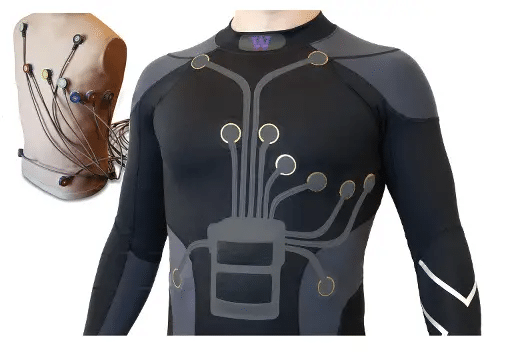
 The global e-textiles and smart clothing market is entering a high-growth phase as textile manufacturing increasingly converges with electronics, sensors, connectivity, and wearable technology. Smart garments can incorporate conductive fibers, embedded sensors, flexible circuits, and communication technologies to provide functions that conventional clothing cannot offer. Applications are expanding across healthcare, sports and fitness, defense, entertainment, and lifestyle products. Growing interest in connected devices, personalized monitoring, and intelligent apparel is encouraging textile manufacturers and technology companies to collaborate on products that combine comfort with digital functionality. Improvements in flexible electronics and textile integration are also helping manufacturers develop garments that can monitor physical activity, body movement, and other useful parameters without compromising everyday wearability.
The global e-textiles and smart clothing market is expected to be valued at US$7.1 billion in 2026 and is projected to reach US$28.1 billion by 2033, growing at a CAGR of 21.7%. Strong growth is being supported by rising adoption of wearable technology, increasing demand for connected healthcare solutions, and growing consumer interest in technologically enhanced sportswear. Among product categories, smart clothing is a leading segment because garments provide a larger surface area for integrating sensors, conductive materials, and electronic components while remaining suitable for continuous use. North America represents a leading geographical market, supported by advanced wearable technology adoption, strong research and development capabilities, established healthcare infrastructure, and the presence of technology companies developing connected apparel solutions.
Regional Insights
North America remains a leading region in the e-textiles and smart clothing market due to strong adoption of wearable technologies and significant investment in advanced electronics and connected devices. The region benefits from an established technology ecosystem and strong research capabilities spanning healthcare, sports technology, and consumer electronics. Demand for connected healthcare and performance-oriented wearable products is encouraging companies to explore increasingly sophisticated textile-based solutions.
Europe is an important market supported by technological innovation, advanced textile manufacturing capabilities, and growing interest in functional and sustainable apparel. European companies are increasingly exploring ways to combine textile expertise with electronics and smart-material technologies. The region also offers opportunities for smart clothing applications in healthcare, sports, and industrial environments.
Asia Pacific is emerging as a significant growth market because of its large textile manufacturing base, expanding technology sector, and rising consumer adoption of wearable devices. Countries with established textile and electronics industries provide favorable conditions for large-scale production and product innovation. Increasing interest in fitness technology and connected consumer products is further supporting regional demand.
Other regions are gradually adopting smart textile technologies as awareness of connected apparel increases. Growing healthcare modernization, sports participation, and interest in technology-enabled products could create additional opportunities for manufacturers seeking to expand their geographic presence.
Market Drivers
One of the strongest drivers of the e-textiles and smart clothing market is the growing popularity of wearable technology. Consumers are becoming increasingly comfortable using connected devices to monitor fitness, activity, and personal performance. Smart clothing extends this trend by embedding technology into garments, potentially allowing users to collect useful information without relying solely on traditional wearable devices. The combination of comfort and functionality is therefore creating a new category of technology-enabled apparel.
Healthcare is another important growth driver. Smart textiles can support wearable monitoring applications by incorporating sensors directly into garments. This creates opportunities for products designed for patient observation, fitness monitoring, rehabilitation, and other healthcare-related applications. As healthcare systems increasingly explore remote and personalized approaches, the potential role of connected textiles is expanding.
Sports and fitness are also contributing significantly to market development. Athletes and fitness enthusiasts increasingly seek detailed performance information, encouraging manufacturers to develop apparel capable of tracking movement and other physical indicators. Smart clothing can provide an unobtrusive approach to monitoring activity because electronic functions are incorporated directly into garments rather than being worn as separate devices.
 Market Restraints
Despite strong growth potential, the e-textiles and smart clothing market faces challenges related to cost, durability, and manufacturing complexity. Integrating electronic components into textiles requires specialized materials and production processes, which can increase product costs compared with conventional apparel. Manufacturers must balance technological functionality with affordability, particularly when targeting mass-market consumers.
Durability and maintenance also remain important concerns. Smart garments may need to withstand washing, stretching, perspiration, and repeated use while maintaining electronic performance. Ensuring reliable connections between textile and electronic components can therefore be technically challenging. Improvements in washable electronics, flexible components, and textile-compatible manufacturing processes will be important for overcoming these barriers.
Consumer acceptance can also influence market adoption. Smart clothing must provide clear benefits while maintaining comfort, appearance, and ease of use. If products are difficult to maintain or uncomfortable to wear, consumers may be reluctant to adopt them despite their technological capabilities.
Market Opportunities
The rapid development of flexible electronics creates substantial opportunities for the e-textiles and smart clothing market. Flexible and textile-integrated components can enable garments to become thinner, lighter, and more comfortable. Continued innovation could support the development of smart apparel capable of delivering advanced functions without significantly changing the look and feel of conventional clothing.
Healthcare presents another major opportunity. The integration of sensors into everyday garments could support continuous and convenient monitoring applications. Smart clothing may become increasingly relevant for remote care, rehabilitation, sports medicine, and personalized wellness. Partnerships between textile manufacturers, healthcare organizations, and technology companies could accelerate commercialization in these areas.
There are also significant opportunities in professional and industrial applications. Smart garments can potentially assist workers in environments where safety, physical monitoring, and communication are important. Defense, emergency response, logistics, and industrial operations could benefit from specialized textile systems designed around specific operational requirements.
Recent developments in the market have increasingly focused on integrating flexible sensors and electronic components directly into textile structures to improve comfort and functionality. Companies are also advancing smart clothing solutions designed for healthcare, sports performance, and continuous monitoring, reflecting the industry’s shift toward practical and application-specific wearable products.
Another notable development is the growing collaboration between textile manufacturers and technology companies. These partnerships are helping combine textile engineering with electronics expertise, supporting the development of washable, flexible, and commercially viable smart garments.
Future Outlook
The future of the e-textiles and smart clothing market is closely connected to advancements in flexible electronics, textile engineering, sensors, connectivity, and wearable computing. As manufacturers overcome challenges related to durability, comfort, affordability, and scalability, smart garments are likely to become more practical across both consumer and professional applications. Healthcare, sports, fitness, defense, and industrial users represent particularly attractive areas for continued development.
With the market expected to increase from US$7.1 billion in 2026 to US$28.1 billion by 2033, the industry is positioned for significant expansion at a 21.7% CAGR. The convergence of textiles and electronics is transforming clothing from a passive product into an interactive platform capable of supporting monitoring, communication, performance enhancement, and personalized experiences. Companies that successfully combine technological innovation with comfort, durability, and practical functionality are likely to be well positioned to capture emerging opportunities in this rapidly evolving market.
By Persistence Market Research