South Korea’s textile and apparel industry is moving aggressively into AI- and robot-driven manufacturing automation. Hansae has signed a contract with robotic gripper technology firm Realworld and is reviewing deployment at production sites, while also conducting proof-of-concept testing with CAPlanet on automated pattern size-adjustment technology. Bokwang INT is applying AI that detects fabric thickness and tension in real time to automatically adjust sewing conditions, and Korean Friends is developing generative AI that converts designs into work orders. The South Korean government is advancing a high-tech future textiles development program with 310 billion won (approximately $222.4 million) in funding starting in 2028, while U.S.-based CreateMe is also developing automated garment assembly systems. The industry is expanding AI adoption as a strategy to preserve South Korea’s domestic manufacturing base amid rising labor costs and a shortage of skilled workers.
The use of artificial intelligence (AI) in the textile industry is rapidly spreading beyond design and demand forecasting into actual manufacturing operations such as fabric cutting, sewing, and quality inspection. With South Korea’s domestic manufacturing base weakening due to rising labor costs and an aging production workforce, efforts to replace processes long dependent on human hand skills with AI and robots are now gaining real momentum.
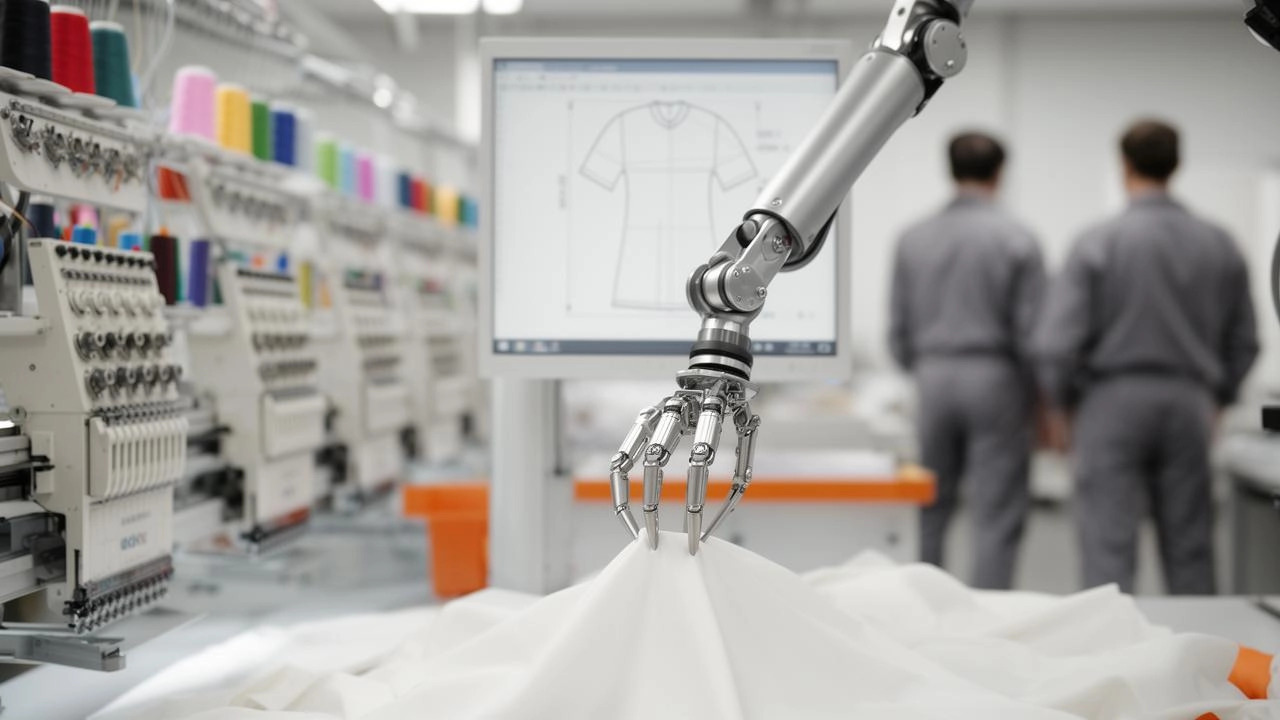
According to industry sources on the 21st, Hansae has signed a contract with Realworld, a robotic gripper technology company, and is reviewing ways to apply AI and robots to its apparel production lines. Realworld develops robotic hand AI technology capable of precisely gripping and manipulating objects like a human hand, and Hansae Vice Chairman Kim Ik-hwan is reported to have personally reviewed the technology. Since establishing a dedicated AI organization in 2023, Hansae has been using AI for design development and product manufacturing, and is now conducting proof-of-concept (PoC) testing with systems software developer CAPlanet on technology that automatically adjusts a single pattern to multiple sizes.
Manufacturing AI adoption is progressing most actively among companies that operate domestic production facilities in South Korea. Bokwang INT, which produces specialized uniforms for defense and firefighting, is applying AI that detects fabric thickness and tension in real time to automatically adjust sewing conditions and identify microscopic surface defects. The goal is to automate sewing and inspection processes where quality can vary depending on worker skill levels.
Korean Friends is developing technology that automatically converts generative AI-created designs into the work orders needed for actual garment production. The aim is to reduce product development time and manpower by eliminating the step where a person manually translates design images into production drawings. Georim Trend, F&I Korea, and Good Trust are collaborating with AI data company SIJE to collect and analyze sewing workload and equipment data in real time, identifying bottlenecks in the production process.
The South Korean government is also supporting the textile manufacturing sector’s AI transition. The Ministry of Trade, Industry and Energy has surveyed corporate demand as it prepares to launch a “High-Tech Future Textiles Development Program” with total funding of 310 billion won (approximately $222.4 million) from 2028 to 2034. The goal is to boost productivity by integrating AI across the entire textile manufacturing process, from yarn and spinning to dyeing, processing, and sewing. Approximately 200 companies reportedly applied for the demand survey — far more than initially expected.
Efforts to revive apparel production bases using AI are also underway outside South Korea. U.S. fashion-tech company CreateMe is developing a production system that tracks fabric positioning in real time to automatically assemble garments, and holds more than 95 related patents. It recently partnered with AI agriculture company Avalo and fabric supplier Laguna Fabrics to launch a project building a U.S. domestic apparel production ecosystem.
Behind the South Korean textile industry’s accelerating AI adoption lies a sense of crisis over the weakening of its production base. South Korea’s textile industry led exports in the 1960s and 1970s, but production facilities rapidly relocated to China and Vietnam as labor and production costs mounted. Compounding this, the aging of the domestic production workforce has made it increasingly difficult to secure skilled labor for sewing and other processes. “If only design and planning remain in South Korea while the production base disappears, K-fashion’s growth will inevitably hit a ceiling,” said an industry insider. “If processes that require extensive human labor, such as cutting and sewing, can be automated with AI and robots, it will help offset the labor shortage and preserve the domestic manufacturing base.”