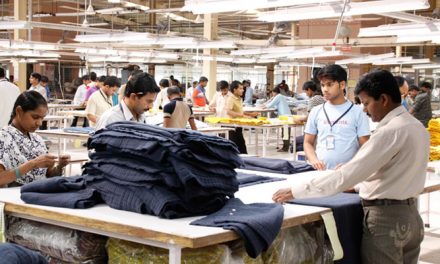
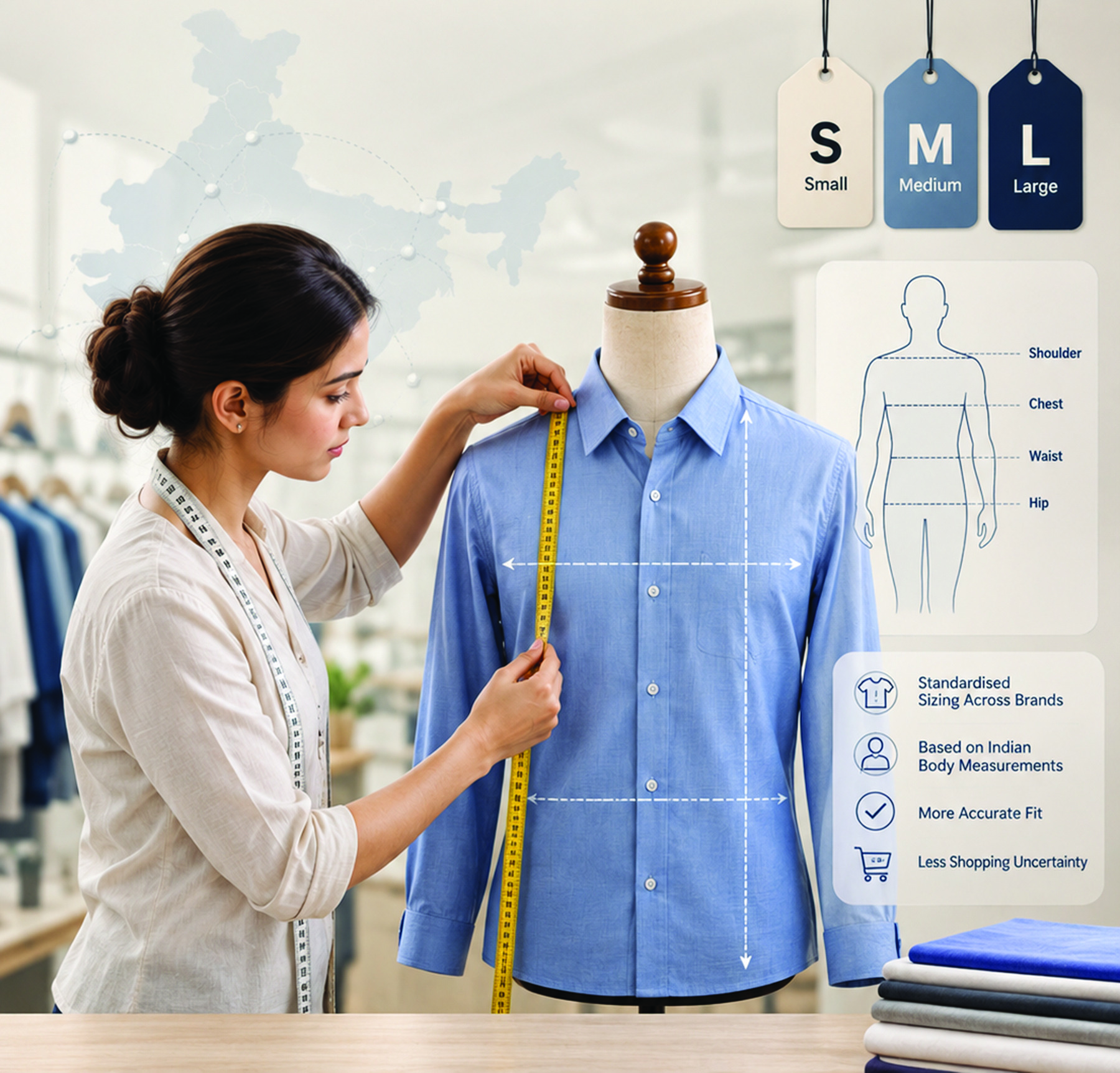
 Shopping for clothes in India may soon become far more convenient and predictable as the Government of India moves closer to introducing a national apparel sizing framework aimed at standardising clothing measurements across brands. Once implemented, consumers will no longer have to wonder whether a “Medium” in one brand is equivalent to a “Large” or “Small” in another. The proposed system is expected to create uniform size standards across the Indian apparel industry, improving both the shopping experience and manufacturing efficiency.
The initiative, spearheaded by the Ministry of Textiles, is part of the government’s broader vision to modernise India’s textile and apparel ecosystem by introducing uniform standards that benefit consumers, retailers and manufacturers alike. The framework is expected to replace the current fragmented sizing practices with a scientifically developed, India-specific size chart that accurately reflects the body measurements of Indian consumers.
A Consumer-Centric Approach
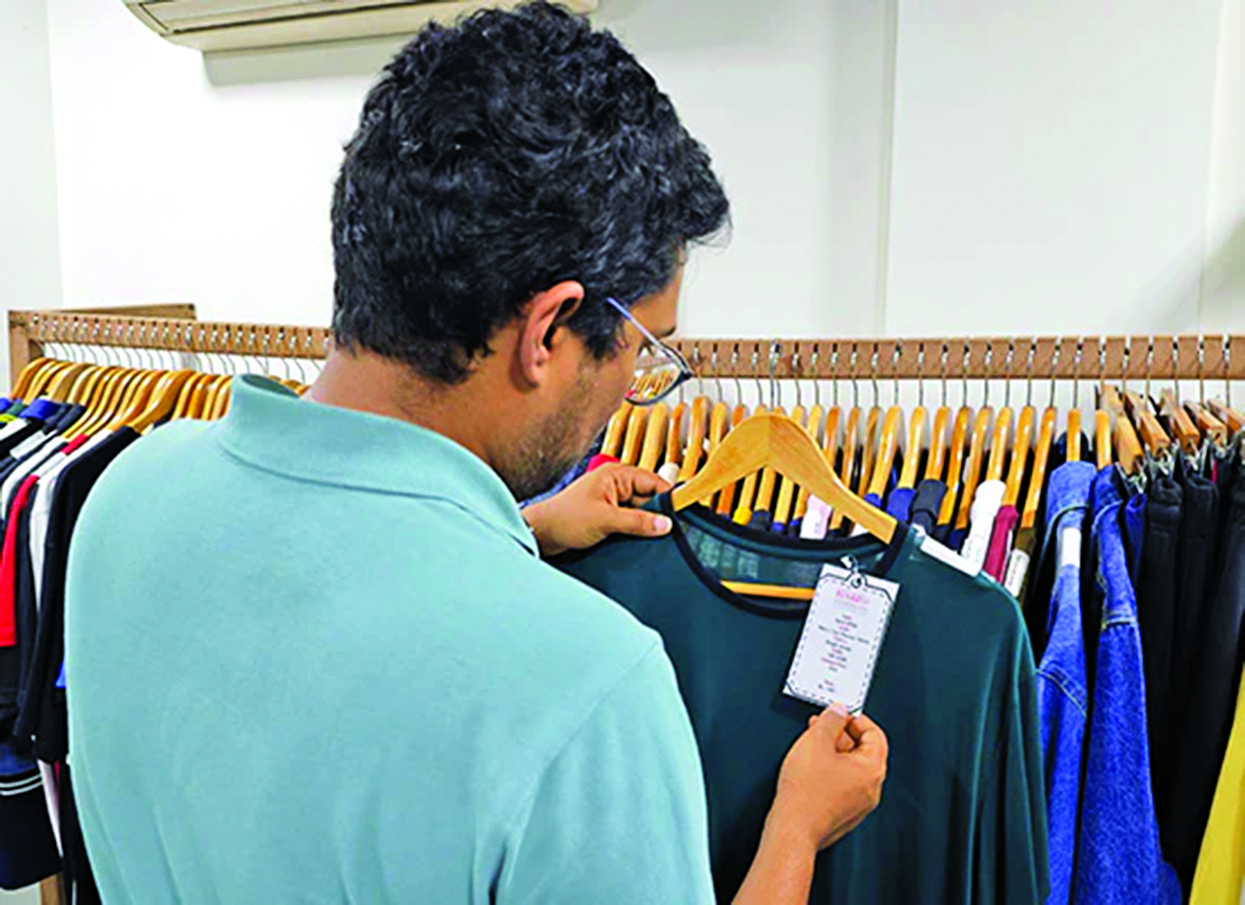
For years, inconsistent sizing has remained one of the biggest challenges faced by apparel shoppers in India. Consumers often find themselves purchasing different sizes across brands despite having similar body measurements. A person who comfortably wears a Medium-sized shirt from one manufacturer may require a Large or even an Extra Large from another. This inconsistency not only causes confusion but also affects customer confidence while shopping, particularly in the rapidly growing e-commerce segment.
The proposed national sizing framework seeks to eliminate this uncertainty by ensuring that standard size labels such as Small (S), Medium (M), Large (L), Extra Large (XL) and other common size categories correspond to uniform body measurements across participating brands. Rather than depending solely on numerical measurements, the framework is expected to adopt internationally familiar alphabetical size labels while ensuring they are based on Indian body dimensions.
For consumers, this means greater confidence while purchasing garments both in stores and online. They will be able to rely on a consistent sizing system irrespective of the brand, reducing the need for repeated trials or frequent exchanges.
Scientific Study Behind the Framework
The proposed sizing standards are backed by one of the most comprehensive anthropometric studies ever conducted in India. The National Institute of Fashion Technology (NIFT), under the Ministry of Textiles, carried out an extensive body measurement survey covering more than 25,000 Indian men and women aged 15 years and above from different geographical regions of the country.
Using advanced body scanning technology and scientific measurement techniques, researchers collected detailed data on multiple body dimensions, including height, chest, waist, hips, shoulder width, sleeve length, inseam, neck circumference and several other critical parameters. The survey represents diverse age groups, regions and body types, providing an accurate reflection of contemporary Indian body proportions.
This data forms the foundation of the new sizing system, ensuring that garments manufactured under the framework are designed specifically for Indian consumers rather than being adapted from Western standards.
Moving Away from Western Size Standards
A majority of apparel brands operating in India currently rely on sizing systems originally developed for US, UK or European markets. Although these standards have been widely adopted, they often fail to accurately represent Indian body shapes and proportions.
Indian consumers generally exhibit different anthropometric characteristics compared to Western populations, including variations in torso length, shoulder width, waist-to-hip ratio and body build. Consequently, garments designed according to foreign size charts frequently result in inconsistent fits, requiring brands to make their own internal adjustments. This has led to considerable differences in sizing even among domestic manufacturers.
The new India-specific framework aims to replace this fragmented approach with a standardised reference that is more relevant to local consumers while allowing brands to maintain their individual styling and fashion aesthetics.
Industry Collaboration for Uniform Standards
 The Ministry of Textiles has constituted a task group comprising government officials, technical experts, representatives from the apparel industry, retailers and standardisation bodies to finalise the framework.
Apart from defining overall size categories, the committee is also standardising critical body measurements such as chest circumference, shoulder width, waist, hips, sleeve length, inseam and other garment dimensions. These technical specifications will serve as common guidelines for manufacturers while allowing sufficient flexibility for different product categories.
Industry participation has been an important aspect of the initiative, ensuring that the proposed standards are practical for large manufacturers, fashion brands, organised retailers and exporters.
Benefits for Consumers
The introduction of standard apparel sizing is expected to transform the shopping experience across both offline and online channels.
One of the biggest advantages will be improved garment fit. Consumers will no longer need to experiment with multiple sizes while shopping or repeatedly consult brand-specific size charts. This will make purchasing decisions faster, simpler and more reliable.
The initiative is particularly significant for India’s booming e-commerce sector. Apparel remains one of the largest categories in online retail, but inconsistent sizing is also one of the primary reasons behind product returns and exchanges. A standardised sizing framework can substantially reduce return rates, benefiting both consumers and retailers by lowering logistics costs and improving customer satisfaction. Additionally, standard sizing can encourage greater confidence among first-time online shoppers, contributing to further growth in digital fashion retail.
Opportunities and Challenges for Apparel Manufacturers
While consumers stand to benefit significantly, apparel manufacturers will also need to prepare for a period of transition.
Brands may have to revise their existing size specifications, redesign patterns, recalibrate grading systems and update production processes to align with the new standards. Inventory planning, quality control and product development practices may also require adjustments during the implementation phase.
However, these short-term investments could deliver long-term operational benefits. Standardised sizing is expected to reduce production inconsistencies, improve inventory management, minimise customer complaints and lower the cost associated with returns and alterations. Manufacturers may also benefit from greater production efficiency by working with uniform specifications across multiple product lines.
Strengthening India’s Apparel Ecosystem
The proposed sizing framework complements the government’s wider efforts to strengthen India’s textile and apparel industry through quality improvement, standardisation and enhanced competitiveness. As India continues to expand its presence in global apparel manufacturing and retail, adopting scientifically developed national standards can improve product consistency and build greater consumer trust.
A standard sizing system may also support export-oriented manufacturers by enabling better alignment between domestic production and international quality benchmarks while preserving sizing specifications tailored to Indian consumers.
A Step Towards Smarter Fashion Retail
If widely adopted across the industry, the new apparel sizing framework has the potential to become a landmark reform for India’s fashion and textile sector. Beyond simplifying shopping, it promises to improve product fit, reduce returns, enhance manufacturing efficiency and create greater transparency across the apparel value chain.
For millions of Indian consumers, purchasing clothing could soon become a far more predictable experience-where a Medium truly means a Medium, regardless of the brand on the label. As retailers, manufacturers and policymakers work together towards implementation, the initiative marks an important step in creating a more organised, consumer-friendly and globally competitive Indian apparel industry.