However, in the context of global brands increasingly demanding sustainability, social responsibility, clean energy, and traceability, the competitive advantage of Vietnamese textile and garment businesses no longer lies solely in price and production capacity. Green transformation, technological innovation, sustainable raw material development, and supply chain upgrading are becoming crucial conditions for Vietnamese businesses to retain orders and move further into the global value chain.
Greening becomes a competitive advantage
According to the Ministry of Industry and Trade, textile and garment exports are expected to reach US$46 billion in 2025; the industry aims to achieve US$48 billion in 2026. As of August 2026, textile and garment export turnover reached approximately US$26.9 billion, an increase of 1.6% compared to the same period last year. This result shows that the industry maintains its competitiveness, but is also facing increasing pressure from production costs, trade policies, and new standards on greening, emissions, and circularity.
The global textile and apparel market is undergoing a significant shift in supplier selection. Alen Wei, Chief Financial Officer of H&M Production China and Southeast Asia, stated that fashion brands are now seeking not only commercially viable supply chains but also those capable of sustainable development, innovation, resilience, and long-term value creation.
For H&M, products remain central to business decisions, but competitiveness is seen in a combination of fashion, quality, price, and sustainability. Suppliers must also continuously improve efficiency, productivity, and innovation.
Previously, production capacity, cost, and delivery time were the deciding factors. Now, businesses must simultaneously meet multiple requirements regarding raw materials, the environment, energy, chemicals, labor conditions, and responsibility throughout the entire supply chain. In particular, the requirement to reduce emissions is directly impacting the textile and garment industry – an industry that uses a lot of energy and raw materials. According to business research, the entire fashion industry produces over 100 billion garments annually; of which more than 60% use polyester fibers, while generating approximately 92 million tons of textile waste each year. Therefore, promoting recycled materials, extending product lifecycles, and building circular models are becoming increasingly prominent trends.
Vietnam holds a crucial position in H&M’s global supply chain. The group has been sourcing goods from Vietnam for over two decades, currently collaborating with more than 40 suppliers, operating over 70 factories nationwide, and employing over 60,000 workers. This provides a foundation for Vietnam to continue maintaining its role in the supply chains of international brands, but also requires businesses to quickly adapt to new standards.
According to Alen Wei, not only H&M but many other fashion brands are aiming for net-zero emissions across their entire value chain, while also promoting the use of recycled materials. Accordingly, products need to be durable, beautiful, safe, and user-friendly, but also minimize environmental impact, be free of harmful chemicals, and have a longer lifespan.
At the Vietnam International Sourcing 2026 event series, organized by the Ministry of Industry and Trade and currently taking place in Ho Chi Minh City, international textile and garment buyers noted that Vietnam has established itself as one of the world ‘s important textile and garment manufacturing centers thanks to its production capacity, workforce, level of integration, and adaptability. The next stage of development requires the industry to shift significantly from a manufacturing hub to a destination for green, high-tech, circular, and high value-added textiles and garments.
Besides environmental requirements, Vietnamese textile and garment businesses are also affected by changes in international trade policies. Mr. Do Ngoc Hung, Commercial Counselor and Head of the Vietnamese Trade Office in the United States , stated that the tariffs applied by the US to many economies will affect the purchasing power of consumers and importers, potentially reducing the price competitiveness of Vietnamese exports. However, major US suppliers and distributors currently have no plans to change their purchasing partners; Vietnam continues to be considered a strategic partner for large corporations, including in the textile, footwear, and many labor-intensive industries.
According to Mr. Do Ngoc Hung, this is a positive sign, but it also shows the urgent need to strengthen the advantages of Vietnamese goods by leveraging factors beyond just price. Businesses need to improve production capacity, increase the proportion of domestically sourced raw materials and technology used, thereby creating greater added value and simultaneously reducing the risk of trade defense investigations or accusations of using opaque raw materials from third countries.
Synchronized supply chain transformation
Faced with changing market conditions, many Vietnamese textile and garment businesses have proactively shifted their focus, considering greening and innovation as part of their business strategy rather than merely meeting export standards. Ms. Nguyen Thi Hong Trang, Deputy Head of the Research, Development and Investment Department of Corporation 28, stated that the company currently operates a closed-loop production chain from yarn spinning, weaving, dyeing, finishing, to garment manufacturing and direct distribution to the market. Current production capacity reaches approximately 2,500 tons of yarn, 3 million meters of tie-dye fabric, and 18 million meters of dyed fabric annually. Corporation 28’s textile and garment products are exported to many markets such as the United States, the EU, Japan, etc., with annual export revenue reaching 90-100 million USD.
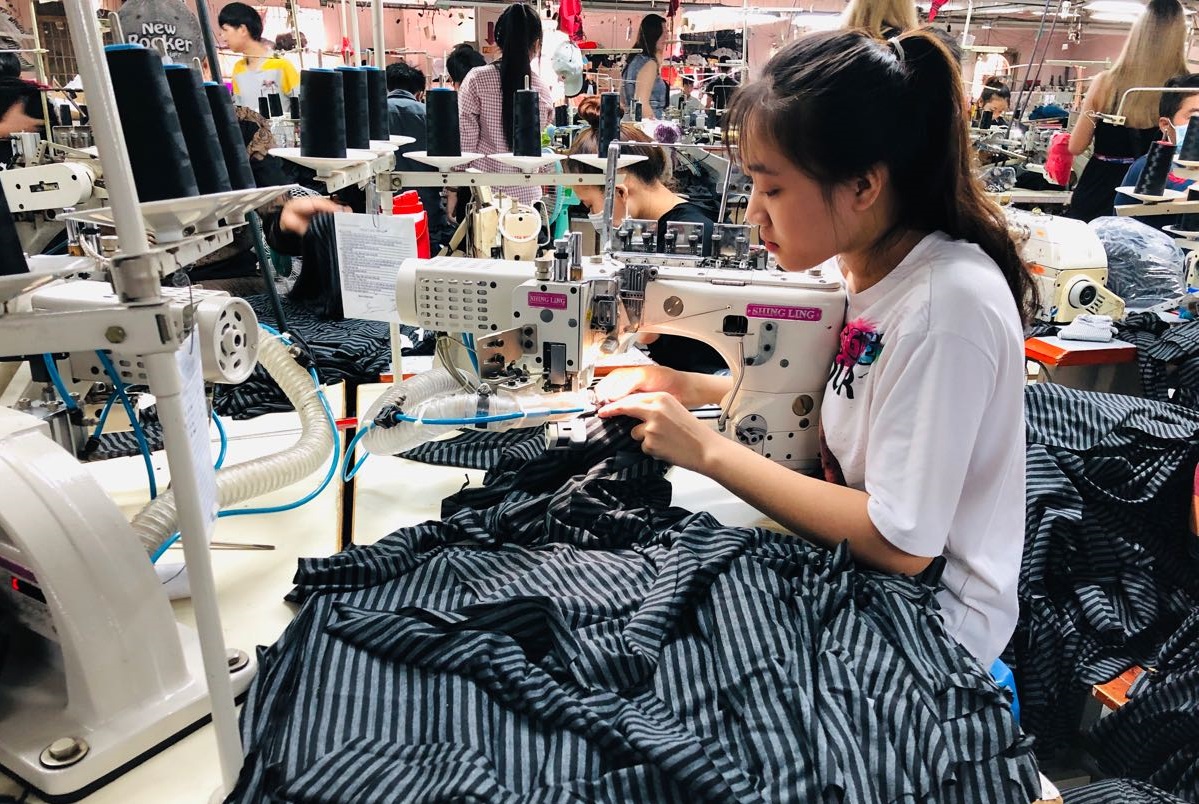
According to Ms. Nguyen Thi Hong Trang, recently, international customers have increasingly shown interest in and prioritized green and sustainable products, from raw materials and energy to the working environment of laborers. In response to this demand, the company has proactively upgraded its production capacity and is gradually shifting towards greening. Along with investing in modern equipment, the company focuses on improving production processes, applying automation to many stages from design, fabric laying, cutting, sewing to product finishing, in order to increase productivity and efficiently utilize raw materials. This strategy not only aims to meet the environmental requirements of current buyers but also prepares to enhance long-term competitiveness, with the goal of further expanding export markets.
Meanwhile, Faslink Vietnam Company has chosen to focus on researching new materials, recycling, and applying technology. Ms. Tran Hoang Phu Xuan, Director of Faslink Vietnam Company, said that the development process of Faslink Vietnam is closely linked to the shift from simply producing products to providing solutions for buyers. Prioritizing environmentally friendly materials and consumer health, Faslink Vietnam continuously launches lines of fabrics made from natural sources such as bamboo fiber, lotus fiber, coffee fabric, mint fabric, etc. Alongside materials, the company is also promoting the application of 3D technology in production, helping to shorten sample development time and reduce waste of raw materials – factors that are increasingly important to buyers. In addition, the company also uses big data analytics to forecast trends and implement circular solutions, recycling old clothes into new ones.
According to Ms. Tran Hoang Phu Xuan, through collaborative application of recycling solutions, businesses can reduce CO2 emissions by approximately 59% and water consumption by 47% compared to conventional production processes. This is a significant advantage that has helped Faslink Vietnam become a supplier of raw materials and production solutions for over 60 fashion brands and a uniform supplier for more than 500 businesses in Vietnam.
Transforming the production chain is not just about the environment or added value; it’s increasingly directly linked to the competitiveness and ability to retain orders in the textile and garment industry. With international brands increasingly seeking suppliers that combine price, quality, speed, innovation, and sustainability, the opportunities for Vietnam’s textile and garment industry remain significant. However, to translate these opportunities into substantial growth, businesses cannot simply produce more; they must create more value in each product and throughout the entire supply chain.
Experts recommend that Vietnam’s textile and garment industry should prioritize shifting from simple processing to higher value-added stages, increasing design and product development capabilities, supply chain management, and proactively securing raw materials. This should be coupled with investment in labor skills, digital technology, automation, trend forecasting, and data management to improve productivity. This is also the direction for Vietnamese businesses to not only meet the immediate requirements of buyers but also maintain their position in global supply chains that are being restructured towards sustainability, flexibility, and low emissions.