Indian apparel manufacturing is at an inflection point. Rising labor costs, tighter buyer compliance, shrinking margins, Competition and faster delivery expectations have changed how factories evaluate technology. What was once treated as a production upgrade is now a strategic financial decision. Cutting automation sits right at the center of this shift.
Today, decision-makers are no longer asking “Which machine is cheaper?”
They are asking “Which system will cost us less over the next 10 years?”
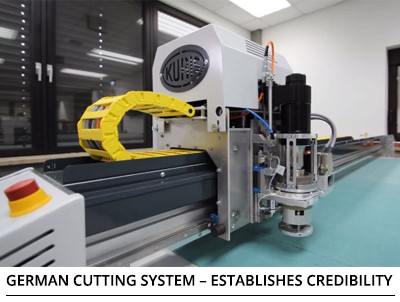 The real cost of cutting goes beyond CAPEX
Cutting directly impacts some of the most critical cost and performance drivers in a factory:
• Fabric utilization
• Output consistency
• Order turnaround time
• Rework and rejection
• Energy and consumables
Yet many cutting investments fail because they are evaluated only on upfront price, not total cost of ownership (TCO).
In the Indian market, manufacturers typically face two choices:
1. Low-entry-cost systems with rising maintenance and downtime
2. Premium systems with strong technology but heavy long-term operating expense
What progressive factories are now seeking is a third path: Proven cutting performance with controlled lifetime cost.
 Why German cutting technology makes a difference
German industrial engineering follows one core principle: Machines must perform reliably for decades, not just during demos.
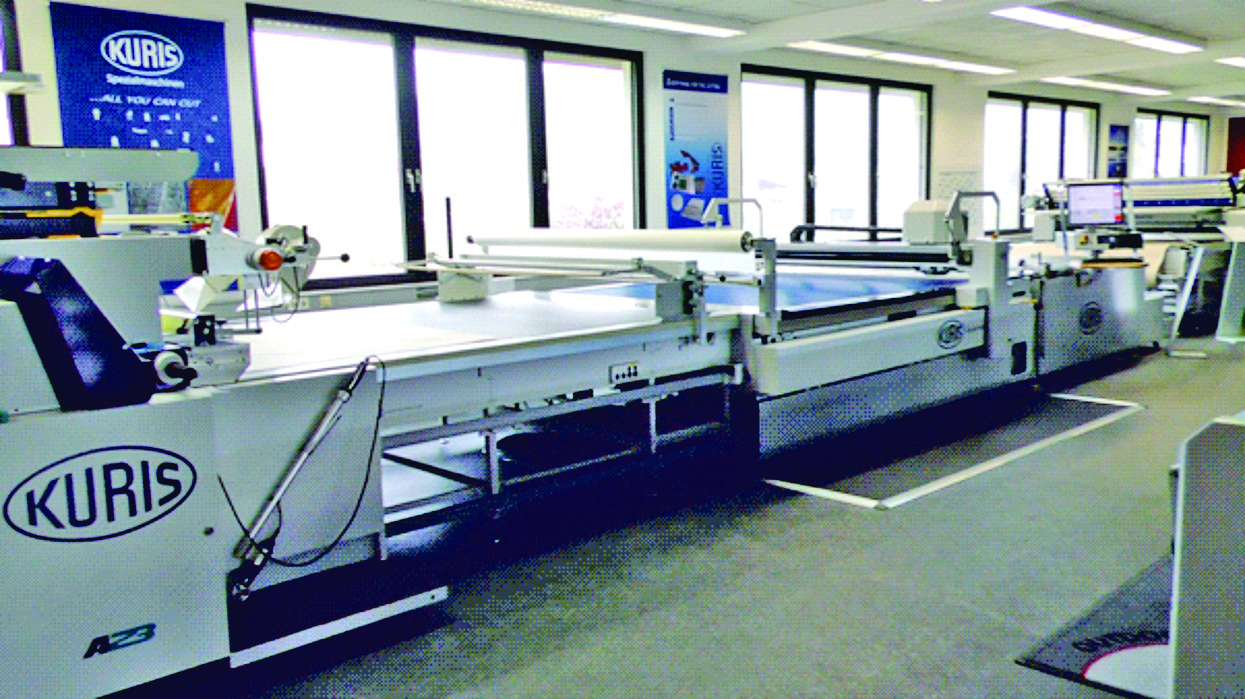
KURIS Spezialmaschinen GmbH embodies this philosophy in cutting and spreading technology. With over 100 years of engineering heritage, Kuris machines are designed for:
• Continuous industrial use
• High mechanical stability
• Long service life with predictable maintenance
This focus on durability and precision directly translates into lower operational variability and better cost control for manufacturers.
 Precision at end , scale at the other
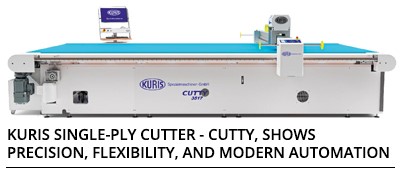
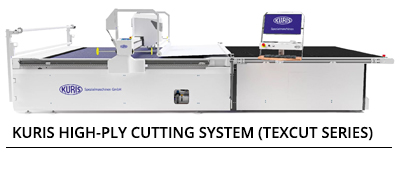
Modern apparel production requires flexibility. Kuris single-ply cutting systems deliver high accuracy and clean cut quality for sampling, short runs, and complex materials. At the same time, Kuris high-ply cutting systems are built for volume production, handling dense lays while maintaining speed and consistency.
This range allows manufacturers to scale operations without compromising output quality.
 Proven at scale, relevant for India
One of the strongest validations of any cutting technology is where it already performs at scale.
Kuris systems are widely deployed in export-driven manufacturing hubs such as Bangladesh, where factories face challenges very similar to India:
• Large order volumes
• Tight buyer timelines
• Margin pressure
• High utilization requirements
Technology that performs reliably in such environments does not rely on theory – it relies on field-proven engineering.
Why cutting automation is now a CFO conversation
Cutting machines don’t just influence production they influence financial predictability.
Energy efficiency, consumables, service intervals, uptime, and machine life all compound over years of operation. This is why CFOs are increasingly involved in automation decisions.
When evaluated correctly, cutting automation becomes:
• A margin protection tool
• A risk-reduction investment
• A long-term productivity asset Not just a line item on the CAPEX sheet.
Looking ahead
As Indian apparel manufacturing becomes more competitive, success will depend on choosing technologies that scale reliably and cost predictably over time. The conversation is no longer about buying machines. It’s about building factories that performyear after year. And cutting automation is where that journey begins.
RAJEEV SHARMA, Co-Founder & Director Sales, Venntags